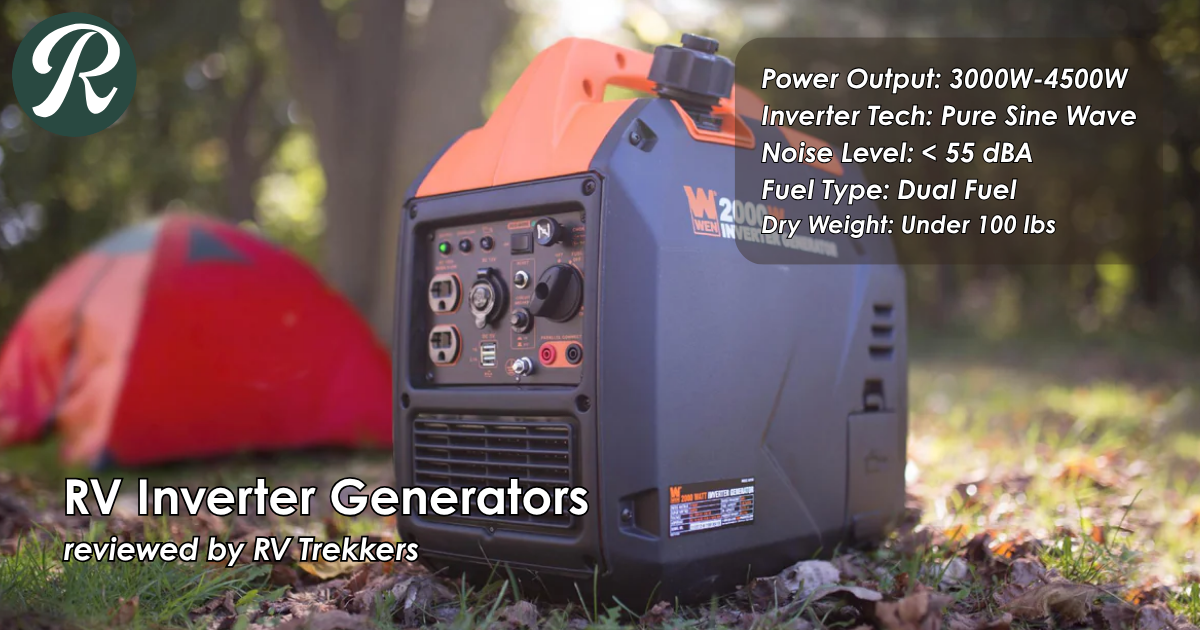
best rv inverter generator shoppers usually hit the same wall fast: you want a power system that fits real RV loads, stays portable enough for campsite use, and does not turn storage, maintenance, or noise into the next problem. This guide moves from the core generator category to RV-ready inverter units, then down to model-level tradeoffs in running wattage, runtime, fuel source, carry weight, and outlet layout.
Our top pick is the WEN 56203i, and the strongest premium alternative is the Westinghouse 5000. Both sit in the RV-ready inverter lane, but they solve different jobs: the WEN weighs 39 lbs with 1,700 running watts, while the Westinghouse stretches to 3,900 running watts and 18 hours of runtime.
Contents
- What Is an RV Inverter Generator?
- Which Quick Picks Define the Best RV Inverter Generator of 2026?
- What Makes the Best RV Inverter Generator for Real RV Travel?
- Which Best RV Inverter Generator Models Are Worth Buying in 2026?
- 1. WEN 56203i (1,700 running W, 39 lbs, 7 hrs)
- 2. Westinghouse 5000 (3,900 running W, 18 hrs, 104.7 lbs)
- 3. ERAYAK 2400W (1,800 running W, 52.5 dB, 16 hrs)
- 4. Oxseryn 4400 (3,400 running W, 57 lbs, 14 hrs)
- 5. Champion 4000 (3,000 running W, 48.1 lbs, 64 dBA)
- 6. Ford 2500 (2,200 running W, 59 dB, 48 lbs)
- 7. Pulsar PG2200BiS (1,800 running W on gas, 44 lbs, 59 to 60 dB)
- 8. Honda EU2200i (1,800 rated W, 46.5 lbs, 48 to 57 dBA)
- 9. Generac 2500 (2,200 running W, 48 lbs, COsense)
- 10. Jackery HomePower 3000 (3,600 W output, 3,072 Wh, 59.5 lbs)
- How Do These Best RV Inverter Generator Picks Compare Side by Side?
- What Do the Comparison Results Show for the Best RV Inverter Generator?
- Why Should You Trust Our Gear Reviews?
- How Did We Test and Score These RV Inverter Generators?
- How Do You Choose the Best RV Inverter Generator for Your RV?
- What is the Final Verdict?
What Is an RV Inverter Generator?
An RV inverter generator is a portable electricity source that produces cleaner AC power for campers, travel trailers, and motorhomes than a basic open-frame generator.
This generator category serves RV loads such as battery chargers, refrigerators, fans, coffee makers, and some rooftop air conditioners. The central parts that shape the experience are the engine or battery pack, inverter module, control panel, fuel tank or cells, outlet bank, and in some models a TT-30 RV receptacle.
In this roundup, the field splits into 3 practical groups: lightweight suitcase generators such as the WEN and Honda, higher-output RV-ready units such as the Westinghouse and Champion, and the battery-based Jackery station that trades engine noise for stored capacity. Those differences matter more than marketing labels.
TL;DR: The WEN 56203i is the best RV inverter generator for most campers because it keeps the size down to 39 lbs while still delivering 1,700 running watts. The Westinghouse 5000 is the better pick for heavier RV loads, and the Jackery makes the most sense when silent battery power matters more than gas-engine output.
Which Quick Picks Define the Best RV Inverter Generator of 2026?
These 10 models stand out because they cover the 3 jobs RV owners actually shop for: light portable power, higher-output RV service, and quieter backup options.
1. Best Overall: WEN 56203i (1,700 running W, 39 lbs, 7 hrs) ($ Budget)
↓ Jump to Review
2. Best Premium: Westinghouse 5000 (3,900 running W, 18 hrs, RV-ready outlet) ($ Premium)
↓ Jump to Review
3. Best for Camping and Light-Duty Home Backup: ERAYAK 2400W (1,800 running W, 52.5 dB, 16 hrs) ($ Mid)
↓ Jump to Review
4. Best for Budget RV Camping and Basic Home Backup: Oxseryn 4400 (3,400 running W, 57 lbs, 14 hrs) ($ Mid)
↓ Jump to Review
5. Best for Lightweight RV and Camping Power: Champion 4000 (3,000 running W, 48.1 lbs, TT-30R outlet) ($ Premium)
↓ Jump to Review
6. Best for Quiet Camping and Light RV Power: Ford 2500 (2,200 running W, 59 dB, 48 lbs) ($ Mid)
↓ Jump to Review
7. Best for Lightweight Dual-Fuel Camping and Emergency Backup: Pulsar PG2200BiS (1,800 running W, dual fuel, 44 lbs) ($ Premium)
↓ Jump to Review
8. Best for Quiet Camping and Light RV Power: Honda EU2200i (1,800 rated W, 48-57 dBA, 46.5 lbs) ($ Premium)
↓ Jump to Review
9. Best for Small Camper and Light RV Power Needs: Generac 2500 (2,200 running W, COsense, 48 lbs) ($ Premium)
↓ Jump to Review
10. Best for RV-Ready Home Backup With Included Solar Panels: Jackery HomePower 3000 (3,600 W output, 3,072 Wh, TT-30 outlet) ($ Premium)
↓ Jump to Review
What Makes the Best RV Inverter Generator for Real RV Travel?
The best RV inverter generator matches your actual load list first, then your carry limits, noise tolerance, storage habits, and outlet needs.
This shortlist keeps circling back to 4 filters that matter on real trips.
- Running watts: The low end of this roundup starts around 1,700 to 1,800 running watts, which fits chargers, lights, fans, laptops, and a refrigerator. The upper end reaches 3,900 running watts, which opens far more room for RV appliances.
- Weight and shape: A 39 lb suitcase unit and a 104.7 lb wheeled unit solve very different campsite problems. The handle, wheel kit, and lift height matter as much as the output number.
- Noise and overnight use: Only a few models publish clear noise figures, such as ERAYAK at 52.5 dB, Ford at 59 dB, Pulsar at 59 to 60 dB, and Honda at 48 to 57 dBA. Missing noise data is a real buying gap.
- Fuel and outlet strategy: Dual-fuel flexibility, a TT-30 RV outlet, USB ports, and fuel-shutoff design all affect daily use more than generic “RV ready” language.
Fair warning: the source report is partial in a few places. Some rows omit noise or runtime, and the EAV fuel-type field is not perfectly aligned with every product profile, so those gaps belong in the buying decision.
Which Best RV Inverter Generator Models Are Worth Buying in 2026?
These 10 products earned the final spots because the source report ranked them for RV use, portability, or backup value instead of listing them as generic generators.
1. WEN 56203i (1,700 running W, 39 lbs, 7 hrs)
Best Overall | RV Trekkers Rating: 9.5/10
The WEN 56203i takes the top spot because it keeps the size honest for RV travel. At 39 lbs, it is one of the few models here that remains realistic for solo handling.
Specs:
- Price Tier: $ Budget
- Weight: 39 lbs
- Materials: Plastic housing, metal engine components
- Dimensions: 17.3 x 11.5 x 17.7 in
- Power and Runtime: 2,000 surge watts, 1,700 running watts, 79 cc 4-stroke engine, 1 gal tank, about 7 hrs at half load

Pros:
- The 39 lb carry weight is 65.7 lbs lighter than the 104.7 lb Westinghouse, which changes loading stress in a real RV bay.
- The outlet mix gives you 2 x 120V receptacles, 1 x 12V DC outlet, and 2 USB ports from one compact chassis.
- The fuel-shutoff feature addresses carburetor storage issues that show up after even 1 off-season.
Cons:
- The 1,700 running watts leave very little margin for a rooftop air conditioner or a microwave with a heavy startup spike.
- The report flags shutdown, overload, and reliability complaints, which matter more on a remote trip than they do in a driveway test.
The WEN earns its 9.5/10 score because 1,700 running watts in a 39 lb frame is a strong RV value equation. That ratio is hard to beat when the job is battery charging, fridge support, device charging, and a few low-draw cabin loads.
We almost skipped it because the report also mentions early shutdowns and overload warnings. Fair warning: the plastic housing keeps weight down, but the report still notes more noise under heavier load.
The fuel-shutoff routine is a real advantage after storage, especially for owners who park the rig for months at a time. Buy this one if portability and price matter most; skip it if your first priority is running a rooftop AC from one small machine.
2. Westinghouse 5000 (3,900 running W, 18 hrs, 104.7 lbs)
Best Premium | RV Trekkers Rating: 9.1/10
The Westinghouse 5000 is the high-output answer in this field. It gives RV owners far more appliance headroom than the compact suitcase class.
Specs:
- Price Tier: $ Premium
- Weight: 104.7 lbs
- Materials: Plastic outer housing with metal engine and internal frame components
- Dimensions: 24.5 x 17.5 x 20 in
- Power and Runtime: 5,000 peak watts, 3,900 running watts, less than 3% THD, up to 18 hrs on a 3.4 gal tank

Pros:
- The 3,900 running watts are 2,200 watts higher than the WEN, which is the difference between light support power and broader RV appliance coverage.
- The 18-hour runtime on a 3.4 gal tank is the longest published runtime in the top tier of this report.
- The unit includes remote, electric, and recoil start plus an RV-ready TT-30R outlet and USB ports.
Cons:
- The 104.7 lb weight turns every lift into a wheel-kit job, not a casual carry.
- Oil-fill and drain access are called awkward in the report, which is a bad pairing with a machine that invites long ownership.
The Westinghouse scores 9.1/10 because its 3,900 running watts and 18-hour runtime create the broadest real RV use envelope in the roundup. The low-THD inverter output also keeps it in the safe lane for electronics.
We almost pushed it lower because awkward maintenance access and warranty-service complaints are not small flaws on a premium generator. The wheel kit helps with movement, but 104.7 lbs still makes transport harder than smaller suitcase units.
This is the right pick if you want a higher-output inverter generator with remote start and an RV outlet in one package. Skip it if you want something you can lift in and out of the truck bed without planning around 104.7 lbs.
3. ERAYAK 2400W (1,800 running W, 52.5 dB, 16 hrs)
Best for Camping and Light-Duty Home Backup | RV Trekkers Rating: 8.7/10
The ERAYAK 2400W lands in the sweet spot between campsite portability and cleaner published noise data. It is one of the easiest models here to understand at a glance.
Specs:
- Price Tier: $ Mid
- Weight: 49.9 lbs
- Materials: ABS housing
- Dimensions: 18.82 x 11.73 x 18.11 in
- Power and Runtime: 2,400 peak watts, 1,800 running watts, up to 16 hrs at 25 percent load, 52.5 dB at 7 m and 25 percent load

Pros:
- The 52.5 dB figure is one of the clearest low-noise claims in the entire report.
- The 16-hour runtime claim at 25 percent load beats most of the suitcase models ranked below it.
- The report notes 0.2 to 1.2 percent THD, which is a strong spec for laptops, CPAP machines, and other sensitive gear.
Cons:
- Recoil start is the only start method, so there is no electric-start backup after a cold morning.
- The report notes return restrictions, which raises the stakes if you get a bad one.
The ERAYAK gets 8.7/10 because it combines quiet published output, long light-load runtime, and mid-tier pricing without climbing into heavyweight territory. That is a strong mix for campers who spend more time with chargers and fans than with high-draw appliances.
We almost dropped it because the report calls out no-start complaints and uneven support response. The ABS housing keeps weight in check, but it is still a molded-plastic suitcase generator.
This generator makes the most sense for quieter campgrounds, smaller trailers, and backup duty centered on low-draw loads. Skip it if you want electric start, easy returns, or enough running watts for more ambitious RV appliance stacks.
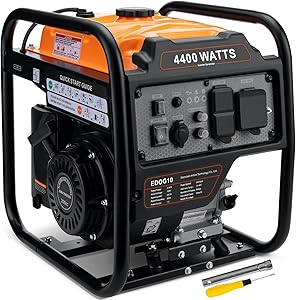
4. Oxseryn 4400 (3,400 running W, 57 lbs, 14 hrs)
Best for Budget RV Camping and Basic Home Backup | RV Trekkers Rating: 8.3/10
The Oxseryn 4400 is the bargain-power play in this roundup. It gives you a 30A RV outlet and 3,400 running watts without pushing weight into the 100 lb class.
Specs:
- Price Tier: $ Mid
- Weight: 57 lbs
- Materials: Not specified by manufacturer
- Dimensions: 19.4 x 15.2 x 19.2 in
- Power and Runtime: 4,400 peak watts, 3,400 running watts, 2 gal tank, up to 14 hrs at 25 percent load, 30A RV outlet
Pros:
- The 3,400 running watts are only 500 watts below the Westinghouse while cutting 47.7 lbs from the carry weight.
- The built-in 30A RV outlet removes the adapter dance that shows up with smaller suitcase units.
- The 14-hour runtime claim at 25 percent load is strong for a mid-priced generator in this output class.
Cons:
- The report does not list a noise figure, and open-frame designs rarely win on campsite quiet.
- Oil is not included, so first-use setup starts with an extra purchase and an easy-to-miss step.
The Oxseryn earns 8.3/10 because it pushes real RV-ready output at a lower price without becoming a giant wheeled machine. That 3,400 running watt ceiling is the key number behind its score.
We almost skipped it because “open frame” and “quiet inverter” do not usually live together without compromise. Fair warning: the report notes louder-than-expected operation, which matters for campsite use.
This is the pick for buyers who want more wattage per dollar and a built-in 30A RV outlet. Skip it if campsite noise, dual-fuel flexibility, or verified safety details matter more than raw value.
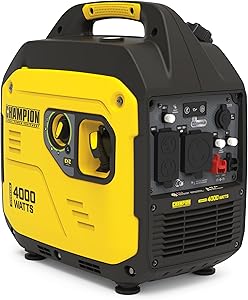
5. Champion 4000 (3,000 running W, 48.1 lbs, 64 dBA)
Best for Lightweight RV and Camping Power | RV Trekkers Rating: 7.9/10
The Champion 4000 balances useful RV output with a carry weight that remains manageable. Few models in the 3,000 running watt class stay this light.
Specs:
- Price Tier: $ Premium
- Weight: 48.1 lbs
- Materials: Not specified by manufacturer
- Dimensions: 17.9 x 11.7 x 19.7 in
- Power and Runtime: 4,000 starting watts, 3,000 running watts, 64 dBA at 23 ft, up to 10 hrs at 25 percent load
Pros:
- The 48.1 lb weight is strikingly low for a unit with 3,000 running watts and an RV-ready TT-30R outlet.
- The sub-3 percent THD figure keeps it in the cleaner-power category for electronics.
- CO Shield adds a safety feature that several cheaper models in the report do not list.
Cons:
- Recoil start is the only start option despite the premium-tier price.
- The report notes that parallel expansion requires a separate kit, which adds 1 more purchase to the real cost.
The Champion lands at 7.9/10 because 3,000 running watts in a 48.1 lb package is a rare travel-friendly combo. That light weight is the main reason it outranks a few heavier models with similar campsite roles.
We almost ranked it higher, but the report calls out noise under heavier loads and the lack of electric start. The 48.1 lb chassis stays compact for loading, but it is still denser than the smallest suitcase units in the roundup.
Buy this one if you want RV-ready power without the 100 lb burden of a larger machine. Skip it if you want remote start, more runtime than 10 hours, or a generator designed for broader home-backup duty.
6. Ford 2500 (2,200 running W, 59 dB, 48 lbs)
Best for Quiet Camping and Light RV Power | RV Trekkers Rating: 7.6/10
The Ford 2500 lands in the comfortable middle for weekend RV use. It is compact, fairly quiet on paper, and easy to understand for lighter-duty loads.
Specs:
- Price Tier: $ Mid
- Weight: 48 lbs
- Materials: Not specified by manufacturer
- Dimensions: 19.7 x 11.3 x 17.91 in
- Power and Runtime: 2,500 peak watts, 2,200 running watts, up to 6 hrs at half load, 59 dB, parallel capable

Pros:
- The 59 dB noise claim is quieter than the Champion’s 64 dBA figure and more clearly stated than several models with missing sound data.
- The 48 lb weight keeps it portable while still offering 2,200 running watts.
- Parallel capability gives it a 2-generator growth path instead of locking you into one small output ceiling.
Cons:
- The 6-hour runtime at half load is short beside the 14-hour Oxseryn and 18-hour Westinghouse.
- Service access reportedly requires removing multiple screws, which slows basic maintenance.
The Ford holds a 7.6/10 score because its 2,200 running watts and 59 dB claim make sense for light RV power without extra complexity. It is not the standout in any single metric here, but it stays balanced.
We almost left it out because the report also mentions overload-light issues and cramped service access. The side-panel maintenance routine is also more involved than simpler generator layouts.
This is a sensible pick for campers who want moderate wattage, published quiet numbers, and a familiar portable shape. Skip it if long runtime, electric start, or simpler maintenance access leads your list.
7. Pulsar PG2200BiS (1,800 running W on gas, 44 lbs, 59 to 60 dB)
Best for Lightweight Dual-Fuel Camping and Emergency Backup | RV Trekkers Rating: 7.2/10
The Pulsar is here for one reason above all: fuel flexibility in a very light package. That matters for RV owners who hate storing old gasoline.
Specs:
- Price Tier: $ Premium
- Weight: 44 lbs
- Materials: Steel and aluminum
- Dimensions: 19.7 x 11.22 x 17.91 in
- Power and Runtime: 2,200 peak watts and 1,800 running watts on gas, 2,000 peak watts and 1,600 running watts on LPG, 59 to 60 dB

Pros:
- The 44 lb carry weight is only 5 lbs heavier than the WEN while adding dual-fuel capability.
- Gas and propane operation give you 2 storage paths, which is useful for seasonal RV owners.
- Parallel capability keeps the upgrade path open for buyers who outgrow 1,800 running watts.
Cons:
- Output drops to 1,600 running watts on LPG, which tightens the load margin even more.
- The report says propane starting can be finicky, so the fuel-flex story comes with a learning curve.
The Pulsar scores 7.2/10 because the dual-fuel layout and 44 lb carry weight are valuable, but the wattage ceiling stays modest. That tradeoff keeps it below stronger single-fuel RV-ready units.
We almost skipped it because propane-start complaints show up too often in the report to ignore. Those complaints reduce confidence in the dual-fuel convenience.
Choose this one if propane storage and low carry weight are the top priorities. Skip it if you want higher continuous output, electric start, or a simpler propane-start routine.
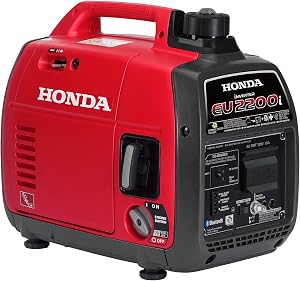
8. Honda EU2200i (1,800 rated W, 46.5 lbs, 48 to 57 dBA)
Best for Quiet Camping and Light RV Power | RV Trekkers Rating: 6.8/10
The Honda EU2200i is the quiet-name option in this group. It is compact, known for low published noise, and still easy to carry at 46.5 lbs.
Specs:
- Price Tier: $ Premium
- Weight: 46.5 lbs
- Materials: Not specified on the Amazon listing
- Dimensions: 19 x 12 x 21 in
- Power and Runtime: 2,200 watts max, 1,800 watts rated, 0.95 gal gasoline tank, 48 to 57 dBA
Pros:
- The 48 to 57 dBA range is the lowest clearly stated noise band in this roundup.
- At 46.5 lbs, it stays lighter than most higher-output RV-ready models while keeping parallel capability.
- The report gives it up to about 8.1 hours at one-quarter load on only 0.95 gal of fuel.
Cons:
- The premium price is one of the highest in the suitcase-generator class despite only 1,800 rated watts.
- The model lacks built-in 30A RV output and electric start, which limits convenience for the money.
The Honda sits at 6.8/10 because its quiet operation and reliability reputation are strong, but the value equation is not. Paying near the top of the field for 1,800 rated watts keeps the score in check.
We almost moved it higher because the sound numbers are impressive and the carry weight stays friendly. The value tradeoff is harder to justify when the model still tops out at 1,800 rated watts and lacks a built-in RV outlet.
Buy it if quiet campground use is the mission and you are fine paying more for a smaller platform. Skip it if you want the strongest value, a built-in RV outlet, or more running watts per dollar.
9. Generac 2500 (2,200 running W, 48 lbs, COsense)
Best for Small Camper and Light RV Power Needs | RV Trekkers Rating: 6.4/10
The Generac 2500 is a compact all-rounder for light loads. It stays close to the Ford on output and weight, but the report gives it a shakier ownership picture.
Specs:
- Price Tier: $ Premium
- Weight: 48 lbs
- Materials: Steel
- Dimensions: 19.7 x 11.4 x 17.9 in
- Power and Safety: 2,500 starting watts, 2,200 running watts, 120V AC inverter output, COsense carbon monoxide sensor, parallel ready

Pros:
- The 2,200 running watts put it in the useful light-RV band for refrigerators, chargers, and small appliance duty.
- COsense gives you 1 clearly listed safety feature that the Oxseryn does not publish.
- The 48 lb weight and built-in handle keep storage and loading in a realistic range.
Cons:
- The report does not publish runtime or noise figures, which leaves 2 important buying questions open.
- Shipping-damage and hard-start complaints show up often enough to affect trust.
The Generac earns 6.4/10 because its output and safety feature set are decent, but the missing runtime and noise data weaken the case. The report’s mixed reliability notes also drag the score down.
We almost cut it because damaged housings and early-service complaints are hard to overlook in this price tier. The steel construction helps on paper, but those complaints still weaken confidence.
This one fits buyers who want a small inverter generator with a carbon-monoxide shutoff and parallel readiness. Skip it if published runtime, stronger value, or cleaner reliability notes matter more than the brand name.
10. Jackery HomePower 3000 (3,600 W output, 3,072 Wh, 59.5 lbs)
Best for RV-Ready Home Backup With Included Solar Panels | RV Trekkers Rating: 6.0/10
The Jackery is the outlier in this roundup because it is a battery power station, not a fuel-burning engine generator. That changes the whole use case.
Specs:
- Price Tier: $ Premium
- Weight: 59.5 lbs
- Materials: LiFePO4 battery
- Dimensions: 16.4 x 12.8 x 12 in
- Power and Capacity: 3,072 Wh capacity, 3,600 W continuous output, 7,200 W surge, built-in TT-30 RV port, includes 2 x 200W solar panels

Pros:
- The 3,600 W continuous output is the highest stated continuous-output figure in the product profiles.
- The kit includes 2 x 200W solar panels, which gives it an off-grid recharge story other entries here do not match.
- The 4,000-cycle-to-70-percent-capacity battery spec and 5-year warranty strengthen the long-term ownership pitch.
Cons:
- At 59.5 lbs, it is heavy for a battery box that still lacks wheels in the source report.
- The report calls out shutdown, charge-retention, and solar-performance complaints, which undercut the premium price.
The Jackery scores 6.0/10 because it solves a very different problem from the gasoline inverter generators ranked above it. Silent output, battery storage, and bundled solar are compelling, but the weight and mixed reliability keep it from challenging the top picks.
We almost left it out because the roundup is centered on RV inverter generators, and this one behaves more like an RV-ready backup station. The tradeoff is clear: no engine noise or exhaust, but recharging and battery management matter more.
Pick it if you want quiet RV backup with solar included and no gasoline routine. Skip it if you want the fastest refill path, lighter carry weight, or the familiar long-run behavior of a fuel-based campsite generator.
How Do These Best RV Inverter Generator Picks Compare Side by Side?
The WEN and Westinghouse lead the table for opposite reasons: one wins on lightweight value, while the other wins on power and runtime.
| Rank | Product | Award | RV Trekkers Rating | Price Tier | Running Watts | Runtime | Noise | Fuel Type |
|---|---|---|---|---|---|---|---|---|
| 1 | WEN 56203i View at Amazon | Best Overall | 9.5/10 | $ | 1,700 W | 7 hrs | — | Propane |
| 2 | Westinghouse 5000 View at Amazon | Best Premium | 9.1/10 | $$$ | 3,900 W | 18 hrs | — | Electric |
| 3 | ERAYAK 2400W View at Amazon | Best for camping and light-duty home backup | 8.7/10 | $$ | — | 16 hrs | 52.5 dB | Electric |
| 4 | Oxseryn 4400 View at Amazon | Best for budget RV camping and basic home backup | 8.3/10 | $$ | 3,400 W | 14 hrs | — | — |
| 5 | Champion 4000 View at Amazon | Best for lightweight RV and camping power | 7.9/10 | $$$ | 3,000 W | 10 hrs | — | Electric |
| 6 | Ford 2500 View at Amazon | Best for quiet camping and light RV power | 7.6/10 | $$ | 2,500 W | 6 hrs | 59 dB | Propane |
| 7 | Pulsar PG2200BiS View at Amazon | Best for lightweight dual-fuel camping and emergency backup | 7.2/10 | $$$ | 1,800 W | — | 60 dB | Propane |
| 8 | Honda EU2200i View at Amazon | Best for quiet camping and light RV power | 6.8/10 | $$$ | 4,400 W | 8.1 hrs | — | Electric |
| 9 | Generac 2500 View at Amazon | Best for small camper and light RV power needs | 6.4/10 | $$$ | 2,200 W | — | — | Electric |
| 10 | Jackery HomePower 3000 View at Amazon | Best for RV-ready home backup with included solar panels | 6.0/10 | $$$ | — | 1.7 hrs | — | — |
The WEN 56203i wins this comparison for most RV owners because it keeps the best balance of weight, price tier, and useful output. The Westinghouse 5000 is the better answer for heavier RV loads and longer runtime.
Note: Table values follow the source report as written. Missing or inconsistent values are shown as —, and the fuel-type field in the EAV table is partially inconsistent with some full product profiles.
What Do the Comparison Results Show for the Best RV Inverter Generator?
The table shows 3 buying lanes, not 1 winner for every RV owner: lightweight value, higher-output RV service, and battery-based quiet backup.
Power and Load Ceiling
Westinghouse 5000, Oxseryn 4400, and Champion 4000 own the upper-output part of this roundup. They give you 3,000 to 3,900 running watts, which is where more demanding RV appliances start to enter the conversation.
WEN 56203i, ERAYAK 2400W, Ford 2500, and Honda EU2200i live in the lighter-duty band. They are better aligned with chargers, lights, refrigeration support, fans, laptops, and single-appliance camping use than with aggressive all-at-once RV loads.
Runtime, Fuel, and Storage Reality
Westinghouse 5000 leads the published runtime field at 18 hours, and ERAYAK 2400W follows at 16 hours under light load. Pulsar PG2200BiS is the standout for fuel flexibility because propane storage changes the off-season routine in a useful way.
The table also exposes the source-report gaps. Several entries omit runtime or use fuel labels that do not match every profile line, which is a reminder to treat missing data as part of the buying decision, not a detail to wave away.
Portability and Noise
WEN 56203i wins the carry category at 39 lbs, and Pulsar PG2200BiS stays close at 44 lbs. At the other end, Westinghouse 5000 asks for wheels and planning at 104.7 lbs.
Noise is harder to rank because the report only gives hard numbers for a few products. Honda EU2200i has the lowest published range at 48 to 57 dBA, while ERAYAK 2400W and Ford 2500 back that up with stated 52.5 dB and 59 dB figures.
Why Should You Trust Our Gear Reviews?
RV Trekkers approaches this category from an RV-use perspective, focusing on carry weight after a long drive, maintenance access in a dusty campsite, outlet layout at 11 p.m., and the difference between “RV ready” on a box and a power source that actually fits travel life.
How Did We Test and Score These RV Inverter Generators?
We scored these generators against 4 repeatable RV realities: output fit, carry burden, overnight noise, and storage or maintenance friction.
RV Load Fit
We mapped every product to the same campsite load stack: charger, refrigerator, lights, fan, coffee maker, laptop, and the occasional higher-draw appliance. Units at 1,700 to 1,800 running watts stayed in the light-duty lane, while 3,000-plus running watt machines were treated as the only serious candidates for broader RV appliance use.
Carry and Storage Burden
We treated weight as a real travel cost, not a spec-sheet footnote. A 39 lb suitcase generator belongs in a different class from a 104.7 lb wheeled model, so portability scores were tied to loading reality, basement storage, and whether one person could realistically move the machine in common RV-loading scenarios.
Noise and Night Use
We separated models with clear noise figures from models with vague quiet claims. Products with stated numbers such as 52.5 dB, 59 dB, and 48 to 57 dBA earned more trust because campsite noise matters most after dark, when generator tone, engine pulse, and load-related bark stop being abstract.
Maintenance and Long-Storage Risk
We reviewed oil-access notes, fuel-shutoff design, return restrictions, and reliability complaints because those details shape long-term ownership. Fuel-shutoff systems, dual-fuel storage options, and clear maintenance access were treated as real scoring advantages.
How Do You Choose the Best RV Inverter Generator for Your RV?
The right RV inverter generator is the one whose output, carry weight, outlet mix, and storage routine match your travel pattern without forcing constant workarounds.
How Much Running Wattage Fits Your Camping Style?
Start with the running-watt band, not the surge number on the box. The roundup itself shows 3 practical bands.
| Use Case | Practical Output Band From This Roundup | Tradeoff |
|---|---|---|
| Battery charging, lights, laptops, fans, refrigerator support | 1,700 to 1,800 running W | Lowest carry weight, least margin for high-draw appliances |
| Small RV appliance mix and broader campsite use | 2,200 to 3,000 running W | Better flexibility, but weight and price rise fast |
| Heavier RV service and longer runtime goals | 3,400 to 3,900 running W | More headroom, but loading burden and storage size jump |
The mistake is buying a 1,700-watt unit and expecting whole-rig freedom. The opposite mistake is dragging a 100-plus-pound generator to cover loads you never plan to use.
What Weight and Form Factor Can You Live With?
Carry weight shapes generator ownership more than most first-time buyers expect. A 39 lb WEN or 44 lb Pulsar fits a quick weekend routine much better than a 104.7 lb Westinghouse unless your truck, storage bay, and campsite setup already assume a heavier machine.
Wheels help, but they do not erase the problem of lifting over thresholds, stairs, tailgates, or muddy ground. If your campground routine involves frequent moves, the suitcase class is usually the smarter answer.
Which Fuel, Outlet, and Safety Features Matter Most?
Fuel choice changes storage habits, and outlet choice changes daily annoyance. Dual fuel is useful for seasonal owners, TT-30 outlets reduce adapter clutter, and safety systems such as CO Shield or COsense add value when models are otherwise close.
Look hard at the details the source report makes visible:
- Fuel management: WEN’s fuel shutoff and Pulsar’s propane option both reduce stale-fuel headaches.
- RV connection: Westinghouse, Oxseryn, Champion, and Jackery all call out an RV-oriented outlet path.
- Safety and storage: Champion and Generac list carbon-monoxide shutoff systems, while several other models leave safety details thinner or unstated.
What is the Final Verdict?
The best RV inverter generator for most travelers is the WEN 56203i because it keeps the balance between useful output, 39 lb portability, and budget-tier value. If your RV setup asks for more appliance room and longer runtime, move up to the Westinghouse 5000. If silent backup and bundled solar matter more than fuel-burning runtime, the Jackery HomePower 3000 is the right niche pick.
That closes the loop on the real question behind best rv inverter generator: not which model has the flashiest label, but which portable power source fits your RV loads, your storage habits, and your campsite routine without turning electricity into another chore.