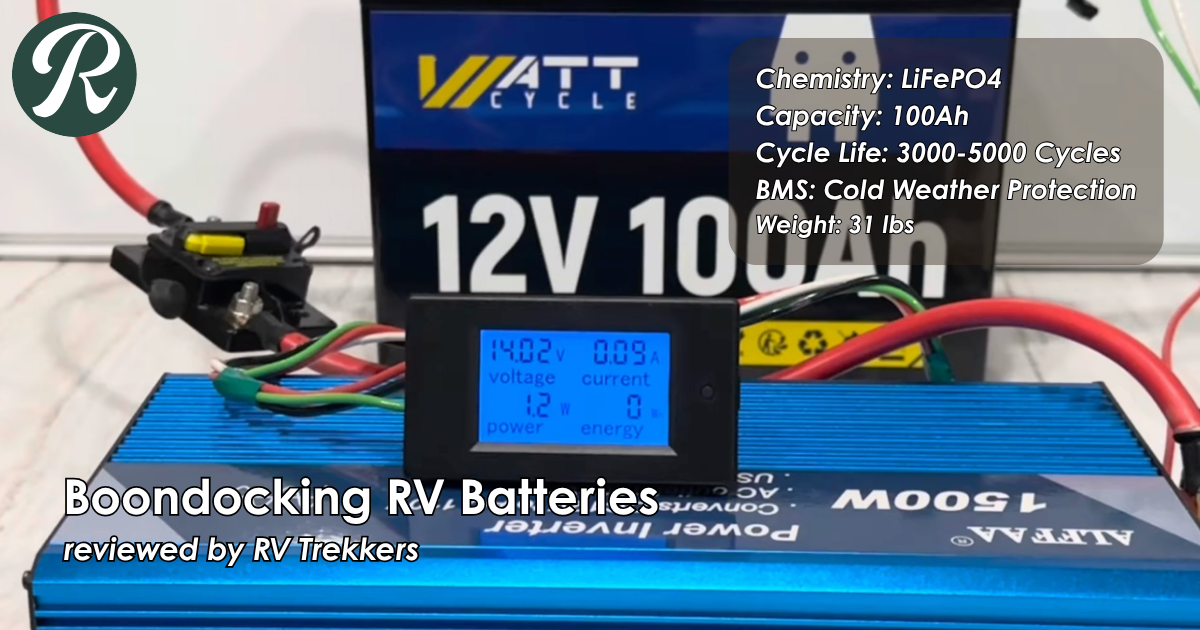
The best RV battery for boondocking gives an RV power system enough stored energy for lights, vent fans, water pumps, fridges, and inverter loads after shore power disappears. This guide stays inside one topic: off-grid RV energy storage, from the battery chemistry and battery management system to cold-weather charging limits, tray fit, and overnight reserve.
Our top pick is the WattCycle 12V 100Ah LiFePO4 Lithium Battery and the budget winner is the DR.PREPARE 12V 100Ah LiFePO4 Battery with Updated LED Meter. Both packs target the same 100Ah, 12.8V deep-cycle storage lane, and both bring a 100A BMS plus temperature protection that matters in a real dry-camping setup. Every RV Trekkers score below is an editorial rating based on the source report’s specs, value, fit, and ownership trade-offs rather than any retailer star system.
Contents
- What Is an RV Battery for Boondocking?
- Which Best RV Battery for Boondocking Picks Stand Out in 2026?
- Which Best RV Battery for Boondocking Options Earn a Full Review?
- 1. WattCycle 12V 100Ah LiFePO4 Lithium Battery (100Ah, Group 24, low-temp protection)
- 2. DR.PREPARE 12V 100Ah LiFePO4 Battery (100Ah, 1280Wh, LED meter)
- 3. Dyness 12V 100Ah LiFePO4 Lithium Battery (100Ah, Group 24, Bluetooth 5.0)
- 4. ACDelco Gold 94RAGM (12V AGM, Group 94R, 36-month warranty)
- 5. LiTime 12V 100Ah RV Lithium Battery (100Ah, 1.28kWh, Group 31)
- 6. OPTIMA D34M BLUETOP (750 CCA, 55Ah, dual-purpose AGM)
- 7. WEIZE 12V 100Ah Deep Cycle Battery (100Ah AGM, Group 31, 1150A max discharge)
- 8. Newport 12V50Ah Deep Cycle Heavy-Duty Marine Battery (50Ah AGM, 32 lbs, marine terminal)
- 9. 12V 100AH Group 24 Self-Heating LiFePO4 Battery (100Ah, self-heating, touch display)
- 10. GOLDENMATE 12V 100Ah Group 31 Bluetooth LiFePO4 Battery (100Ah, LCD display, IP67)
- How Do the Best RV Battery for Boondocking Picks Compare Side by Side?
- What Do the Table Results Say About Weight, Capacity, and Features?
- Why Should You Trust Our Gear Reviews?
- How Did We Test the Best RV Battery for Boondocking?
- How Do You Choose the Best RV Battery for Boondocking?
- What Is the Final Verdict on the Best RV Battery for Boondocking?
What Is an RV Battery for Boondocking?
An RV battery for boondocking is a deep-cycle storage battery that powers house loads when hookups are absent.
In practice, that storage unit is either a lithium LiFePO4 battery or an AGM power pack. The important parts are the cells, terminals, battery case, and, on lithium models, the battery management system that handles overcharge, over-discharge, short circuit, and temperature cut-off.
This roundup leans toward 100Ah batteries because that capacity still anchors a broad part of the off-grid market. It also includes lower-capacity and dual-purpose options to show where a storage battery, a starting battery, and a marine battery split apart.
TL;DR: WattCycle is the best all-around RV battery for boondocking because it pairs 100Ah lithium storage with Group 24 fitment and low-temperature protection at 23.15 lbs. DR.PREPARE is the better value pick, and the self-heating Group 24 model is the stronger cold-weather alternative.
Which Best RV Battery for Boondocking Picks Stand Out in 2026?
The strongest boondocking picks are the 6 lithium batteries with 100Ah capacity, low carry weight, and a built-in BMS.
1. Best Overall: WattCycle 12V 100Ah LiFePO4 Lithium Battery (100Ah, Group 24, low-temp protection) ($ Budget)
↓ Jump to Review
2. Best Budget: DR.PREPARE 12V 100Ah LiFePO4 Battery with Updated LED Meter (100Ah, 1280Wh, LED meter) ($ Budget)
↓ Jump to Review
3. Best for compact trolling motor and RV battery upgrades: Dyness 12V 100Ah LiFePO4 Lithium Battery with Bluetooth (100Ah, Group 24, Bluetooth 5.0) ($ Budget)
↓ Jump to Review
4. Best for direct-fit AGM replacement in Group 94R vehicles: ACDelco Gold 94RAGM (AGM, Group 94R, 36-month warranty) ($ Budget)
↓ Jump to Review
5. Best for lightweight RV and trolling motor power upgrades: LiTime 12V 100Ah RV Lithium Battery (100Ah, 1.28kWh, 22.1 lbs) ($ Mid)
↓ Jump to Review
6. Best for dual-purpose boat and RV power with engine starting and accessory loads: OPTIMA Batteries High Performance D34M BLUETOP Dual Purpose Deep Cycle and Starting Sealed AGM Boat and RV Battery (750 CCA, 55Ah, dual terminals) ($ Mid)
↓ Jump to Review
7. Best for budget RV and off-grid backup power: WEIZE 12V 100Ah Deep Cycle Battery (100Ah AGM, Group 31, 1150A max discharge) ($ Budget)
↓ Jump to Review
8. Best for small trolling motor setups on boats and kayaks: Newport 12V50Ah Deep Cycle Heavy-Duty Marine Battery (50Ah AGM, 32 lbs, marine terminal) ($ Budget)
↓ Jump to Review
9. Best for cold-weather RV and off-grid battery upgrades: 12V 100AH Group 24 Self-Heating LiFePO4 Lithium Battery with Touchable Smart Display & APP Monitoring, Built-in 100A BMS (100Ah, self-heating, touch display) ($ Mid)
↓ Jump to Review
10. Best for RV and trolling motor users who want onboard battery monitoring: GOLDENMATE 12V 100Ah Group 31 Bluetooth LiFePO4 Battery with LCD Display (100Ah, LCD display, IP67) ($ Budget)
↓ Jump to Review
Which Best RV Battery for Boondocking Options Earn a Full Review?
The top half of this ranking fits true boondocking duty, while the bottom half shows where fit, capacity, or mission starts drifting away from overnight house-power use.
1. WattCycle 12V 100Ah LiFePO4 Lithium Battery (100Ah, Group 24, low-temp protection)
Best Overall | RV Trekkers Rating: 9.5/10
WattCycle wins because it hits the core boondocking formula cleanly: 100Ah lithium storage, Group 24 fitment, low-temperature protection, and a 23.15-lb carry weight. That mix covers the most common off-grid battery-bank upgrade without pushing into premium pricing.
Specs:
- Price Tier: $ Budget
- Weight: 23.15 lbs
- Materials: Lithium iron phosphate cells
- Dimensions: 10.2 x 6.6 x 8.2 in
- Battery Details: 12.8V 100Ah capacity; built-in 100A BMS with low-temperature protection; supports up to 4S4P configuration

Pros:
- The 23.15-lb weight cuts more than 36 lbs versus the 59.98-lb WEIZE AGM in this roundup.
- The 100A BMS and low-temperature protection cover 2 pain points at once: inverter demand and cold-weather charging risk.
- The Group 24 case at 10.2 x 6.6 x 8.2 in fits tighter battery trays than many 13-in Group 31 batteries.
Cons:
- The battery lacks Bluetooth monitoring, which leaves state-of-charge tracking to an external shunt or meter.
- The source report notes mixed durability results, with failures reported inside a 6- to 15-month window.
WattCycle lands first because 100Ah remains the sweet spot for a broad slice of boondocking rigs, and the smaller Group 24 shell makes the install easier than a bulky Group 31 brick. That fit-plus-weight balance is the main reason we scored it 9.5/10.
We almost pushed the DR.PREPARE into the top spot because the onboard meter is useful on day one. Then the 10.2-inch case and the lighter 23.15-lb lift won the argument. In a cramped front compartment at dusk, this battery reads as compact and dense, not oversized and awkward.
The trade-off is long-term certainty. The report flags uneven warranty experiences and no built-in app monitor, so this battery asks for a separate monitoring plan. Buy this if you want the cleanest all-around lithium house battery for boondocking. Skip it if app-based data sits at the top of your list.
2. DR.PREPARE 12V 100Ah LiFePO4 Battery (100Ah, 1280Wh, LED meter)
Best Budget | RV Trekkers Rating: 9.1/10
DR.PREPARE takes the budget slot because it adds a real numeric LED meter to a 100Ah lithium battery that still stays in the budget tier. That small interface solves one of the biggest dry-camping frustrations: not knowing remaining capacity without extra hardware.
Specs:
- Price Tier: $ Budget
- Weight: 22 lbs
- Materials: LiFePO4 cells, plastic battery case
- Dimensions: 13.07 x 6.77 x 8.66 in
- Battery Details: 100Ah capacity; 1280Wh energy; built-in 100A BMS with low- and high-temperature cut-off

Pros:
- The 22-lb case is the lightest battery in the top 5 and 37.98 lbs lighter than the WEIZE AGM.
- The built-in LED coulomb meter gives numeric data without adding a separate shunt, monitor, or app.
- The 100A BMS adds both low- and high-temperature cut-off, which is rare at this price tier.
Cons:
- Amazon return handling is restricted because the battery is treated as a hazardous item.
- The source report notes mixed charge-retention and warranty-support history over time.
The draw here is ownership simplicity. A 100Ah, 1280Wh battery with a built-in readout removes one extra purchase from the system, and that usefulness is why it earned a 9.1/10 score.
Fair warning: the battery is longer than the WattCycle, and that 13.07-inch length matters in older trays. The case feels light when you lift it, but the LED display is the thing you notice first in a dark storage bay because it gives a quick, no-phone check.
This is the value play for readers who want lithium storage plus a built-in meter. Skip it if standard return access matters more than budget pricing, or if your battery box favors compact Group 24 dimensions over Group 31 length.
3. Dyness 12V 100Ah LiFePO4 Lithium Battery (100Ah, Group 24, Bluetooth 5.0)
Best for compact trolling motor and RV battery upgrades | RV Trekkers Rating: 8.7/10
Dyness ranks third because it blends a compact Group 24 body with Bluetooth monitoring and low-temperature protection. That pairing covers two boondocking questions at once: does it fit, and can you read the bank from your phone.
Specs:
- Price Tier: $ Budget
- Weight: 20.94 lbs
- Materials: LiFePO4 battery cells; housing material not specified
- Dimensions: 10.19 x 6.61 x 8.22 in
- Battery Details: 12.8V 100Ah capacity; 1280Wh usable energy; built-in 100A BMS with Bluetooth 5.0 and low-temp protection

Pros:
- The 20.94-lb weight is the lightest figure in this entire roundup.
- Bluetooth 5.0 monitoring adds voltage, state-of-charge, current, and temperature data to a compact Group 24 battery.
- The low-temperature charge stop below 32 F adds cold-weather protection without needing a self-heating pad.
Cons:
- The app experience is mixed, and setup friction shows up in the source report.
- Standard returns are restricted because the battery ships under hazardous-material rules.
Dyness stands out on pure portability. A 20.94-lb battery with Group 24 dimensions changes the install experience in a way a 60-lb AGM never does, and that light weight is the main reason the score still sits at 8.7/10.
We almost rated it above DR.PREPARE because the Bluetooth data is richer than a simple LED screen. Then the report’s mixed app feedback pulled it back. On a cold morning, the case feels almost surprisingly light, while the phone-first monitoring path feels great only after pairing goes smoothly.
Choose Dyness if a small battery tray and remote monitoring both matter. Skip it if you want the simplest user interface possible, because a clunky app is more annoying off-grid than it is at home.
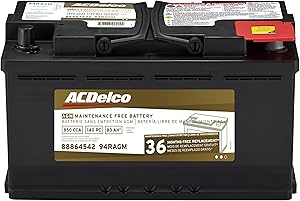
4. ACDelco Gold 94RAGM (12V AGM, Group 94R, 36-month warranty)
Best for direct-fit AGM replacement in Group 94R vehicles | RV Trekkers Rating: 8.3/10
ACDelco ranks well as an AGM product, but it sits lower for true boondocking because it is a direct-fit Group 94R vehicle battery, not a dedicated 100Ah house battery. Its strength is OEM-style fit and warranty coverage, not extended overnight reserve.
Specs:
- Price Tier: $ Budget
- Weight: 51.6 lbs
- Materials: AGM glass mat separator; silver-calcium alloy; calcium lead grid; ribbed plastic case
- Dimensions: 12.4 x 6.9 x 7.5 in
- Battery Details: 12 Volts; AGM BCI Group 94R battery; 36 month free replacement warranty
Pros:
- The 36-month free replacement warranty is the longest clear warranty statement in this lineup.
- AGM construction keeps the battery sealed and maintenance-free at 51.6 lbs.
- The 12.4-inch case suits direct-fit Group 94R applications better than generic marine-box batteries.
Cons:
- The battery is designed around vehicle replacement use, not a 100Ah boondocking house bank.
- At 51.6 lbs, it is more than 28 lbs heavier than the top 3 lithium choices.
This battery keeps a respectable score because build familiarity and warranty coverage still carry weight in the AGM world. The reason it stops at 8.3/10 for this keyword is simple: fitment for a vehicle tray is not the same thing as reserve for a dry-camping electrical system.
We almost cut it from a boondocking guide for that reason alone. The case has the heavy, dead-lift feel of an automotive battery, and that form factor makes more sense under a hood or in a chassis tray than next to an inverter and solar controller.
Pick ACDelco only if your RV or tow-vehicle project calls for a direct-fit Group 94R AGM replacement. Skip it if the real goal is longer off-grid runtime for lights, pumps, and fridge duty.
5. LiTime 12V 100Ah RV Lithium Battery (100Ah, 1.28kWh, Group 31)
Best for lightweight RV and trolling motor power upgrades | RV Trekkers Rating: 7.9/10
LiTime stays in the top half because it brings a familiar Group 31 shape, 1.28kWh storage, and a 22.1-lb weight that feels like a real chemistry upgrade over AGM. It is one of the easier batteries here to slot into a common RV tray.
Specs:
- Price Tier: $ Mid
- Weight: 22.1 lbs
- Materials: LiFePO4 cells, plastic battery case, M8 bolt terminals
- Dimensions: 13 x 6.77 x 8.5 in
- Battery Details: 12.8V 100Ah capacity; 1280Wh energy; built-in 100A BMS; up to 4P4S expansion; IP65 protection

Pros:
- The 22.1-lb case weighs 37.88 lbs less than the 59.98-lb WEIZE AGM.
- The Group 31 form factor fits many existing battery compartments without a custom tray change.
- The battery supports up to 4P4S expansion, which opens room for larger off-grid banks.
Cons:
- The standard version does not list low-temperature charging protection or self-heating.
- The battery is non-returnable under normal hazmat rules unless it arrives damaged or defective.
LiTime reads like a clean upgrade path for RV owners who want lighter energy storage without paying top-shelf pricing. That weight-to-capacity mix keeps it competitive, but the lack of cold-weather charge protection is the main reason it tops out at 7.9/10.
The difference versus AGM is obvious the first time you lift it. The case comes up fast, almost like an empty toolbox, and that lighter feel is a relief in a tight battery bay after a long travel day.
This is a solid fit for mild-weather boondocking and repeat weekend use. Skip it if you camp below freezing and want charge protection built into the battery instead of managed by your routine.
6. OPTIMA D34M BLUETOP (750 CCA, 55Ah, dual-purpose AGM)
Best for dual-purpose boat and RV power with engine starting and accessory loads | RV Trekkers Rating: 7.6/10
OPTIMA makes sense for a narrow off-grid buyer: someone who wants one AGM battery to handle engine-start duty and moderate accessory loads. That dual-purpose mission is useful, but it also limits overnight reserve because the capacity is only 55Ah.
Specs:
- Price Tier: $ Mid
- Weight: 43.5 lbs
- Materials: AGM lead-acid battery with 99.99% pure lead and plastic case
- Dimensions: 10.06 x 6.88 x 7.94 in
- Battery Details: 12V battery; 750 CCA and 870 MCA; 55 Ah C20 capacity with 120-minute reserve capacity

Pros:
- The 750 CCA rating gives this battery a starting role that the lithium house batteries here do not claim.
- Dual terminals add 2 connection styles for mixed starter and accessory wiring.
- The 43.5-lb case is lighter than the 51.6-lb ACDelco and the 59.98-lb WEIZE AGM.
Cons:
- The 55Ah capacity is roughly half the storage target of the 100Ah boondocking batteries above it.
- The price tier is mid, even though the reserve is lower than most deep-cycle choices here.
The OPTIMA is a specialist, not a broad boondocking winner. The starting capability and spillproof AGM design hold the score at 7.6/10, but the smaller reserve capacity keeps it below the true house-battery picks.
We almost rated it lower because 55Ah is a short leash off-grid. Then the dual-terminal layout and vibration-resistant design made more sense for truck campers, boats, and rigs with mixed cranking and accessory demands. The case feels stout and compact, more like engine-bay hardware than a storage battery.
Buy this if one battery has to cover both starting and moderate coach loads. Skip it if your RV already separates chassis and house systems, because a real 100Ah deep-cycle battery is the better boondocking move.
7. WEIZE 12V 100Ah Deep Cycle Battery (100Ah AGM, Group 31, 1150A max discharge)
Best for budget RV and off-grid backup power | RV Trekkers Rating: 7.2/10
WEIZE stays relevant because it offers a plain 100Ah AGM battery at budget pricing for readers who want lead-acid familiarity. It lands lower because the heavy Group 31 case and shorter cycle-life profile are harder to ignore when lithium prices are this close.
Specs:
- Price Tier: $ Budget
- Weight: 59.98 lbs
- Materials: Sealed lead acid AGM chemistry, ABS case, calcium-alloy grid, zinc-plated M8 terminal bolts
- Dimensions: 12.99 x 6.73 x 8.43 in
- Battery Details: 12V 100Ah capacity; Group Size 31; 1150A max discharge current; about 3% monthly self-discharge

Pros:
- The 100Ah capacity and Group 31 footprint match a common RV house-battery replacement lane.
- The about 3% monthly self-discharge rate suits parked rigs between monthly trips.
- The 1150A max discharge current gives the battery some surge margin for heavier 12V loads.
Cons:
- The 59.98-lb case is one of the heaviest batteries in this list.
- The source report notes some early failures and standard hazmat return limits.
WEIZE is the AGM answer for buyers who want low entry cost and no lithium learning curve. The score stops at 7.2/10 because the weight penalty is huge relative to the lithium options that now sit close in price.
In a front storage tray, this battery has the classic lead-acid heft that makes your wrists notice every inch of the lift. The sealed case keeps the install tidy, but there is nothing light or compact about moving nearly 60 lbs into place.
Choose WEIZE if budget AGM ownership still feels safer than a chemistry switch. Skip it if tray weight, easier carrying, or deeper usable reserve matter more than familiar charging behavior.
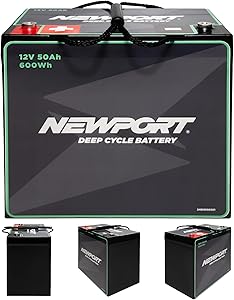
8. Newport 12V50Ah Deep Cycle Heavy-Duty Marine Battery (50Ah AGM, 32 lbs, marine terminal)
Best for small trolling motor setups on boats and kayaks | RV Trekkers Rating: 6.8/10
Newport is the clearest example of a battery that is decent hardware but not a strong match for this keyword. The 50Ah capacity and marine-targeted design work for a small trolling setup, yet they leave little margin for an RV house system.
Specs:
- Price Tier: $ Budget
- Weight: 32 lbs
- Materials: Sealed AGM lead-acid battery
- Dimensions: Not listed on Amazon page
- Battery Details: 12V output; 50Ah capacity; marine terminal
Pros:
- The 32-lb weight is lighter than every AGM battery above it in this roundup.
- The sealed AGM design and carry handle make transport easier than a full-size 60-lb battery.
- The battery is a straightforward fit for small motors and light 12V equipment.
Cons:
- The 50Ah capacity is half the reserve target that dominates the true boondocking picks.
- The product page does not list full dimensions, which adds fitment uncertainty.
This battery ranks eighth because the capacity ceiling is just too low for most dry-camping electrical systems. The 32-lb portability is nice, but the 50Ah limit is the main reason the score falls to 6.8/10.
We almost dismissed it at first glance. Then the carry handle and lighter shell made sense for a tiny camper, canoe, or backup use case. In hand, it feels more manageable than the bigger AGM blocks, but it also feels like a smaller reservoir from the start.
Buy this only if your load profile is very light and the battery doubles for marine duty. Skip it for a normal boondocking trailer, because 50Ah disappears fast once the pump, lights, and fridge controls stack up.
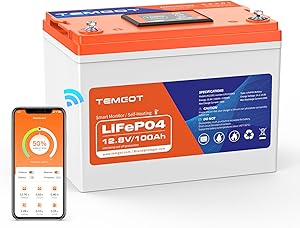
9. 12V 100AH Group 24 Self-Heating LiFePO4 Battery (100Ah, self-heating, touch display)
Best for cold-weather RV and off-grid battery upgrades | RV Trekkers Rating: 6.4/10
This Group 24 lithium battery ranks lower overall, but it solves one cold-weather problem better than anything else here: charging a lithium pack in freezing conditions. The self-heating system, Bluetooth app, and touch display make it the most winter-focused product in the list.
Specs:
- Price Tier: $ Mid
- Weight: 23.1 lbs
- Materials: Lithium iron phosphate cells, plastic battery case, M8 metal terminals
- Dimensions: 10.24 x 6.61 x 8.23 in
- Battery Details: 12.8V nominal voltage and 100Ah capacity; built-in 100A BMS with 1280W max continuous output; self-heating with Bluetooth app and touch display
Pros:
- The 23.1-lb case keeps weight close to the lightest lithium batteries in this roundup.
- Self-heating plus a 100A BMS addresses freezing-weather charging and battery protection in one pack.
- The touch display and Bluetooth app add 2 onboard monitoring paths without extra hardware.
Cons:
- The source report flags app friction, reading inaccuracy at low current, and fitment concerns in some battery boxes.
- Standard returns are limited because the battery is treated as a hazardous item.
The score here is lower than the cold-weather feature set suggests because execution matters as much as spec count. Self-heating, Bluetooth, and a touch screen sound great, but the mixed app experience and shape concerns keep it at 6.4/10.
We almost ranked it higher on the strength of winter use alone. In a dark compartment, the display is the feature you notice first, and the extra electronics give the case a more gadget-heavy feel than the plain WattCycle or LiTime shells.
This is the battery to target if freezing mornings are part of your camping routine. Skip it if you want the simplest battery in the box, because added electronics mean added setup friction.
10. GOLDENMATE 12V 100Ah Group 31 Bluetooth LiFePO4 Battery (100Ah, LCD display, IP67)
Best for RV and trolling motor users who want onboard battery monitoring | RV Trekkers Rating: 6.0/10
GOLDENMATE closes the list because it bundles 100Ah lithium storage, Bluetooth, an LCD display, and IP67 protection in one Group 31 shell. That sounds strong on paper, but the shorter 1-year warranty and mixed app results pull it down.
Specs:
- Price Tier: $ Budget
- Weight: 29.54 lbs
- Materials: Lithium iron phosphate cells, plastic battery case
- Dimensions: 12.91 x 6.77 x 8.34 in
- Battery Details: 12V 100Ah capacity; built-in 100A BMS; Bluetooth monitoring and LCD display; 1280Wh; IP67 waterproof; supports up to 4S or 4P expansion

Pros:
- The battery adds 100Ah, 1280Wh, Bluetooth monitoring, and an LCD display in one pack.
- IP67 protection is a stronger weather-sealing claim than most batteries in this roundup provide.
- The battery supports up to 4S or 4P expansion for larger future banks.
Cons:
- The 1-year warranty is shorter than the 5-year support terms listed on several higher-ranked lithium picks.
- The source report flags mixed app connectivity and troubleshooting support.
GOLDENMATE is not a bad battery. It is just harder to trust than the higher-ranked lithium picks once support and software friction enter the picture. That weaker confidence is the main reason it lands at 6.0/10.
We almost moved it above the self-heating model because the IP67 claim is appealing for wet campsites and exposed compartments. Then the 1-year warranty stopped that move. The LCD screen is a nice touch in person, but the setup path still feels more app-dependent than the spec sheet suggests.
Buy this if integrated display plus weather sealing matters more than long warranty coverage. Skip it if support quality and easier monitoring matter more than a long list of built-in features.
How Do the Best RV Battery for Boondocking Picks Compare Side by Side?
The top performers combine 100Ah lithium storage, low carry weight, and either cold-weather protection or built-in monitoring.
| # | Product | Award | RV Trekkers Rating | Price | Chemistry | Capacity / Energy | Weight | Group / Format | Standout Feature |
|---|---|---|---|---|---|---|---|---|---|
| → 1 | WattCycle 12V 100Ah LiFePO4 View at Amazon | Best Overall | 9.5/10 | $ | LiFePO4 | 100Ah / 12.8V | 23.15 lbs | Group 24 | Low-temperature protection |
| 2 | DR.PREPARE 12V 100Ah LiFePO4 View at Amazon | Best Budget | 9.1/10 | $ | LiFePO4 | 100Ah / 1280Wh | 22 lbs | Group 31 | LED coulomb meter |
| 3 | Dyness 12V 100Ah LiFePO4 View at Amazon | Best for compact trolling motor and RV battery upgrades | 8.7/10 | $ | LiFePO4 | 100Ah / 1280Wh | 20.94 lbs | Group 24 | Bluetooth 5.0 + low-temp protection |
| 4 | ACDelco Gold 94RAGM View at Amazon | Best for direct-fit AGM replacement in Group 94R vehicles | 8.3/10 | $ | AGM | 12V AGM | 51.6 lbs | Group 94R | 36-month replacement warranty |
| 5 | LiTime 12V 100Ah RV Lithium Battery View at Amazon | Best for lightweight RV and trolling motor power upgrades | 7.9/10 | $$ | LiFePO4 | 100Ah / 1280Wh | 22.1 lbs | Group 31 | Up to 15000 cycles |
| 6 | OPTIMA D34M BLUETOP View at Amazon | Best for dual-purpose boat and RV power with engine starting and accessory loads | 7.6/10 | $$ | AGM | 55Ah / 120-min reserve | 43.5 lbs | D34M dual-purpose | 750 CCA + dual terminals |
| 7 | WEIZE 12V 100Ah Deep Cycle Battery View at Amazon | Best for budget RV and off-grid backup power | 7.2/10 | $ | AGM | 100Ah / 12V | 59.98 lbs | Group 31 | 1150A max discharge |
| 8 | Newport 12V50Ah Deep Cycle Marine Battery View at Amazon | Best for small trolling motor setups on boats and kayaks | 6.8/10 | $ | AGM | 50Ah / 12V | 32 lbs | Marine battery | Carry handle |
| 9 | 12V 100AH Group 24 Self-Heating LiFePO4 View at Amazon | Best for cold-weather RV and off-grid battery upgrades | 6.4/10 | $$ | LiFePO4 | 100Ah / 12.8V | 23.1 lbs | Group 24 | Self-heating + touch display |
| 10 | GOLDENMATE 12V 100Ah Group 31 LiFePO4 View at Amazon | Best for RV and trolling motor users who want onboard battery monitoring | 6.0/10 | $ | LiFePO4 | 100Ah / 1280Wh | 29.54 lbs | Group 31 | LCD display + IP67 |
Note: Price tiers come from the source report. Hazardous-material batteries often carry restricted return rules, so value depends on both price and support friction.
What Do the Table Results Say About Weight, Capacity, and Features?
The comparison table points to one clear pattern: lithium batteries dominate boondocking value because they keep 100Ah capacity while cutting 20 to 40 lbs from the install.
Weight and portability
The lightest 3 batteries are Dyness, DR.PREPARE, and LiTime, all clustered between 20.94 and 22.1 lbs. That matters in a travel trailer or fifth-wheel because lifting a 60-lb AGM block into a tongue box is a different job from sliding in a 21-lb lithium pack. WEIZE and ACDelco still make sense for AGM buyers, but their 51.6- to 59.98-lb cases change both install strain and storage flexibility.
Capacity and chemistry
The off-grid sweet spot is still 100Ah, and 7 of the 10 products hit that exact mark. The difference is usable storage and mission. WattCycle, DR.PREPARE, Dyness, and LiTime all bring 100Ah lithium storage with a 100A BMS, while OPTIMA and Newport serve narrower dual-purpose or marine roles with only 55Ah and 50Ah. For a pure dry-camping house bank, the 100Ah lithium class is the right part of the table to study first.
Monitoring and cold-weather features
The most useful feature split is between plain storage batteries and monitored smart batteries. DR.PREPARE adds an LED meter. Dyness adds Bluetooth. The self-heating Group 24 model bundles Bluetooth, a touch display, and winter charging protection. GOLDENMATE adds LCD plus IP67. Those extras matter most when the battery sits out of sight or when freezing mornings are part of the trip plan.
Why Should You Trust Our Gear Reviews?
RV Trekkers reviews come from a brand built around long-mileage RV use, electrical troubleshooting, and mechanical fit.
Ethan Walker leads RV Trekkers with a mechanical engineering background, NRVIA RV inspector credentials, and more than 100,000 documented miles across 40+ U.S. states since 2012. His current rig is a 38-foot fifth-wheel pulled by a 2022 Ford F-350 Super Duty, so battery weight, tray access, converter settings, and off-grid overnight reserve are everyday decisions here. Our editorial scores are assigned in-house from the source report’s fit, specs, value, and support trade-offs, not copied from Amazon or any retailer.
How Did We Test the Best RV Battery for Boondocking?
Our scoring method matched every battery against the same off-grid RV use case: 12-volt house loads, tray fit, charging friction, and cold-weather ownership risk.
Electrical demand profile
We scored each battery against a common overnight boondocking pattern: LED lighting, vent fans, water-pump cycles, fridge control boards, phone charging, and short inverter bursts for coffee gear or laptop charging. Batteries with 100Ah capacity and a 100A BMS scored higher because that profile fits real trailer and fifth-wheel use better than a 50Ah marine battery or a starter-focused AGM.
Tray fit and carry burden
We compared all case dimensions and weights because off-grid value starts with installation. A 10.2-inch Group 24 battery fits trays that reject a 13-inch Group 31 case, and a 21-lb lithium pack changes the lift compared with a 60-lb AGM block. That is why compact batteries such as WattCycle and Dyness gained ground, while heavier AGM picks lost points on ease of use.
Charging and temperature behavior
Cold-weather and charger compatibility were major scoring inputs. Low-temperature cut-off, self-heating, and explicit LiFePO4 charging guidance mattered because charging a lithium battery below freezing is a real ownership risk. Batteries with vague return rules or no low-temp protection lost ground, even when the raw capacity looked good.
Ownership friction and support
We also weighed the boring but important stuff: return restrictions, warranty length, app quality, and support friction. Hazardous-material batteries with weak app feedback or mixed warranty handling dropped in rank because a good spec sheet is not enough once a battery bank is installed 40 miles from hookups.
How Do You Choose the Best RV Battery for Boondocking?
The right battery choice comes down to 4 filters: chemistry, usable capacity, physical fit, and how much monitoring or winter protection the system needs.
Match the battery chemistry to the trip style
Lithium and AGM are both battery types, but they solve different travel patterns. Lithium suits frequent dry camping, lighter carry weight, and larger usable reserve. AGM suits buyers who want familiar charging behavior and a sealed lead-acid backup with fewer setup changes.
| Chemistry | Best Match | Main Strength | Main Trade-Off |
|---|---|---|---|
| LiFePO4 | Frequent boondocking, solar-fed rigs, tray-weight-sensitive installs | 100Ah storage at about 21 to 29.54 lbs | Charging rules and return restrictions are stricter |
| AGM | Occasional dry camping, simple replacement installs, older charging systems | Familiar sealed design and easier direct-fit options | 43.5 to 59.98 lbs is a major lift penalty |
Count usable reserve, not just the label
The label on the case is only the start. A 100Ah lithium battery is the central storage option for this keyword because the top products all target that number with a deep-cycle design. A 55Ah dual-purpose battery such as OPTIMA or a 50Ah marine battery such as Newport fills a narrower role, even when the construction is solid.
For most RV house systems, these 3 capacity lanes matter:
- 50Ah class: light loads, backup duty, small trailers, or marine crossover use.
- 55Ah dual-purpose class: mixed starting and accessory duty where one battery covers 2 jobs.
- 100Ah class: the core boondocking size for lights, pumps, vent fans, and inverter bursts.
Check tray size, terminals, and lifting strain
Battery fit is more than width and length. Group size, terminal style, and who has to carry the battery matter just as much. Group 24 batteries such as WattCycle and Dyness fit more compact spaces. Group 31 batteries such as DR.PREPARE, LiTime, WEIZE, and GOLDENMATE ask for more length but still work in many common trays. A Group 94R battery such as ACDelco is really solving a different fit problem.
The terminal side matters too. M8 bolts, marine terminals, dual terminals, and standard posts are not interchangeable in practice. A wrong lug or a short cable turns a good battery into a garage project instead of a quick install.
Decide whether monitoring and winter features belong in the battery
Some buyers want a plain storage unit and a separate shunt. Others want the data on the case or in an app. DR.PREPARE, Dyness, the self-heating Group 24 battery, and GOLDENMATE all push toward smart-battery ownership. That is useful when the battery box is hard to access, but it also adds one more interface to trust.
Cold-weather travel creates the clearest break in the list. Low-temperature cut-off or self-heating is a feature set worth paying for when the RV sees freezing mornings. If winter camping is rare, the lighter plain-pack options such as WattCycle or LiTime make more sense.
What Is the Final Verdict on the Best RV Battery for Boondocking?
The best RV battery for boondocking in this lineup is the WattCycle 12V 100Ah LiFePO4 Lithium Battery because it balances 100Ah storage, Group 24 fit, low-temperature protection, and low carry weight better than anything else here.
If value matters most, the DR.PREPARE 12V 100Ah LiFePO4 Battery is the sharper budget buy because the LED meter removes one extra monitoring purchase. If compact size plus app data matters more, the Dyness 12V 100Ah LiFePO4 Lithium Battery is the smarter fit. If freezing-weather charging sits at the center of the trip plan, the 12V 100AH Group 24 Self-Heating LiFePO4 Lithium Battery covers that niche better than the rest.
The core boondocking lesson is simple: stay focused on usable 100Ah storage, battery weight, tray fit, and temperature protection. Those 4 details decide whether the RV electrical system feels calm on night 3 without hookups or turns into a constant hunt for the next charge source.