The RV Industry Association reported 333,733 wholesale RV shipments for the 2024 U.S. market (RV Industry Association, 2024). Owners and aspiring RV travelers face dense decisions on tow vehicles, hitch hardware, lithium and lead-acid electrical systems, and campground logistics. RV Trekkers exists as an outdoor travel media publisher that pairs mechanical rigor with documented road miles so readers compare options against real limits—not slogans alone.
TL;DR: RV Trekkers publishes safety-first RV guidance led by mechanical engineer and NRVIA-certified RV inspector Ethan Walker. Editorial standards require field-tested gear picks where applicable, transparent affiliate disclosure, and balanced reviews across travel trailers, fifth-wheels, and tow rigs.
Contents
- What Is RV Trekkers?
- Who Leads RV Trekkers and Which Credentials Apply to Towing and RV Systems?
- How Does RV Trekkers Test Gear and Document Real-World RV Use?
- What Editorial and Safety Rules Govern RV Trekkers Content?
- Which Topics Does RV Trekkers Publish for Owners and Aspiring RV Travelers?
- Where Is RV Trekkers Based and How Can Readers or Partners Reach the Team?
- Which Policies Explain Monetization, Privacy, Liability, and Terms of Use?
- Frequently Asked Questions
- How Does RV Trekkers Help Readers Pursue Safer, More Confident RV Travel?
What Is RV Trekkers?

RV Trekkers is an RV travel media brand that publishes gear reviews, how-to guides, route plans, and family RV lifestyle articles for beginners, budget travelers, full-time RVers, and boondockers—grounded in towing safety and field testing. The organization’s stated mission connects RV owners and aspiring RVers with experience-based guidance on rigs, towing, power systems, and trip planning. The publisher differentiates from generic forum threads and vendor-only marketing through hands-on mechanical expertise, disclosed long-distance travel data, and explicit monetization transparency.
That shipment volume increases demand for publishers that name manufacturer limits, weight definitions, and electrical load math in plain language.
The 5 audience segments named in the RV Trekkers charter include families new to RVing, budget-conscious travelers, safety-minded owners, full-time RVers, boondockers, and remote workers. Content types span towable RV categories such as travel trailers and fifth-wheels, motorhome considerations where covered, and outdoor travel workflows such as campground selection, national park loops, and dispersed camping on public land.
Who Leads RV Trekkers and Which Credentials Apply to Towing and RV Systems?
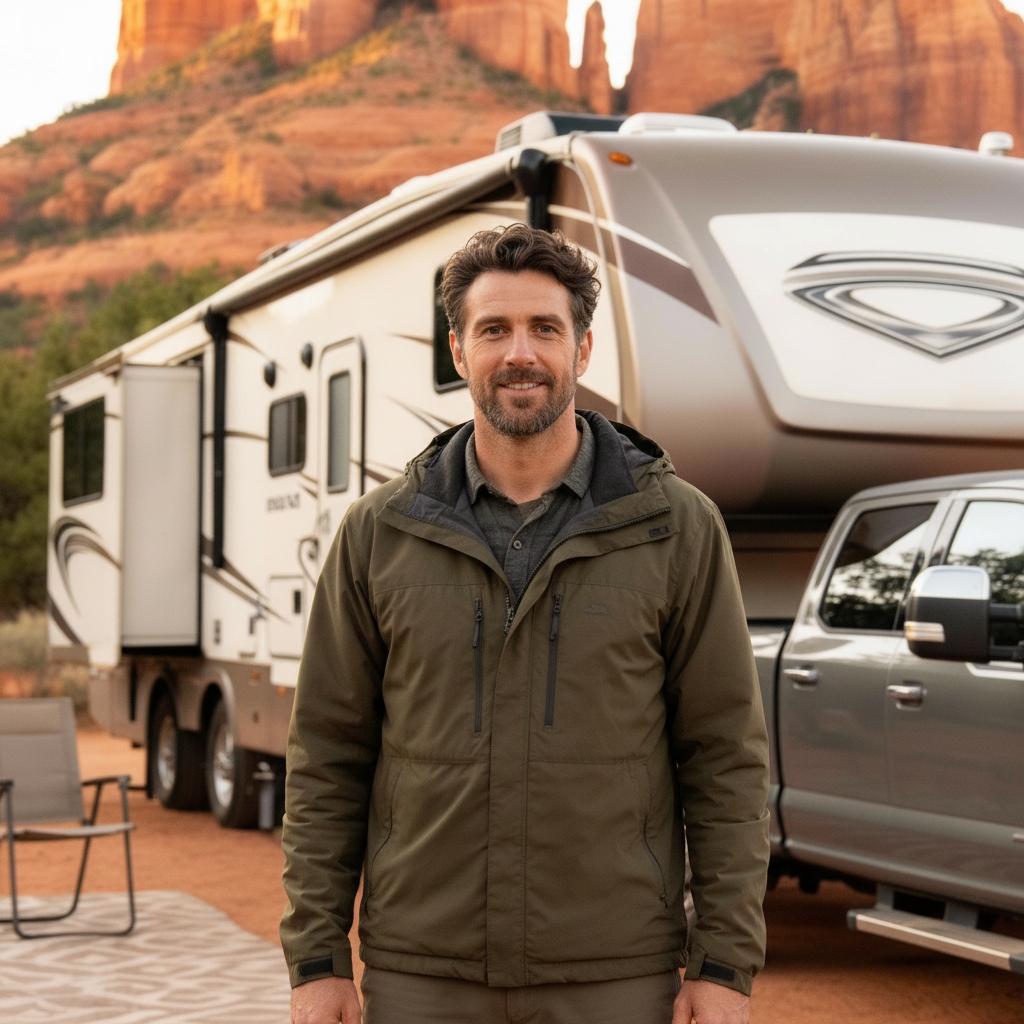
Ethan Michael Walker leads RV Trekkers. He holds a B.S. in Mechanical Engineering from Colorado State University (2002–2006), NRVIA Certified RV Inspector credentials, NRVTA RV Maintenance Course completion, and Advanced Towing & Safety Certification.
Walker’s engineering concentration includes automotive suspension systems and materials science. His professional history includes automotive mechanical engineering work on vehicle suspension, towing capacity, and braking, plus product engineering roles for RV and outdoor gear focused on hitches, racks, and leveling systems. Those roles map directly to reader decisions on tongue weight, weight-distributing hitches, and chassis loading.
The Walker family travels full-time in a 38-foot fifth-wheel with a front bedroom and mid-bunk layout for children. The tow vehicle is a 2022 Ford F-350 Super Duty diesel with a long bed. Household members include spouse Lauren and children Owen and Emma. The RV progression timeline begins in 2012 with a pop-up camper, moves to a travel trailer in 2015, adds part-time fifth-wheel use in 2018, and shifts to full-time RV living in 2020.
According to RV Trekkers’ published author profile, the lead author has documented more than 100,000 miles and travel across more than 40 U.S. states. Those figures function as experience signals tied to weather variation, mountain grades, and interstate mileage—not studio photography alone.
How Does RV Trekkers Test Gear and Document Real-World RV Use?
Recommendations emphasize products exercised on real trips, with trip context such as mileage bands, terrain types, and weather conditions when those variables affect performance claims. The publisher states a field-first rule: gear that shapes safety or major purchase decisions receives scrutiny under actual camping loads, not catalog specifications alone.
Testing notes often touch meronym-level systems: solar charge controllers, inverters, battery banks, freshwater systems, and stabilizer or leveling hardware. Contrasts include desk-written “best list” posts that omit hitch ratings, factory GVWR labels, or inverter surge limits.
Readers who want the full catalog of tutorials and evaluations browse the site’s content index on the All Content page.
What Editorial and Safety Rules Govern RV Trekkers Content?
RV Trekkers applies five core values: Safety First, Radical Honesty, Real-World Testing, Family-Friendly Travel, and Educational Empowerment. Safety First blocks shortcuts that violate towing limits, electrical overcurrent risk, or manufacturer specifications. Radical Honesty requires visible affiliate and sponsorship disclosure and space for negative product conclusions when field data supports them. Real-World Testing limits “favorite gear” stories to items used in outdoor travel conditions. Family-Friendly Travel highlights responsible campground etiquette, kid-ready routing, homeschooling logistics, and realistic family pacing. Educational Empowerment breaks complex topics—tongue weight, solar watt-hours, winterization checkpoints—into sequential explanations.
Monetization follows a stated ban on payments designed to inflate ratings. Affiliate relationships operate primarily through Amazon Associates and direct brand programs; disclosures appear near monetized links or in review headers per house style. Readers review the full monetization language on the Affiliate Disclosure page. Limits on professional liability and use of site materials appear on the Disclaimer page.
Which Topics Does RV Trekkers Publish for Owners and Aspiring RV Travelers?
The editorial mix concentrates on four pillars: RV and gear reviews, how-to guides and checklists, routes and campground guides, and family or full-time lifestyle coverage—weighted heaviest toward reviews and tutorials. Representative review subjects include fifth-wheels, travel trailers, tow vehicles, solar builds, batteries, and hitches. How-to clusters cover hookup sequences, winterizing, towing verification checklists, and electrical or freshwater troubleshooting. Route and campground content targets Southwest loops, national parks, boondocking on BLM land, and big-rig-friendly sites. Lifestyle articles address homeschooling, remote work connectivity, and monthly road budgeting.
Search intents across those pillars include buyer research (“best travel trailer” classes), procedural queries (“how to calculate tongue weight”), troubleshooting (“inverter fault under load”), and destination research (“big-rig campground near Zion”). The All Content page aggregates those article types for topical browsing.
Where Is RV Trekkers Based and How Can Readers or Partners Reach the Team?
RV Trekkers lists a legal home base at 1200 W Highway 89A, Suite 145, Sedona, AZ 86336, USA, with public contact channels at [email protected] and +1 (928) 555-0194. A dedicated Contact Us page collects reader questions, corrections, and general inquiries. Brands, publishers, and collaboration partners route proposals through the Work with Us page so campaign scope, disclosure requirements, and editorial fit stay documented.
Which Policies Explain Monetization, Privacy, Liability, and Terms of Use?
Privacy rules, site terms, affiliate mechanics, and liability limits each have a dedicated policy page on rvtrekkers.com.
- Privacy Policy — data practices, cookies, and subscriber communications.
- Terms of Service — site rules, intellectual property, and account conduct.
- Affiliate Disclosure — commission programs and link placement standards.
- Disclaimer — liability limits, educational-use boundaries, and reader responsibilities.
That policy cluster supports trust signals search engines associate with accountable publishers: reachable humans, written legal baselines, and monetization transparency separate from article prose.
Frequently Asked Questions
Is RV Trekkers paid by brands to post higher ratings?
RV Trekkers states it does not accept payment to artificially inflate ratings. Qualifying purchases through disclosed affiliate links earn commissions; the Affiliate Disclosure page lists programs and placement rules. Industry-scale RV wholesale volume—333,733 units in 2024 per RVIA reporting—makes independent methodology material to readers comparing crowded product categories.
Does RV Trekkers provide personalized engineering, inspection, or legal advice?
Site articles deliver general education, not a professional-client relationship. Specific load calculations, legal interpretations, or on-site inspections require qualified local professionals. The Disclaimer and Terms of Service pages define use limits and liability boundaries.
How does RV Trekkers disclose affiliate relationships?
Disclosures appear adjacent to monetized links or in review headers so readers see compensation context before clicking. Full program details sit on the Affiliate Disclosure page.
How can brands or media teams collaborate with RV Trekkers?
Partners submit structured requests through the Work with Us page. Urgent clarifications route through Contact Us.
How Does RV Trekkers Help Readers Pursue Safer, More Confident RV Travel?
RV Trekkers merges inspection-level RV systems knowledge, towing-focused engineering training, and long-form travel documentation so readers reduce expensive mismatches between tow vehicles, trailers, and power systems. Outdoor travel publishing spans trip photography alone; this publisher adds towable-RV depth across fifth-wheel and travel trailer workflows, with component-level attention to hitches, battery banks, and inverters. That approach contrasts vendor-only storytelling and unverified social threads.
Continue with deep dives across reviews and guides via All Content. Send corrections, reader reports, or partnership details through Contact Us.