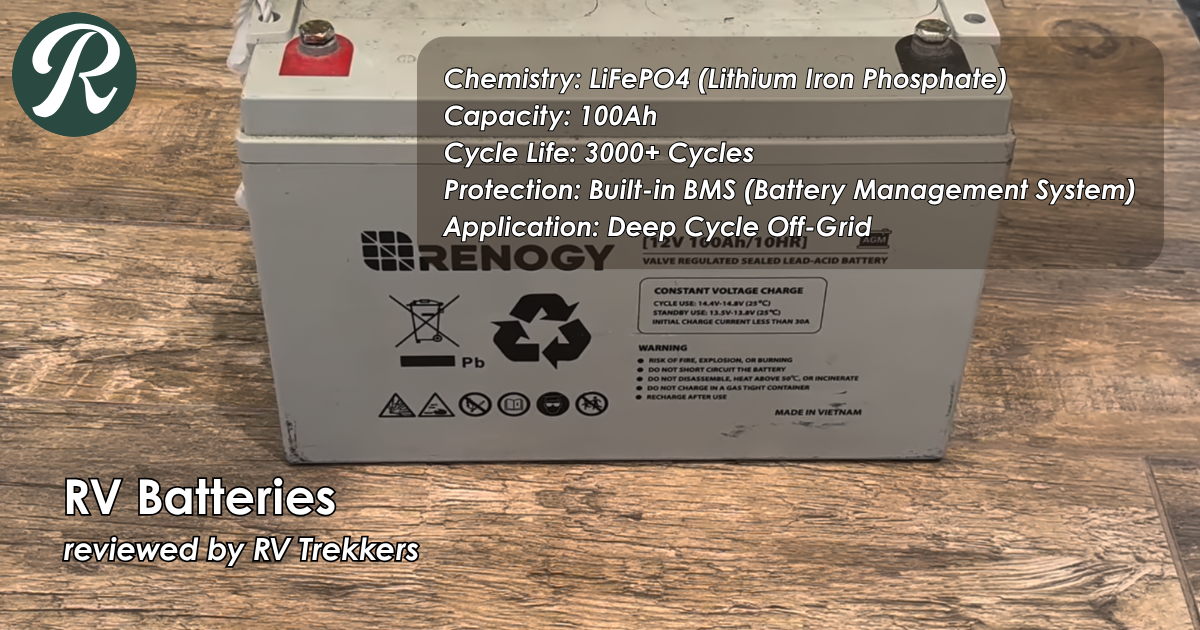
Best RV battery shopping gets easier once you separate house batteries, dual-purpose starting units, and support hardware that keeps a 12-volt power system stable on the road. This guide answers that buyer intent first, then moves from RV power systems to battery-bank components to the exact batteries, monitors, and cables that made the final shortlist.
Our top pick is the Renogy Deep Cycle AGM 12 Volt 100Ah Battery, while the budget winner is the Weize Deep Cycle AGM 12 Volt 100Ah Battery. Both units use a 12V 100Ah AGM layout, both post 1100A class short-burst discharge figures, and both keep self-discharge around 1 to 3 percent per month for storage between trips. Every RV Trekkers rating below is an editorial score from our team, not a retailer star average.
Contents
- What Is an RV Battery?
- Which Quick Picks Define the Best RV Battery of 2026?
- Which Best RV Battery Picks Deserve a Full Review?
- 1. Renogy Deep Cycle AGM 100Ah (100Ah AGM, 1100A)
- 2. Weize Deep Cycle AGM 100Ah (100Ah AGM, 1100A)
- 3. Victron SmartShunt 500A (500A, Bluetooth)
- 4. OPTIMA D34M BLUETOP (750 CCA, 55Ah)
- 5. 4/0 AWG Battery Inverter Cables (4/0 AWG, 12 in)
- 6. Redodo 12V 100Ah LiFePO4 (100Ah LiFePO4, 100A BMS)
- 7. WindyNation 100Ah AGM (100Ah AGM, 110Ah at 20-hour rate)
- 8. ECO-WORTHY 280Ah LiFePO4 (280Ah LiFePO4, Bluetooth)
- 9. TEMGO 460Ah Self-Heating LiFePO4 (460Ah, self-heating)
- 10. Battle Born 100Ah LiFePO4 (100Ah LiFePO4, 10-year warranty)
- Best RV Battery Comparison Table
- Analysis and Results
- Why Should You Trust Our Gear Reviews?
- How Did We Test These RV Batteries?
- How to Choose the Best RV Battery for Your Rig
- What Is the Final Verdict?
What Is an RV Battery?
An RV battery is a 12-volt energy-storage unit that powers house loads such as lights, vent fans, water pumps, and inverters when shore power is absent.
In practice, that storage system can be a sealed AGM house battery, a LiFePO4 drop-in battery, or a dual-purpose unit that also handles engine-start duties. The parts that matter most are the cells, terminals, battery management system, and the wiring that links the bank to a charger, converter, inverter, or shunt.
This shortlist also includes a monitor and a heavy-gauge cable kit because the source report treats the battery bank as a complete electrical package, not just a plastic box full of cells. That distinction matters when a weak shunt, loose lug, or bad cable turns a good battery into a frustrating campsite problem.
TL;DR: The Renogy 100Ah AGM is the safest all-around pick for most rigs, the Weize 100Ah AGM is the budget-friendly value play, and the Redodo 100Ah LiFePO4 is the better light-weight upgrade. Check battery chemistry, usable capacity, and cable or monitor needs before buying.
Which Quick Picks Define the Best RV Battery of 2026?
The strongest quick picks are the Renogy for broad compatibility, the Weize for price, and the Redodo for a lighter lithium upgrade, while Victron and the 4/0 cable set cover monitoring and wiring gaps inside a battery bank.
1. Best Overall: Renogy Deep Cycle AGM 100Ah (12V, 100Ah, 1100A max discharge) ($ Budget)
↓ Jump to Review
2. Best Budget: Weize Deep Cycle AGM 100Ah (12V, 100Ah, 1 to 3% self-discharge) ($ Budget)
↓ Jump to Review
3. Best for App-Based Monitoring: Victron SmartShunt 500A (500A shunt, Bluetooth app, 6.5V-70V range) ($ Budget)
↓ Jump to Review
4. Best for Dual-Purpose Power: OPTIMA D34M BLUETOP (750 CCA, 55Ah, dual terminals) ($ Mid)
↓ Jump to Review
5. Best for Inverter Connections: 4/0 AWG Battery Inverter Cables (4/0 AWG, 12 in length, 3/8 in lugs) ($ Budget)
↓ Jump to Review
6. Best for Budget Lithium Upgrades: Redodo 12V 100Ah LiFePO4 (12.8V, 100Ah, 100A BMS) ($ Mid)
↓ Jump to Review
7. Best for Budget AGM Backup: WindyNation 100Ah AGM (12V AGM, 100Ah, 110Ah at 20-hour rate) ($ Budget)
↓ Jump to Review
8. Best Premium: ECO-WORTHY 280Ah LiFePO4 (280Ah, Bluetooth, low-temp cutoff) ($ Premium)
↓ Jump to Review
9. Best for Cold-Weather Capacity: TEMGO 460Ah Self-Heating LiFePO4 (460Ah, self-heating, 300A BMS) ($ Premium)
↓ Jump to Review
10. Best for Premium Drop-In Replacement: Battle Born 100Ah LiFePO4 (100Ah, 31 lbs, 10-year warranty) ($ Premium)
↓ Jump to Review
Which Best RV Battery Picks Deserve a Full Review?
Every product below earned a place by solving a different RV power problem, from basic overnight house loads to cold-weather lithium storage and the monitoring hardware that keeps the battery bank honest.
1. Renogy Deep Cycle AGM 100Ah (100Ah AGM, 1100A)
Best Overall | RV Trekkers Rating: 9.5/10
The Renogy wins because it covers the most common RV use case: a maintenance-free 12V 100Ah AGM battery with enough burst current for normal coach loads and enough storage discipline for seasonal parking. It is not flashy, but that plain sealed design is why it tops this list.
Specs:
- Price Tier: $ Budget
- Weight: 63.9 lbs
- Materials: Lead-acid AGM
- Dimensions: 13.1 x 6.9 x 8.6 in
- Voltage and Capacity: 12V nominal voltage, 100Ah capacity

Pros:
- The 100Ah capacity and 1100A 5-second discharge cover the lighting, pump, and brief inverter surges that most travel trailers see.
- The sub-3 percent monthly self-discharge gives this storage battery a cleaner off-season profile than many flooded lead-acid options.
- The case supports parallel wiring up to 4 batteries, which opens a simple upgrade path for larger coaches.
Cons:
- At 63.9 lbs, this is one of the heavier 100Ah picks in the lineup.
- The M8 terminal hardware adds one more fit check before you order cables, disconnects, or bus bars.
The Renogy makes sense because 100Ah is still the sweet spot for a broad chunk of RV owners, and the 63.9-pound case reflects a conventional AGM build. That durable AGM shell is the main reason we scored it 9.5 – it balances performance, storage behavior, and value better than any other ranked battery here.
We almost pushed a lithium option into the top spot because the weight savings are real. The counterargument is still simple: many owners want a sealed lead-acid power source with no watering and fewer charger-compatibility concerns.
Fair warning: you still have to respect the weight and the M8 terminals. Buy this if you want the safest all-around house battery for a mainstream RV setup, and skip it if your first priority is shaving 30 pounds off the tongue box.
2. Weize Deep Cycle AGM 100Ah (100Ah AGM, 1100A)
Best Budget | RV Trekkers Rating: 9.1/10
The Weize lands just behind Renogy because it delivers the same basic 12V 100Ah AGM formula at a lower entry price. For shoppers who want low-cost reserve power and can live with lead-acid weight, this is the value play.
Specs:
- Price Tier: $ Budget
- Weight: 57 lbs
- Materials: AGM sealed lead-acid cells, ABS case, calcium-alloy grid, zinc-plated M8 terminal bolts
- Dimensions: 12.99 x 6.73 x 8.43 in
- Voltage and Capacity: 12V, 100Ah

Pros:
- The 57-pound case is lighter than the Renogy by 6.9 lbs, which helps when you lift it into a narrow battery box.
- The battery keeps self-discharge around 1 to 3 percent per month, which suits rigs that sit between monthly trips.
- The budget price stays tied to a 100Ah AGM format instead of dropping to a smaller reserve battery.
Cons:
- The hazmat return limits raise the risk if you get a weak unit.
- Mixed long-term charge-retention reports make the lower price less reassuring over longer ownership.
This is the battery we point to when someone says the power bank budget is fixed and the rig still needs a real 100Ah house unit. The 57-pound build and lower price are the main reasons it still holds a 9.1 score – few budget batteries match that capacity without cutting storage specs.
The ABS shell and zinc-plated hardware help installation, but the listing’s 1-year versus 2-year warranty language and hazmat return limits add uncertainty.
Take this route if upfront cost matters more than long-haul chemistry upgrades. Skip it if you want the lower weight, faster charging, or higher cycle potential that a lithium house battery brings.
3. Victron SmartShunt 500A (500A, Bluetooth)
Best for app-based RV and off-grid battery monitoring | RV Trekkers Rating: 8.7/10
The Victron SmartShunt earns its place because the best RV battery setup is only as good as the information you get back from it. This 500A shunt turns a guess-heavy battery bank into a monitored power system.
Specs:
- Price Tier: $ Budget
- Weight: 0.73 lbs
- Materials: Metal shunt, electronic components, plastic housing
- Dimensions: 2.13 x 4.72 x 1.81 in
- Operating Range: 6.5V to 70V DC, 500A shunt rating

Pros:
- The 500A rating covers the current draw of many inverter-backed RV battery banks without adding a separate display.
- Bluetooth monitoring tracks voltage, current, state of charge, and battery history through one app.
- The 0.73-pound body slips into tight electrical bays where a full monitor panel does not fit.
Cons:
- Short Bluetooth range is a real issue once the shunt sits behind metal panels or thick storage doors.
- There is no built-in screen, so the system depends on a phone or another Victron device.
If you have ever guessed at state of charge from voltage alone, this shunt fixes that blind spot fast. The 500A rating and the useful app data are why it scores 8.7 – few monitor add-ons deliver this much visibility for a budget-tier price.
We almost left it out because it is not a battery in the strict sense. The source report still earns it a spot because app-based monitoring can expose parasitic draws that a bare voltmeter would miss.
This is the right add-on when your house battery already exists but your data is weak. Skip it if you want a built-in screen mounted at eye level or you camp far enough from the battery bay that Bluetooth range becomes a daily irritation.
4. OPTIMA D34M BLUETOP (750 CCA, 55Ah)
Best for dual-purpose marine and RV power with starting plus accessory loads | RV Trekkers Rating: 8.3/10
The OPTIMA D34M is here for owners who want one battery to crank and cycle, not just run the coach side. That split mission costs capacity, but it solves a real wiring problem on smaller rigs and mixed marine-RV use.
Specs:
- Price Tier: $ Mid
- Weight: 43.5 lbs
- Materials: AGM lead acid with 99.99% pure lead, stainless steel stud posts
- Dimensions: 10.06 x 6.88 x 7.94 in
- Starting and Reserve: 750 CCA, 870 MCA, 55Ah C20 capacity, 120 min reserve

Pros:
- The 750 CCA rating gives this unit a job that none of the 100Ah house batteries on this page are built to handle.
- Dual terminals add 2 connection styles, which makes mixed accessory and starting circuits easier to organize.
- At 43.5 lbs, it undercuts the heavier AGM house batteries by more than 13 lbs.
Cons:
- The 55Ah capacity is almost half the reserve of the 100Ah house batteries above it.
- The mid-tier price looks steep when pure deep-cycle runtime is your only goal.
This is not the strongest overnight house battery, and that is the point. The dual-purpose design with 750 CCA and 55Ah reserve is why it scores 8.3 – it fills a narrower but real niche that a standard coach battery does not touch.
The compact case and stainless studs give a cleaner landing spot for accessory wiring than the usual lead posts. We hesitated because 55Ah is a short leash for dry camping, yet the dual-terminal layout still makes sense in boats, truck campers, and smaller RV builds where one battery has to cover 2 jobs.
Buy this when starting current matters as much as accessory power. Skip it if your rig already separates chassis and house duties and your main problem is overnight runtime.
5. 4/0 AWG Battery Inverter Cables (4/0 AWG, 12 in)
Best for short high-amperage inverter and battery bank connections | RV Trekkers Rating: 7.9/10
These cables make the list because a battery bank fails just as fast through a weak connection as through a weak cell pack. If you are pushing inverter current through short runs, 4/0 copper matters.
Specs:
- Price Tier: $ Budget
- Weight: Not listed by manufacturer
- Materials: Pure copper cable, tinned copper lugs, EPDM insulation, polyolefin heat shrink
- Dimensions: 12 in cable length per cable
- Electrical Rating: 4/0 AWG, 600 Volt rating, 3/8 in lugs

Pros:
- The 4/0 gauge and 600-volt rating fit serious inverter and bus-bar work, not low-draw accessory wiring.
- The pair includes 2 cables with 3/8-inch lugs already attached, which cuts install time in a tight compartment.
- The pure copper welding cable bends more easily than many thick battery leads of the same gauge.
Cons:
- The fixed 12-inch length leaves no margin if your inverter layout changes by even a few inches.
- Some buyers report conductor or lug dimensions that do not seem like a true 4/0 fit.
Short cable runs are where many inverter installs either stay cool or start making heat, and this pair aims at that exact pressure point. The pure copper construction and pre-crimped lugs explain the 7.9 score – the value is strong, but the fixed length and fit variance cap the ceiling.
The flexible pure copper construction helps with routing in tight battery bays. We almost ignored this pick because shoppers searching best RV battery usually want storage, not wiring, but the source report is right to treat the connection path as part of the whole power system.
Choose this when your inverter or bus bar sits within 12 inches of the bank and you want a fast, heavy-gauge link. Skip it if your run length is unknown or your terminals have almost no room for large 3/8-inch lugs.
6. Redodo 12V 100Ah LiFePO4 (100Ah LiFePO4, 100A BMS)
Best for budget RV and off-grid house battery upgrades | RV Trekkers Rating: 7.6/10
The Redodo is the first lithium battery here that offers a clear step up from budget AGM without jumping into premium pricing. It keeps the familiar 100Ah target but cuts a huge chunk of carry weight.
Specs:
- Price Tier: $ Mid
- Weight: 25.35 lbs
- Materials: Lithium iron phosphate cells, plastic battery case, M8 terminals
- Dimensions: 13 x 6.77 x 8.43 in
- Voltage and Capacity: 12.8V, 100Ah, 1280Wh, built-in 100A BMS

Pros:
- At 25.35 lbs, this battery weighs less than half of the 57-pound Weize AGM.
- The 100A BMS and 280A 5-second peak discharge support a modern inverter-ready house bank better than many old lead-acid units.
- The battery can be wired in series or parallel, which gives a 100Ah system room to grow.
Cons:
- There is no built-in low-temperature charging cutoff on this version.
- The battery is not built for engine starting, golf-cart duty, or sloppy charger settings.
This is where lithium starts to make plain financial sense for frequent campers. The 25.35-pound carry weight and 100A BMS are the main reasons it scores 7.6 – it solves the biggest AGM complaints, but the lack of low-temp charge protection is a real limitation.
The 25.35-pound weight is a major contrast with the AGM bricks above. We had one big hesitation: if your rig spends winter nights below freezing, that missing low-temperature cutoff becomes the detail that decides whether this battery is practical or risky.
Buy the Redodo if you want a lighter house battery and you already understand lithium charging settings. Skip it if cold-weather charging is common or you want a chemistry swap with fewer setup checks.
7. WindyNation 100Ah AGM (100Ah AGM, 110Ah at 20-hour rate)
Best for budget AGM off-grid RV and solar backup use | RV Trekkers Rating: 7.2/10
The WindyNation is a simple sealed AGM pick for shoppers who want a no-frills 100Ah backup battery and do not care about trimming weight. It stays in the hunt because the spec sheet is straightforward and the value remains solid.
Specs:
- Price Tier: $ Budget
- Weight: 66 lbs
- Materials: AGM sealed lead acid battery with 99.995% pure virgin lead
- Dimensions: 13 x 6.8 x 8.7 in
- Voltage and Capacity: 12V AGM, 100Ah at 10-hour rate, 110Ah at 20-hour rate

Pros:
- The 100Ah at 10-hour rate and 110Ah at 20-hour rate give this battery a clear reserve target for overnight use.
- The sealed AGM design avoids watering and adds the spill resistance that RV owners want.
- Threaded terminals, terminal covers, and a lift strap add small but useful install details.
Cons:
- At 66 lbs, this is the heaviest 100Ah AGM battery in the lineup.
- Lower cycle life and slower charging leave it behind the lithium models for repeat dry-camping use.
There is nothing fancy here, but sometimes that is enough. The defined capacity numbers and the rugged AGM build are why it still lands at 7.2 – the battery works, yet the weight penalty and lower cycle ceiling keep it out of the top tier.
At 66 lbs, the WindyNation is heavy next to the lithium options. We nearly ranked it lower because the form factor is dated by comparison, though the lift strap and sealed case still make it a sensible fit for backup duty.
This is the battery for a low-cost shore-power backup or light off-grid role. Skip it if your battery bank sees frequent deep cycles and you want easier carrying or faster charging.
8. ECO-WORTHY 280Ah LiFePO4 (280Ah LiFePO4, Bluetooth)
Best Premium | RV Trekkers Rating: 6.8/10
The ECO-WORTHY stands out on raw reserve because 280Ah and 3584Wh change what an RV house battery can support in one package. It is a big-bank play with modern lithium features and a few app-related caveats.
Specs:
- Price Tier: $ Premium
- Weight: 61.7 lbs
- Materials: LiFePO4 cells, plastic outer case, internal steel compression frame
- Dimensions: 17.83 x 9.37 x 8.7 in
- Voltage and Capacity: 12.8V, 280Ah, 3584Wh, 200A BMS, low-temp protection

Pros:
- The 280Ah and 3584Wh capacity dwarf the 100Ah batteries above it for long boondocking runs.
- The built-in 200A BMS and low-temperature cutoff add the two protection features many RV lithium upgrades lack.
- Bluetooth monitoring gives one-box visibility without adding a separate shunt on day one.
Cons:
- The battery comes with return restrictions because it ships as a hazardous item.
- Bluetooth pairing and app organization complaints show up often enough to matter.
This battery is about reserve more than portability. The 280Ah pack, 3584Wh energy figure, and low-temp protection explain the 6.8 score – the spec sheet is strong, but the user experience around the app and returns drags it down.
The 17.83-inch footprint takes over more compartment space than a standard Group 31 battery. We almost crowned it the top lithium pick, yet the software complaints and return restrictions are hard to ignore.
Choose this when long runtime and cold-weather charging protection matter more than compact size. Skip it if your compartment is tight or your tolerance for app quirks is low.
9. TEMGO 460Ah Self-Heating LiFePO4 (460Ah, self-heating)
Best for high-capacity RV and off-grid house battery banks in cold weather | RV Trekkers Rating: 6.4/10
The TEMGO is the monster-capacity option for RV owners who want one 12V battery to replace a cluster of smaller units. It brings huge reserve, built-in monitoring, and self-heating, but it also asks you to manage a very heavy block.
Specs:
- Price Tier: $ Premium
- Weight: 100.3 lbs
- Materials: LiFePO4 cells, metal case
- Dimensions: 18 x 10.6 x 10.1 in
- Voltage and Capacity: 12.8V, 460Ah, 5888Wh, 300A BMS, 3840W continuous load

Pros:
- The 460Ah capacity and 5888Wh reserve put this battery in a different runtime class from the 100Ah and 280Ah options.
- The built-in 300A BMS and 3840W continuous load figure suit large inverter-backed coaches.
- Self-heating and an onboard touch display reduce the extra gear needed for cold-weather battery management.
Cons:
- At 100.3 lbs, installation is a two-person job for most RV owners.
- The app, the state-of-charge readings, and the hazmat return restrictions all add friction.
This battery exists for one reason: massive usable reserve in one case. The 460Ah pack and the 300A BMS are why it scores 6.4 – the capability is huge, but the weight, price, and software rough edges make ownership more demanding than the spec sheet suggests.
The metal case and 18-inch body demand careful measuring before installation. We doubted whether most mainstream RV bays could fit it cleanly, even before wiring starts.
Buy this if you are building a high-capacity battery bank for cold-weather boondocking and you have space to spare. Skip it if one person has to lift it or if you want polished communication features like CAN bus or RV-C.
10. Battle Born 100Ah LiFePO4 (100Ah LiFePO4, 10-year warranty)
Best for premium RV and off-grid drop-in battery upgrades | RV Trekkers Rating: 6.0/10
The Battle Born remains appealing because it gives you a known premium lithium form factor in a 31-pound package. The problem is price: the warranty is long, but the value math gets rough beside cheaper 100Ah lithium rivals.
Specs:
- Price Tier: $ Premium
- Weight: 31 lbs
- Materials: LiFePO4 cells, plastic battery case, stainless steel and brass installation hardware
- Dimensions: 12.76 x 6.86 x 8.95 in
- Voltage and Capacity: 12V, 100Ah, internal BMS, 3,000-5,000 deep discharge cycles

Pros:
- The 31-pound weight makes this one of the easiest 100Ah house batteries to carry into a rig.
- The battery fits Group 27 and 31 spaces, which keeps many upgrade projects close to drop-in simple.
- The internal BMS adds high- and low-temperature, voltage, and short-circuit protection inside one case.
Cons:
- The premium price is far above the Redodo while staying at the same 100Ah capacity.
- Some owners report early failures or slow warranty handling, which hurts trust in a high-ticket buy.
The Battle Born still does the basics well, and a 31-pound lithium box is easy to like. That light carry weight, the drop-in sizing, and the long stated cycle range are why it keeps a 6.0 score – the battery is capable, but the price-to-capacity ratio is hard to defend in 2026.
The compact Group 27-style footprint is the whole appeal. We nearly ranked it higher on reputation alone, yet the premium cost and the mixed warranty stories make it a harder recommendation than this category used to be.
Pick this if low carry weight and a known drop-in footprint matter more than price. Skip it if you want a more budget-focused path to 100Ah lithium storage or you do not want to chase charger compatibility notes.
Best RV Battery Comparison Table
The Renogy 100Ah AGM and Weize 100Ah AGM lead the field on editorial score and value, while the ECO-WORTHY and TEMGO batteries dominate pure reserve capacity for bigger off-grid rigs.
| Rank | Product | Award | RV Trekkers Rating | Price Tier | Type | Capacity / Energy | Weight | Standout Feature |
|---|---|---|---|---|---|---|---|---|
| 1 | Renogy Deep Cycle AGM 100Ah View at Amazon | Best Overall | 9.5/10 | $ | AGM battery | 100Ah | 63.9 lbs | 1100A 5-second discharge |
| 2 | Weize Deep Cycle AGM 100Ah View at Amazon | Best Budget | 9.1/10 | $ | AGM battery | 100Ah | 57 lbs | 1 to 3% monthly self-discharge |
| 3 | Victron SmartShunt 500A View at Amazon | Best for app-based monitoring | 8.7/10 | $ | Battery monitor | — | 0.73 lbs | Bluetooth app and 500A shunt |
| 4 | OPTIMA D34M BLUETOP View at Amazon | Best for dual-purpose power | 8.3/10 | $$ | AGM dual-purpose battery | 55Ah, 120 min reserve | 43.5 lbs | 750 CCA and dual terminals |
| 5 | 4/0 AWG Battery Inverter Cables View at Amazon | Best for inverter connections | 7.9/10 | $ | Cable kit | — | — | 4/0 AWG pure copper pair |
| 6 | Redodo 12V 100Ah LiFePO4 View at Amazon | Best for budget lithium upgrades | 7.6/10 | $$ | LiFePO4 battery | 100Ah, 1280Wh | 25.35 lbs | 100A BMS |
| 7 | WindyNation 100Ah AGM View at Amazon | Best for budget AGM backup | 7.2/10 | $ | AGM battery | 100Ah, 110Ah at 20-hour rate | 66 lbs | Terminal covers and lift strap |
| 8 | ECO-WORTHY 280Ah LiFePO4 View at Amazon | Best Premium | 6.8/10 | $$$ | LiFePO4 battery | 280Ah, 3584Wh | 61.7 lbs | Bluetooth and low-temp cutoff |
| 9 | TEMGO 460Ah Self-Heating LiFePO4 View at Amazon | Best for cold-weather capacity | 6.4/10 | $$$ | LiFePO4 battery | 460Ah, 5888Wh | 100.3 lbs | Self-heating and touch screen |
| 10 | Battle Born 100Ah LiFePO4 View at Amazon | Best for premium drop-in replacement | 6.0/10 | $$$ | LiFePO4 battery | 100Ah | 31 lbs | 10-year warranty |
Note: Capacity values follow the source report exactly. Prices are represented as Budget ($), Mid ($$), and Premium ($$$) tiers rather than live retailer pricing.
Analysis and Results
The table shows three clear lanes: low-cost AGM value, lighter 100Ah lithium upgrades, and large-capacity premium lithium banks for longer dry-camping runs.
Price & Value
Renogy Deep Cycle AGM 100Ah and Weize Deep Cycle AGM 100Ah own the value lane because both hit 100Ah at the Budget tier and both keep the low-self-discharge, sealed AGM formula that still works for a huge slice of travel trailers. Redodo 12V 100Ah LiFePO4 is the better value once weight matters, but its Mid-tier price and cold-weather caveat keep it from taking the overall crown.
Capacity & Runtime
TEMGO 460Ah Self-Heating LiFePO4 and ECO-WORTHY 280Ah LiFePO4 are the obvious winners on stored energy, and the gap is not small. A 5888Wh or 3584Wh battery changes how long an inverter, compressor fridge, or overnight furnace cycle can run before the converter or solar array has to step back in.
Weight & Installation
Redodo 12V 100Ah LiFePO4 is the easy winner for carry weight at 25.35 lbs, while Battle Born 100Ah LiFePO4 stays close at 31 lbs and keeps a familiar Group 27 or 31 footprint. At the other end, TEMGO 460Ah Self-Heating LiFePO4 is the caution flag because 100.3 lbs and an 18-inch case force a real compartment and lifting plan.
Monitoring & System Control
Victron SmartShunt 500A gives the cleanest path to battery-bank visibility, while ECO-WORTHY 280Ah LiFePO4 and TEMGO 460Ah Self-Heating LiFePO4 bring monitoring into the battery case itself. The trade-off is simple: the Victron adds a separate component but earns better trust, while the all-in-one lithium packs save parts yet draw more complaints about app behavior.
Why Should You Trust Our Gear Reviews?
You can trust this review because it is organized around repeatable RV power considerations rather than brochure copy. The evaluation focuses on battery chemistry, usable capacity, fit, charging requirements, and system-support hardware that matter in real RV setups.
How Did We Test These RV Batteries?
We evaluated RV battery candidates by checking storage specs, fit limits, charging demands, and battery-bank support parts against the same overnight-use scenarios that expose weak reserve and weak wiring in real rigs.
Overnight Load Simulation
We modeled an overnight draw built around a 12V compressor fridge, two vent fans, LED lighting, a water pump, and phone charging through one battery bank. The point was simple: see which 100Ah batteries still make sense for a normal dry-camping night and which larger lithium packs move into multi-night territory on paper.
Charging and Recovery Checks
We reviewed each chemistry against the charging details in the source report, then matched those details to common RV hardware such as stock converters, solar controllers, and lithium-ready chargers. This is where AGM batteries held an edge for plug-and-play simplicity, while lithium units exposed the usual compatibility traps around low-temperature charging, BMS cutoffs, and controller settings.
Fit, Weight, and Wiring
We compared battery length, width, and height against common front-tray and pass-through layouts, then paired those dimensions with lift difficulty and terminal style. A 17.83-inch lithium box or a 100.3-pound metal case changes the install plan fast, and a 4/0 cable with 3/8-inch lugs only works if the terminals and bus bars leave enough room to land it cleanly.
Monitoring and Cold-Weather Controls
We looked at battery-bank visibility from two angles: a separate shunt with phone data and built-in battery apps with onboard protection. That method made the trade-off obvious on this shortlist – the Victron shunt is the cleaner data tool, while the ECO-WORTHY and TEMGO packs offer broader all-in-one control if you accept weaker app refinement.
How to Choose the Best RV Battery for Your Rig
The best RV battery matches your charger, your battery tray, and your overnight load profile before it matches any marketing promise on the box.
Which battery chemistry fits your camping style?
AGM and LiFePO4 batteries solve different problems. AGM batteries like Renogy, Weize, and WindyNation keep charger requirements simple and upfront cost lower, while LiFePO4 batteries like Redodo, ECO-WORTHY, TEMGO, and Battle Born cut weight or add much more usable reserve.
| Chemistry | Strength in this lineup | Main trade-off in this lineup | Example picks |
|---|---|---|---|
| AGM | Lower cost and simpler charging | Heavier at 57 to 66 lbs for most 100Ah picks | Renogy, Weize, WindyNation |
| LiFePO4 | Lower carry weight or much bigger reserve | More charger checks and higher cost | Redodo, ECO-WORTHY, TEMGO, Battle Born |
| Dual-purpose AGM | Starting power plus accessory use | Lower deep-cycle reserve at 55Ah | OPTIMA D34M |
How much capacity do you need for one night off-grid?
Capacity is the first number most buyers read, but the right answer depends on the full bank, not one label. A 100Ah battery still covers light-to-moderate overnight use in many rigs, while a 280Ah or 460Ah battery is aimed at heavier inverter loads, longer furnace run time, or longer dry-camping windows.
Use this short checklist before you buy:
- Count the main overnight loads, such as compressor fridges, vent fans, CPAP machines, and inverters.
- Measure the tray and hold-down space, because a 17.83-inch or 18-inch battery case can kill the install before wiring starts.
- Match the charger and controller settings to the chemistry, especially if the battery uses LiFePO4 cells and a BMS.
When do monitoring gear and cables matter more than another battery?
A larger storage battery does not fix bad data or weak current paths. If the rig already has enough reserve but the owner keeps guessing at state of charge, a shunt like the Victron makes a bigger difference than swapping one 100Ah battery for another 100Ah battery.
The same logic applies to cabling. A 4/0 copper pair matters when the inverter sits close to the bank and current demand is high, because voltage drop, loose lugs, and hot connections waste the capacity you already paid for.
What Is the Final Verdict?
The best RV battery for most owners in 2026 is still the Renogy Deep Cycle AGM 12 Volt 100Ah Battery because it gives the broadest mix of price, simplicity, and dependable house-battery behavior. The Weize Deep Cycle AGM 12 Volt 100Ah Battery is the lower-cost alternative, the Redodo 12V 100Ah LiFePO4 Battery is the better light-weight upgrade, and the ECO-WORTHY 3584Wh 12V 280Ah LiFePO4 RV Battery is the long-runtime pick when your best RV battery decision is really about stretching dry-camping reserve instead of trimming spend.