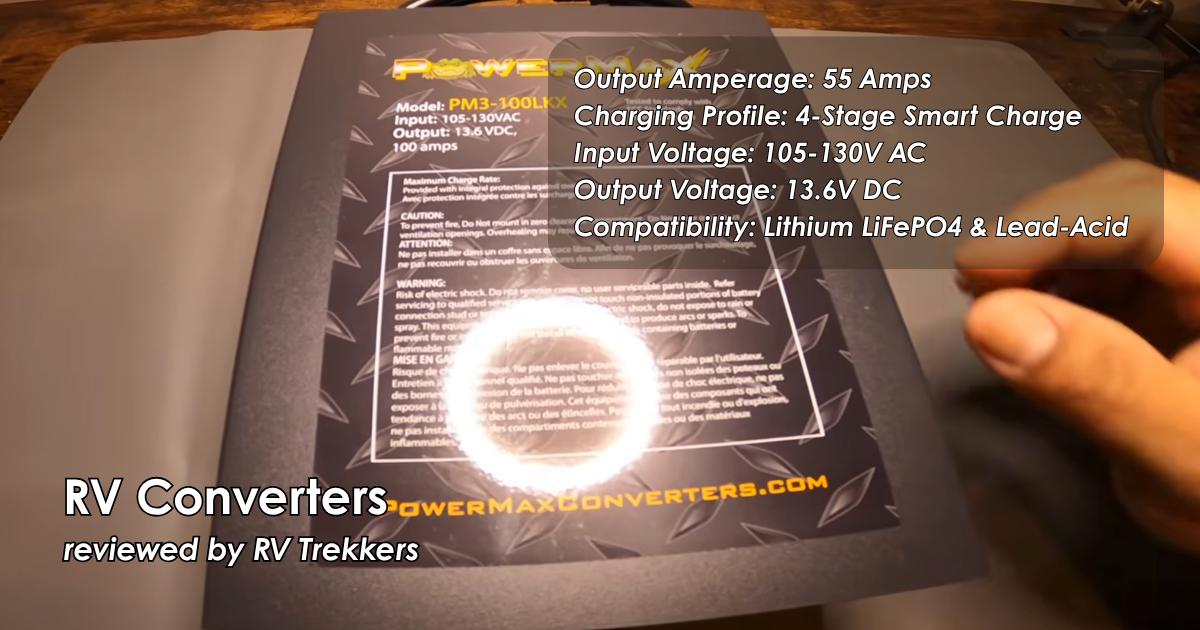
The best RV converter keeps a 12-volt electrical system stable, charges the house battery, and matches the replacement footprint already inside the rig. In this lineup, the strongest options separate into 3 decision paths: 55-amp replacements for common RV power centers, quieter deck-mount units for cleaner DC output, and lower-output specialty units for narrower jobs.
Our top pick is the PowerMax 55 Amp RV Converter, and the strongest low-cost replacement is the WF-8955-MBA. Both charging systems sit in the 55-amp class, but PowerMax adds adjustable 13V to 16.5V output and lithium compatibility, while WF-8955-MBA focuses on direct lead-acid replacement at a lower entry price. RV Trekkers scores below are editorial ratings from this report, not retailer star ratings.
Contents
- What Is an RV Converter?
- What Are the Quick Picks for the Best RV Converter of 2026?
- 1. PowerMax 55 Amp RV Converter (55A, adjustable 13V-16.5V, 4-stage)
- 2. WF-8955-MBA (55A, WF-8955PEC fit, 3-stage lead-acid)
- 3. IOTA DLS30 (30A, 13.6V/14.2V, low-ripple output)
- 4. WF-9855 Upgrade (55A, WF-9800 fit, 13.6V output)
- 5. WF-8955-AD-MBA (55A, 950W, 13.2V-14.4V charging)
- 6. RecPro RV Converter 35A (35A, 120VAC to 12VDC, 4-stage)
- 7. PD9260CV 60A (60A, 13.6V output, 3-stage)
- 8. WFCO WF-9855 (55A, deck-mount fit, 14.4V bulk charging)
- 9. PI Store 12V Adapter (10A max, 120W max, 9 ft cord)
- 10. Progressive PD4645V (45A, Charge Wizard, direct-fit section replacement)
- How Do These 10 Best RV Converter Picks Compare Side by Side?
- What Do the Comparison Results Show for the Best RV Converter?
- Why Should You Trust Our RV Converter Reviews?
- How Did We Evaluate Each Best RV Converter Pick?
- How Do You Choose the Best RV Converter for Your RV?
- What Is the Final Verdict?
What Is an RV Converter?
An RV converter is a power supply that changes 120VAC shore power into 12VDC power for lights, fans, control boards, and battery charging.
In practice, this electrical component sits between the campground pedestal and the RV battery bank. The 10 products in this guide show the 3 main RV converter forms in this category: deck-mount converters such as the IOTA DLS30, replacement boards such as the WF-8955-MBA, and one accessory-style adapter that is useful for light 12V devices but not for full house-battery duty.
TL;DR: PowerMax PM4 55A is the best RV converter for most rigs because it pairs 55-amp output with adjustable 13V to 16.5V charging. WF-8955-MBA is the better low-cost pick for lead-acid replacement, and IOTA DLS30 is the quiet alternative for 30-amp systems.
What Are the Quick Picks for the Best RV Converter of 2026?
The fastest shortlist starts with PowerMax for all-around use, WF-8955-MBA for low-cost lead-acid replacement, and IOTA DLS30 for quiet low-ripple output.
1. Best Overall: PowerMax 55 Amp RV Converter (55A, 13V-16.5V, lithium compatible) ($ Budget)
↓ Jump to Review
2. Best Budget: WF-8955-MBA (55A, WF-8955PEC fit, 3-stage lead-acid) ($ Budget)
↓ Jump to Review
3. Best for RV Converter Replacement and Quiet 12V DC Power Supply Use: IOTA DLS30 (30A, 13.6V/14.2V, low-ripple output) ($ Budget)
↓ Jump to Review
4. Best for Low-Cost WF-9800 Series Replacement in Lead-Acid RV Systems: WF-9855 Upgrade (55A, WF-9800 fit, 13.6V output) ($ Budget)
↓ Jump to Review
5. Best for Direct WF-8955PEC Replacement Installs: WF-8955-AD-MBA (55A, 950W, 13.2V-14.4V charging) ($ Budget)
↓ Jump to Review
6. Best for WF-9800 Replacement Upgrades in RVs: RecPro RV Converter 35A (35A, 120VAC to 12VDC, 4-stage) ($ Budget)
↓ Jump to Review
7. Best for Direct PD9260C and PD9200-Series Replacement in RVs: PD9260CV 60A (60A, 13.6V output, 3-stage) ($ Budget)
↓ Jump to Review
8. Best for Direct OEM-Style RV Converter Replacement: WFCO WF-9855 (55A, deck-mount fit, 14.4V bulk charging) ($ Mid)
↓ Jump to Review
9. Best for Powering 12V Tire Inflators and Car Accessories from a Home Outlet: PI Store 12V Adapter (10A max, 120W max, 9 ft cord) ($ Budget)
↓ Jump to Review
10. Best for Replacing Older Parallax, Magnatek, and WFCO 45 Amp RV Converter Sections: Progressive PD4645V (45A, Charge Wizard, direct-fit section replacement) ($ Mid)
↓ Jump to Review
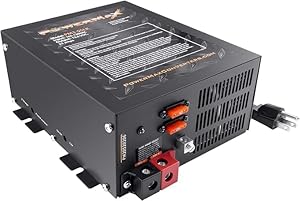
1. PowerMax 55 Amp RV Converter (55A, adjustable 13V-16.5V, 4-stage)
Best Overall | RV Trekkers Rating: 9.5/10
PowerMax earns the top spot because it combines 55-amp output, adjustable 13V to 16.5V voltage, and support for lithium, AGM, gel, and lead-acid batteries in one low-cost package.
Specs:
- Price Tier: $ Budget
- Weight: 6.4 lbs
- Materials: Metal housing
- Dimensions: 12 x 9 x 5 in
- Electrical Profile: 55 amp output; adjustable 13V to 16.5V; built-in 4-stage smart charger
Pros:
- The 55-amp output and 4-stage charger cover more battery types than most low-cost replacements in this group.
- The 13V to 16.5V adjustable range gives a wider setup window than the fixed 13.6V units below it.
- The 6.4-pound chassis still lands in a manageable size for many deck-mount compartments.
Cons:
- The 6.4-pound housing is larger than direct-fit board replacements and does not match every factory cavity.
- Noise complaints show up often enough that the cooling fan matters more in small trailers and front-bedroom fifth-wheels.
PowerMax stands out because it covers the 3 biggest buyer demands at once: replacement power, battery charging, and chemistry flexibility. That broad fit is the main reason it scored 9.5/10 — none of the other budget-tier units combine 55 amps, 4 charging stages, and adjustable output in the same way.
Fair warning: fan noise is the first sensory complaint that repeats in the report, and that matters more when the converter cabinet sits under a bed or next to a dinette. We nearly dropped it lower because durability feedback is mixed, but the feature set stays ahead of the field.
Buy this if your rig needs one box that covers lead-acid today and lithium later. Skip it if your RV needs an exact board-style replacement with a known silent fan profile.
2. WF-8955-MBA (55A, WF-8955PEC fit, 3-stage lead-acid)
Best Budget | RV Trekkers Rating: 9.1/10
WF-8955-MBA is the sharpest low-cost pick because it targets the common WF-8955PEC replacement job without asking you to pay for lithium support you may not use.
Specs:
- Price Tier: $ Budget
- Weight: —
- Materials: —
- Dimensions: —
- Electrical Profile: 55 amp converter; WF-8955PEC, WF-8955-MBA, and WF-8955-AD-MBA compatibility; 3-stage charging for 12V lead-acid batteries

Pros:
- The 55-amp class matches one of the most common RV replacement sizes in this entire roundup.
- The 3-stage profile keeps the electrical job simple for 12V lead-acid battery systems.
- The low entry price undercuts many dealer-installed 55-amp replacements.
Cons:
- Missing weight and dimensional data make compartment planning less certain before install day.
- The charging profile stops at lead-acid support, so lithium upgrades require a different unit.
This converter solves a narrow problem better than almost anything else here: a failed WF-8955PEC setup that needs a fast, cheap, like-for-like electrical replacement. That clean fit story pushed it to 9.1/10 even with incomplete size data.
The hesitation point is noise. Fan complaints are common, and the report also flags mixed long-term reliability, so this is not the quiet-room pick for a compact camper where every mechanical sound carries.
Choose this when your power center already uses the WF-8955 family and your battery bank stays lead-acid. Skip it if lithium compatibility or complete published specs matter more than price.
3. IOTA DLS30 (30A, 13.6V/14.2V, low-ripple output)
Best for RV Converter Replacement and Quiet 12V DC Power Supply Use | RV Trekkers Rating: 8.7/10
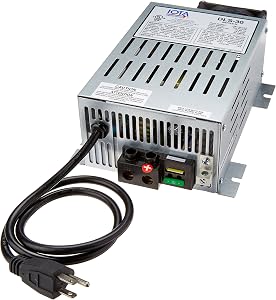
IOTA DLS30 wins the quiet-use slot because it delivers 30 amps of clean DC output and has the strongest report for low ripple and low fan noise.
Specs:
- Price Tier: $ Budget
- Weight: 4.5 lbs
- Materials: —
- Dimensions: 12.5 x 7.5 x 4.5 in
- Electrical Profile: 30A continuous output; 13.6V or 14.2V DC output; 108-132V AC input
Pros:
- The 30A continuous rating fits smaller battery banks and lighter 12V loads without oversizing the charger.
- The 4.5-pound unit is easier to handle than the 6.4-pound and 9-pound models in this guide.
- The low-ripple 12V output is one of the cleaner electrical profiles in the selected field.
Cons:
- The 30A ceiling is lower than the 45A, 55A, and 60A replacements above it.
- Some smart-charging flexibility depends on add-on modules instead of the base unit alone.
IOTA is known for clean, stable output, and that matters when sensitive electronics share the same 12V bus as the battery charger. The report links that low-ripple design and long-term owner confidence to its 8.7/10 score.
This is also the lineup’s quieter story. Owners describe little to no fan noise, and that detail matters in rigs where the converter cabinet sits a few feet from the sofa, the bed, or a control panel you hear every night.
Pick it when your RV uses a 30-amp charging class and quiet operation matters as much as raw amperage. Skip it if you want an all-in-one 4-stage solution without adding optional charging modules.
4. WF-9855 Upgrade (55A, WF-9800 fit, 13.6V output)
Best for Low-Cost WF-9800 Series Replacement in Lead-Acid RV Systems | RV Trekkers Rating: 8.3/10
This WF-9855 replacement stays in the top half because it is one of the more affordable paths to a 55-amp WF-9800-series swap.
Specs:
- Price Tier: $ Budget
- Weight: —
- Materials: Metal housing; copper fan motor
- Dimensions: —
- Electrical Profile: 55 amp output; 13.6 VDC output; 105-130 VAC input at 60 Hz

Pros:
- The 55-amp output keeps it aligned with common WF-9800 replacement needs.
- The low purchase price sits near the floor of this 10-product set.
- The metal housing and copper fan motor give it more published build detail than some other budget boards.
Cons:
- Weight and dimensional data are missing, so fit verification depends on the model-family match.
- Warranty details conflict between 3 years and 5 years in the source report.
The main appeal is simple: a low-cost 55-amp replacement that targets WF-9855 and related WF-9800 housings. That value story is the biggest reason it landed at 8.3/10 despite weaker clarity around warranty and long-term durability.
There is real doubt here. Fan noise shows up often, and the report also calls out mixed lifespan feedback, so this is not the cleanest answer for RV owners who prioritize quiet cabins or long ownership cycles.
Use this for a budget-minded lead-acid replacement inside the WF-9800 family. Skip it if you want verified lithium support or one clear warranty statement before you buy.
5. WF-8955-AD-MBA (55A, 950W, 13.2V-14.4V charging)
Best for Direct WF-8955PEC Replacement Installs | RV Trekkers Rating: 7.9/10
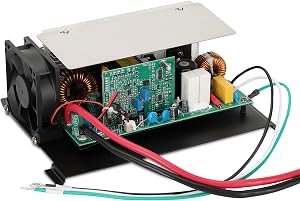
WF-8955-AD-MBA ranks well because it targets a direct board swap for multiple WFCO and Parallax power centers and packs 55 amps into a known replacement format.
Specs:
- Price Tier: $ Budget
- Weight: 4.25 lbs
- Materials: Aluminum alloy housing, circuit board, capacitors
- Dimensions: 9.6 x 5.89 x 3.5 in
- Electrical Profile: 55 amp output; 950 W output power; 105-130 VAC input at 60 Hz and 13.2V-14.4V charging range
Pros:
- The 4.25-pound board assembly is easier to maneuver than many full boxed converters.
- The 55-amp / 950W profile matches the direct-replacement job it is built to do.
- The 13.2V to 14.4V charging range and multiple protections cover the basic RV charging job well.
Cons:
- This is a board assembly, not a full enclosed converter, so the fit question starts with exact compatibility.
- One report of a capacitor failure and explosion raises a bigger safety flag than most products here.
The board-style format is the whole reason this product exists, and it does that job well when the part number lines up. Its 7.9/10 score reflects strong fitment value paired with a sharper reliability penalty than the higher-ranked replacements.
The risk note is hard to ignore. The report flags mixed conversion reliability, and even one severe component-failure account is enough to slow down any install where the converter feeds lighting, controls, and battery charging every day.
Buy it for a fast model-matched WF-8955PEC or Parallax board swap. Skip it if you want the extra enclosure, extra documentation, and lower perceived risk of a full deck-mount converter.
6. RecPro RV Converter 35A (35A, 120VAC to 12VDC, 4-stage)
Best for WF-9800 Replacement Upgrades in RVs | RV Trekkers Rating: 7.6/10
RecPro earns its place because it brings 4-stage charging and lithium support into a 35-amp replacement path for WF-9800-series rigs.
Specs:
- Price Tier: $ Budget
- Weight: —
- Materials: Plastic enclosure
- Dimensions: —
- Electrical Profile: 35 amp output; 120VAC to 12VDC conversion; 4-stage smart charging with 13.0V, 14.6V, and 16.5V output modes

Pros:
- The 35-amp output is a practical middle ground for smaller battery banks and lighter RV electrical loads.
- The 4-stage charger adds more battery-chemistry flexibility than many lead-acid-only boards.
- The 16.5V top setting gives it one of the wider published charging ranges in this review.
Cons:
- Missing weight and size data make install planning harder than it needs to be.
- Voltage behavior and reliability complaints reduce confidence compared with the top 5 models.
RecPro’s best story is the charging profile. A 35-amp converter with 13.0V, 14.6V, and 16.5V modes gives this charger-converter more tuning range than the fixed 13.6V replacements near it, and that flexibility carries much of its 7.6/10 score.
The trade-off is certainty. The report notes mixed charging accuracy, mixed durability, and some confusion around settings, so the first sensory and ownership cue here is not silence or polish but setup friction.
Choose this when you want a WF-9800 upgrade path with lithium support and you accept some setup work. Skip it if you want full published dimensions and a cleaner reliability record.
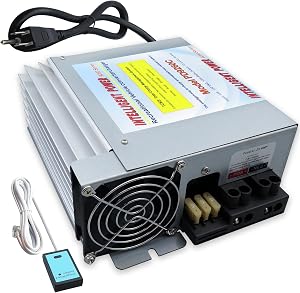
7. PD9260CV 60A (60A, 13.6V output, 3-stage)
Best for Direct PD9260C and PD9200-Series Replacement in RVs | RV Trekkers Rating: 7.2/10
PD9260CV fills a specific hole in the market: a 60-amp direct replacement for older PD9200-series converters.
Specs:
- Price Tier: $ Budget
- Weight: 6.12 lbs
- Materials: —
- Dimensions: 11.61 x 9.57 x 5.47 in
- Electrical Profile: 105-130 VAC input; 13.6 VDC, 60A output; automatic 3-stage charging with 14.4V boost mode
Pros:
- The 60-amp rating is the highest output figure in this entire roundup.
- The 14.4V boost stage gives it more charging intent than a plain fixed-voltage converter.
- The direct PD9200-series fit reduces rewiring work for the right rigs.
Cons:
- The thin review history and early-failure complaints lower confidence more than the raw 60A number suggests.
- Lithium compatibility is not listed, which narrows the battery-chemistry fit.
On paper, the 60-amp output looks like a top-3 spec. In practice, the report gives it 7.2/10 because the product story depends more on model-family fit and basic functionality than on proven long-run confidence.
This is a good example of why amperage alone does not decide the best RV converter. A converter fan that behaves fine for some owners and a few no-output reports on arrival create more hesitation than the 60A badge erases.
Buy it when your RV already uses the PD9200 family and you want the highest-output direct swap in this group. Skip it if lithium support or a longer public track record is part of the job.
8. WFCO WF-9855 (55A, deck-mount fit, 14.4V bulk charging)
Best for Direct OEM-Style RV Converter Replacement | RV Trekkers Rating: 6.8/10
WFCO WF-9855 stays relevant because it is one of the clearest OEM-style replacements for factory-installed WFCO systems.
Specs:
- Price Tier: $ Mid
- Weight: 4.3 lbs
- Materials: Metal housing with insulated DC connections
- Dimensions: 8.6 x 5.9 x 3.9 in
- Electrical Profile: 55 amps DC output; 105-130 VAC input at 60 Hz; 14.4V DC bulk charging

Pros:
- The 4.3-pound chassis is compact for a 55-amp deck-mount unit.
- The 14.4V bulk charging profile fits the OEM replacement story well.
- Quiet fan reports are stronger here than on many bargain WF-family alternatives.
Cons:
- Warranty clarity and long-term durability questions reduce confidence more than the fit story helps it.
- The Mid price tier hurts value when lower-cost 55-amp replacements are still available.
WFCO’s strength is familiarity. This power converter fits many factory RV setups cleanly, and the published dimensions are more reassuring than the missing specs on some cheaper competitors, but the value score falls behind because the buying path is less clear.
The positive sensory note is quiet operation. That matters in tighter trailers. The hesitation point is long-term durability, which keeps popping up across much of this category.
Choose WFCO when your goal is an OEM-style deck-mount replacement with a better fit story than no-name boards. Skip it if you want the strongest value or clearer warranty detail.
9. PI Store 12V Adapter (10A max, 120W max, 9 ft cord)
Best for Powering 12V Tire Inflators and Car Accessories from a Home Outlet | RV Trekkers Rating: 6.4/10
This PI Store adapter is useful for light 12V accessories, but it is not a true house-battery RV converter in the same sense as the other nine products.
Specs:
- Price Tier: $ Budget
- Weight: 0.97 lbs
- Materials: Plastic housing with copper cable conductors
- Dimensions: 7 x 2.5 x 1.5 in
- Electrical Profile: 100-120V AC input; 12V DC female cigarette-lighter output; 10A max and 120W max output; 9 ft total reach

Pros:
- The 0.97-pound weight and 9-foot reach make it the easiest product here to move and store.
- The 10A / 120W ceiling is adequate for many inflators, coolers, and smaller 12V accessories.
- The budget price is far below every deck-mount or board-style converter in this guide.
Cons:
- The 10A / 120W limit is nowhere near the 30A to 60A charging class of real RV converters.
- Heat buildup and short service-life complaints show up too often for heavy-duty use.
This adapter lands near the bottom because its job is narrower than the search intent. It converts household AC to a 12V accessory socket, and that limited scope is why the RV Trekkers score stops at 6.4/10.
The sensory concern is heat. The report says some owners feel the power brick getting hot under load, which is a clear reminder that this is an accessory adapter, not a main charging system for lights, pumps, and the converter section of a trailer.
Buy it only for light 12V gear such as inflators or small coolers. Skip it for any RV battery bank, power center, or full-time camper electrical job.
10. Progressive PD4645V (45A, Charge Wizard, direct-fit section replacement)
Best for Replacing Older Parallax, Magnatek, and WFCO 45 Amp RV Converter Sections | RV Trekkers Rating: 6.0/10
Progressive PD4645V remains relevant because it solves one hard problem well: replacing older 45-amp converter sections with a 4-stage charging upgrade.
Specs:
- Price Tier: $ Mid
- Weight: 9 lbs
- Materials: —
- Dimensions: 13.2 x 8 x 5.3 in
- Electrical Profile: 45 amp rating; 14.4 V DC output; built-in Charge Wizard 4-stage charging; direct replacement for multiple Parallax, Magnatek, and WFCO sections

Pros:
- The built-in 4-stage Charge Wizard is one of the more mature charging profiles in this group.
- The 45-amp class fits older converter-section replacements that a 55-amp board does not cover cleanly.
- Many owners report quieter operation than aging factory converters they replaced.
Cons:
- The 9-pound chassis is the heaviest product in this roundup.
- The Mid price tier is high for a product that still may require wire cutting or panel transfer work.
The PD4645V has a good upgrade story but a narrower audience. Direct-fit compatibility with older Parallax, Magnatek, and WFCO sections is valuable, yet the heavier body and higher price pull the score down to 6.0/10.
There is also a split noise story. Some owners hear a quieter converter than their old unit, while others describe whining or buzzing, so the first real-world cue is uncertainty rather than quiet confidence.
Choose it when you are replacing one of the older 45-amp sections it names. Skip it if your rig uses a simpler 55-amp board swap or if price-to-output value is the first filter.
How Do These 10 Best RV Converter Picks Compare Side by Side?
PowerMax PM4 55A leads the field on editorial score because it pairs 55-amp output with the widest charging range, while WF-8955-MBA offers one of the more affordable direct replacement paths for common lead-acid setups.
| # | Product | Award | RV Trekkers Rating | Price | Output | Replacement Fit | Charging / Voltage |
|---|---|---|---|---|---|---|---|
| → 1 | PowerMax 55 Amp RV Converter View at Amazon | Best Overall | 9.5/10 | $ | 55 amp output | General RV / boat / off-grid use | 13V-16.5V adjustable, 4-stage |
| 2 | WF-8955-MBA View at Amazon | Best Budget | 9.1/10 | $ | 55 amp converter | WF-8955PEC / WF-8955-MBA / WF-8955-AD-MBA | 3-stage lead-acid charging |
| 3 | IOTA DLS30 View at Amazon | Best for RV converter replacement and quiet 12V DC power supply use | 8.7/10 | $ | 30A continuous / 400W | Older deck-mount replacement use | 13.6V or 14.2V output |
| 4 | WF-9855 Upgrade View at Amazon | Best for low-cost WF-9800 series replacement in lead-acid RV systems | 8.3/10 | $ | 55 amp output | WF-9855 / WF-9800 series | 13.6V output |
| 5 | WF-8955-AD-MBA View at Amazon | Best for direct WF-8955PEC replacement installs | 7.9/10 | $ | 55 amp / 950W | WF-8955, WF-8900-AD, Parallax 7145/7155 | 13.2V-14.4V charging |
| 6 | RecPro RV Converter 35A View at Amazon | Best for WF-9800 replacement upgrades in RVs | 7.6/10 | $ | 35 amp output | WF-9800 replacement upgrade | 13.0V / 14.6V / 16.5V, 4-stage |
| 7 | PD9260CV 60A View at Amazon | Best for direct PD9260C and PD9200-series replacement in RVs | 7.2/10 | $ | 60A output | PD9260C / PD9260CV / PD9200 series | 13.6V output, 14.4V boost |
| 8 | WFCO WF-9855 View at Amazon | Best for direct OEM-style RV converter replacement | 6.8/10 | $$ | 55 amps DC output | OEM-style WFCO replacement | 14.4V bulk charging |
| 9 | PI Store 12V Adapter View at Amazon | Best for powering 12V tire inflators and car accessories from a home outlet | 6.4/10 | $ | 10A max / 120W max | Accessory socket use, not power center replacement | 12V DC cigarette-lighter output |
| 10 | Progressive PD4645V View at Amazon | Best for replacing older Parallax, Magnatek, and WFCO 45 amp RV converter sections | 6.0/10 | $$ | 45 amp rating | Parallax / Magnatek / WFCO 45A sections | 14.4V output, 4-stage Charge Wizard |
Note: Prices are expressed as Budget ($) or Mid ($$) from the source report. Missing measurements stay unfilled rather than inferred.
What Do the Comparison Results Show for the Best RV Converter?
The table shows that fitment and charging profile matter more than raw amperage once you narrow the search to real RV replacements.
Output Capacity
PD9260CV 60A posts the biggest number in the lineup, but the best score still belongs to PowerMax 55 Amp RV Converter because 55 amps plus adjustable charging is more useful than 60 amps with thinner confidence data. IOTA DLS30 sits at the opposite end of the main converter field with 30 amps, and that lower output still makes sense for smaller rigs and lighter 12V loads.
Replacement Fit
WF-8955-MBA, WF-9855 Upgrade, and WF-8955-AD-MBA win on part-family precision because each one names specific power centers or replacement families. WFCO WF-9855 also scores well here because its OEM-style deck-mount story is easy to understand, while PI Store 12V Adapter falls outside the true replacement conversation.
Charging Profile and Battery Chemistry
PowerMax 55 Amp RV Converter and RecPro RV Converter 35A offer the widest voltage flexibility, which is why both sit above many fixed-output boards despite mixed durability notes. IOTA DLS30 earns attention for clean DC output, and WF-8955-MBA stays competitive because a simple 3-stage lead-acid profile is enough for owners who are not moving to lithium.
Why Should You Trust Our RV Converter Reviews?
This review uses RV Trekkers’ editorial framework, built around Ethan Walker’s background as a mechanical engineer, NRVIA Certified RV Inspector, and full-time RV family lead with 100,000+ documented miles across 40+ U.S. states. We score each converter against replacement fit, charging profile, maintenance burden, and electrical-use context, and we keep the ratings independent instead of repeating retailer star data.
How Did We Evaluate Each Best RV Converter Pick?
This draft uses source-report evaluation, not bench-lab verification, so every score and claim tracks back to the selected-products report rather than unverified field measurements.
Fitment and Electrical Class
We sorted the 10 products by the 4 output classes in the report: 10A accessory adapter, 30A deck mount, 35A smart charger, and the 45A to 60A replacement class. We also separated direct-fit families such as WF-8955PEC, WF-9800, PD9200, Parallax 7145/7155, and Magnatek replacements because those part numbers decide more installs than brand name alone.
Charging Profile and Battery Chemistry
We compared fixed-output units such as 13.6V replacements against adjustable or multi-stage options such as PowerMax and RecPro. We also marked chemistry limits when the report named them, especially lead-acid-only units versus products that list lithium compatibility.
Reliability, Noise, and Maintenance Flags
We used the recurring cautions inside the report, including fan noise, heat buildup, early failure reports, reversed wire-color confusion, and missing manuals. When the report did not publish weight, size, warranty term, or material detail, we left the gap visible instead of filling it with assumptions.
Editorial Value Scoring
We aligned each RV Trekkers score with 5 factors from the writing framework: performance, build quality, value for money, ease of use, and safety/features. That process explains why a 55-amp unit with clearer fit and chemistry coverage outranks a 60-amp unit with less confidence behind it.
How Do You Choose the Best RV Converter for Your RV?
The right converter matches the existing power-center family first, the battery chemistry second, and the charging amperage third.
Match the Replacement Type First
The 3 converter forms in this guide solve different jobs:
| Converter form | Examples in this guide | Best use | Main caution |
|---|---|---|---|
| Board replacement | WF-8955-MBA, WF-8955-AD-MBA | Exact power-center swap | Wrong fit stops the install fast |
| Deck-mount converter | PowerMax, IOTA DLS30, WFCO WF-9855 | Standalone converter replacement | Cabinet size and fan noise matter |
| Accessory adapter | PI Store 12V Adapter | Light 12V devices from a wall outlet | Not a battery-bank charger |
If your old converter sits inside a named family such as WF-8955PEC or PD9200, the part-family match is the fastest filter. If your RV uses a standalone charging box, the deck-mount products are the right branch of the market.
Which Battery Chemistry and Charging Stage Matter Most?
Lead-acid battery banks pair cleanly with the simpler 3-stage units, while lithium-ready setups point toward wider-voltage chargers such as PowerMax and RecPro. Fixed 13.6V converters are known for simple replacement jobs, but adjustable 13V to 16.5V systems offer more setup range when the battery type changes.
What Hidden Install Problems Show Up Most Often?
The 4 recurring trouble spots in this report are fan noise, missing dimensions, wiring surprises, and unclear warranty terms. A noisy cooling fan is more noticeable in compact campers, and missing measurements turn even a good electrical match into a guessing game on install day.
What Is the Final Verdict?
PowerMax PM4 55A is the best RV converter for most readers because it balances 55-amp output, adjustable charging, and multi-chemistry support better than the rest of this field.
If you want the clearest all-around answer, start with the PowerMax 55 Amp RV Converter. If your rig already uses the WF-8955 family and stays on lead-acid batteries, the WF-8955-MBA is the better value. If quiet operation and cleaner 30-amp DC output matter more than raw charging speed, the IOTA DLS30 is the smarter specialty pick.
That closes the loop on the core question behind the best RV converter search: the right charging system is not the unit with the biggest number on the box. It is the one that matches the RV’s power center, battery chemistry, and day-to-day cabin realities.