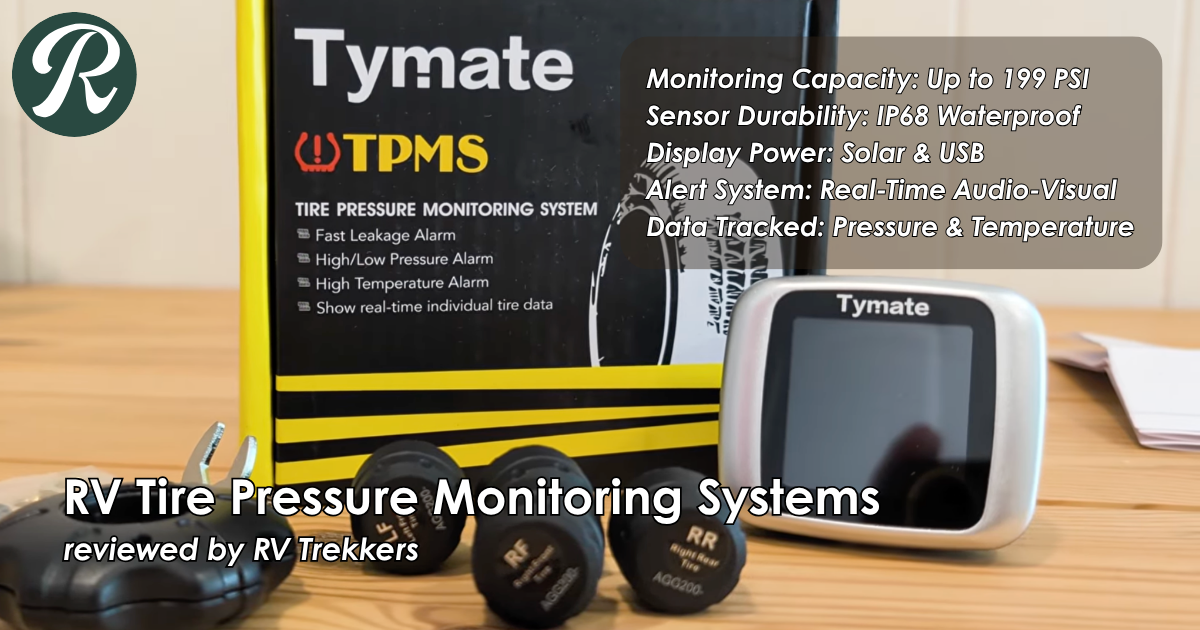
Best RV tire pressure monitoring system choices matter because a slow leak looks small on the dash and expensive on the shoulder. The strongest systems in this group balance sensor count, pressure range, readable alerts, and signal stability across real RV towing layouts. In this guide, we move from the core tire-monitoring system to the parts around it, including sensors, display hardware, repeaters, and maintenance details that shape everyday RV safety.
Our top pick is the Tymate RV Tire Pressure Monitoring System – M7-3, and the best budget-heavy multi-tire alternative is the Vesafe TPMS. Both systems use external sensors and live pressure alerts, but the Tymate keeps the buy-in low while the Vesafe adds 10 anti-theft sensors and an included signal booster for bigger combinations. RV Trekkers ratings are editorial scores based on the ranked product report, not retailer star averages.
Contents
- What Is an RV Tire Pressure Monitoring System?
- Quick Picks: Best RV Tire Pressure Monitoring System of 2026
- 1. Tymate RV Tire Pressure Monitoring System – M7-3 (0 to 87 PSI, 4 sensors, up to 7 tires)
- 2. Vesafe TPMS (up to 17 tires, 10 anti-theft sensors, signal booster)
- 3. Marcala Tire Pressure Monitoring System (0 to 98 PSI, 4 wheels, 50 ft claimed range)
- 4. Hieha Tire Pressure Monitoring System (7.84 in screen, 0 to 198 PSI, 130 ft signal distance)
- 5. Masoll Tire Pressure Monitoring System (4 sensors, +/- 1.5 PSI accuracy, solar charging)
- 6. RV Tire Pressure Monitoring System M12-3 (0 to 144 PSI, 6 sensors, 65 ft sensing distance)
- 7. TST 507 Tire Pressure Monitoring System (4 cap sensors, 3.5 in color display, 3-year warranty)
- 8. TireMinder Smart TPMS (up to 22 tires, 0 to 232 PSI, Bluetooth adapter)
- 9. GUTA RV Tire Pressure Monitoring System (0 to 188 PSI, 8 sensors, up to 10 positions)
- 10. Easesuper RV Tire Pressure Monitoring System (0 to 199 PSI, 6 flow-through sensors, repeater included)
- How Do These 10 RV Tire Pressure Monitoring Systems Compare Side by Side?
- Analysis and Results
- Why Should You Trust Our Gear Reviews?
- How Did We Test and Score Each RV Tire Pressure Monitoring System?
- How Do You Choose the Best RV Tire Pressure Monitoring System?
- Conclusion
What Is an RV Tire Pressure Monitoring System?
An RV tire pressure monitoring system is a safety system that tracks tire pressure and temperature across an RV, trailer, or tow vehicle and warns you before a leak turns into a blowout.
Most setups in this guide use screw-on external sensors, a dash display or phone connection, and alarm logic for pressure loss, heat, or weak batteries. That makes them very different from passive pressure checks with a handheld gauge alone, especially on multi-axle trailers where one soft tire hides easily.
TL;DR: The Tymate M7-3 is the best RV tire pressure monitoring system for most towables, while the Vesafe is stronger for larger tire counts. If your rig is long or your tires run high PSI, repeater support and pressure range matter as much as price.
Quick Picks: Best RV Tire Pressure Monitoring System of 2026
These are the 10 systems worth shortlisting first, with Tymate leading for all-around value and Vesafe leading for larger tire counts.
1. Best Overall: Tymate RV Tire Pressure Monitoring System – M7-3 (0 to 87 PSI, 4 sensors, up to 7 tires) ($ Budget)
↓ Jump to Review
2. Best Budget: Vesafe TPMS (up to 17 tires, 10 anti-theft sensors, signal booster) ($ Budget)
↓ Jump to Review
3. Best for Budget RV and Trailer Tire Monitoring: Marcala Tire Pressure Monitoring System (0 to 98 PSI, 4 wheels, 50 ft claimed range) ($ Budget)
↓ Jump to Review
4. Best for RV and Travel Trailer Owners Needing a Large Solar-Powered Display: Hieha Tire Pressure Monitoring System (7.84 in screen, 0 to 198 PSI, 130 ft signal distance) ($ Budget)
↓ Jump to Review
5. Best for Budget-Friendly 4-Wheel Trailer and Tow Vehicle Monitoring: Masoll Tire Pressure Monitoring System (4 sensors, +/- 1.5 PSI accuracy, solar charging) ($ Budget)
↓ Jump to Review
6. Best for Budget-Minded RV Owners Needing 6-Tire Monitoring: RV Tire Pressure Monitoring System M12-3 (0 to 144 PSI, 6 sensors, 65 ft sensing distance) ($ Budget)
↓ Jump to Review
7. Best for Multi-Trailer RV Tire Monitoring with Expandable Coverage: TST 507 (4 cap sensors, 3.5 in color display, 3-year warranty) ($ Mid)
↓ Jump to Review
8. Best for RV Owners Who Want Smartphone-Based Tire Monitoring: TireMinder Smart TPMS (up to 22 tires, 0 to 232 PSI, Bluetooth adapter) ($ Mid)
↓ Jump to Review
9. Best for Solar-Powered RV and Trailer Tire Monitoring with 8 Sensors: GUTA RV Tire Pressure Monitoring System (0 to 188 PSI, 8 sensors, up to 10 positions) ($ Mid)
↓ Jump to Review
10. Best for Monitoring 4 to 6 RV or Trailer Tires at Once: Easesuper RV Tire Pressure Monitoring System (0 to 199 PSI, 6 flow-through sensors, repeater included) ($ Mid)
↓ Jump to Review
1. Tymate RV Tire Pressure Monitoring System – M7-3 (0 to 87 PSI, 4 sensors, up to 7 tires)
Best Overall | RV Trekkers Rating: 9.5/10
The Tymate M7-3 wins because it covers the core RV brief without inflating the price. We almost pushed it lower because long-rig signal complaints and bright-sun visibility issues show up often, but the feature mix still lands best for most towable owners.
Specs:
- Price Tier: $ Budget
- Weight: Not specified by manufacturer
- Materials: Not specified by manufacturer
- Dimensions: 6.3 x 4.72 x 1.97 in
- Coverage: 0 to 87 PSI monitoring range; 4 external sensors included; monitors up to 7 tires

Pros:
- The package starts with 4 external sensors and expands to monitoring for up to 7 tires, which fits many trailer layouts without another full kit.
- Solar charging plus USB backup reduces one more cable problem in the cab during long 300- to 400-mile drive days.
- The system tracks both pressure and temperature and adds 5 alarm modes in a Budget-tier package.
Cons:
- The 0 to 87 PSI ceiling excludes some higher-pressure tire setups that sit well above 87 PSI.
- Multiple reviews in the report tie signal issues to rigs longer than about 36 ft when no repeater is present.
The Tymate stands out because it covers the usual travel trailer footprint without burying the setup in add-ons. Four included cap sensors handle the common trailer layout, and the move to 7 monitored tires leaves room for the tow vehicle or a spare. That blend of coverage and price is the main reason we scored it 9.5/10.
The trade-off shows up in the radio path and the screen. The report calls out motion-activated sensors, delayed readings, and daylight washout, which matters when you stop for fuel at noon and want one fast glance before pulling back onto the highway. The LCD is serviceable, but it is not the screen we trust most in hard sun.
Buy this if your rig is a travel trailer, camper, or smaller fifth wheel and you want a low-drama monitoring system with good core coverage. Skip it if your tires run above 87 PSI or your trailer length already tells you a repeater belongs in the plan.
2. Vesafe TPMS (up to 17 tires, 10 anti-theft sensors, signal booster)
Best Budget | RV Trekkers Rating: 9.1/10
The Vesafe earns its spot because it solves one of the biggest RV TPMS pain points: scale. We almost moved it above the Tymate because the included booster and 10 anti-theft sensors fit bigger combinations out of the box, but the setup friction and daylight readability hold it at No. 2.
Specs:
- Price Tier: $ Budget
- Weight: 1.8 lbs
- Materials: Plastic, metal, rubber
- Dimensions: 6.77 x 3.78 x 7.91 in
- Coverage: Supports up to 17 tires total; 5 alarm modes; includes 10 anti-theft sensors and signal booster

Pros:
- The box includes 10 anti-theft sensors and a booster, which cuts accessory shopping for 6-, 8-, and 10-tire combinations.
- Support for up to 17 tires gives this system more headroom than most kits in this guide.
- The system covers high and low pressure, temperature, leakage, and battery status through 5 alarm modes.
Cons:
- The 6.77 x 3.78 x 7.91 in package is bulkier than compact dash units in this roundup.
- Several report notes flag setup instructions as confusing, which slows the first install more than a 4-sensor kit.
The Vesafe is the system we point to when a tow vehicle, fifth wheel, and extra axle make tire count the first filter. Its included booster addresses a failure point that cheaper systems leave for later, and the 17-tire ceiling gives it far more runway than the entry-level models. That scale is the main reason it still scores 9.1/10 despite the bigger learning curve.
The downside is interface polish. The report ties bright-sun visibility and mixed instructions to real frustration, and that shows up fast when you are programming a large rig in a campground parking loop instead of a quiet garage. It covers the job well, but it asks for more patience.
Choose the Vesafe if your main problem is coverage across a lot of tires and a long signal path. Skip it if you want the smallest display, a solar panel on the monitor, or the simplest setup in this class.
3. Marcala Tire Pressure Monitoring System (0 to 98 PSI, 4 wheels, 50 ft claimed range)
Best for Budget RV and Trailer Tire Monitoring | RV Trekkers Rating: 8.7/10
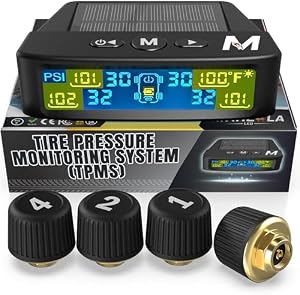
The Marcala is a sharp low-cost pick for drivers who want live pressure and temperature data without paying mid-tier money. We almost left it lower because dead-on-arrival sensor complaints are hard to ignore, but the 0 to 98 PSI range and lifetime replacement promise keep it highly competitive.
Specs:
- Price Tier: $ Budget
- Weight: 0.49 lbs
- Materials: Materials not specified by manufacturer
- Dimensions: 4 x 4 x 1.3 in
- Coverage: Monitors 1 to 4 wheels; pressure range 0 to 98 PSI; claimed 50 ft extended range
Pros:
- The 0 to 98 PSI ceiling beats the 87 PSI ceiling on several budget rivals while staying in the Budget tier.
- Solar plus USB charging gives this small 4 x 4 x 1.3 in monitor two power paths.
- The system adds 6 alarm modes and IP67 waterproof sensors in a kit that weighs only 0.49 lbs.
Cons:
- The kit monitors only 1 to 4 wheels, so multi-axle combinations hit the ceiling fast.
- Some reviews in the report mention failed sensors right out of the box or after a short period of use.
What pushes the Marcala up the list is its balance of price and usable headroom. A 98 PSI ceiling fits more tire setups than the 87 PSI crowd, and the 50 ft claimed range gives it a cleaner case for shorter RV and trailer combinations. That extra flexibility in the Budget tier is why it lands at 8.7/10.
The risk is hardware confidence. The report points to mixed long-range performance and a few failed sensors, so this is not the system we buy for a large caravan where every tire position matters. It looks strong on paper, but it does not carry the same trust margin as the top two.
Buy the Marcala if you want an inexpensive 4-wheel tire-monitoring system with a slightly wider pressure window. Skip it if your RV setup runs more than 4 monitored tires or you refuse to gamble on sensor reliability.
4. Hieha Tire Pressure Monitoring System (7.84 in screen, 0 to 198 PSI, 130 ft signal distance)
Best for RV and Travel Trailer Owners Needing a Large Solar-Powered Display | RV Trekkers Rating: 8.3/10
The Hieha moves up because its giant display and high PSI ceiling answer two common complaints at once. We almost ranked it below the Masoll because accuracy complaints are more common here, but few Budget-tier systems combine a 7.84 in screen with 0 to 198 PSI coverage.
Specs:
- Price Tier: $ Budget
- Weight: 1.76 lbs
- Materials: Plastic
- Dimensions: 7.87 x 4.33 x 3.15 in
- Coverage: 7.84 in color screen; pressure range 0 to 198 PSI; 130 ft signal distance

Pros:
- The 7.84 in color screen is far larger than the 3.5 in TST display and easier to scan from the driver seat.
- A 0 to 198 PSI range covers far higher-pressure tire setups than 87 PSI or 98 PSI systems.
- The stated 130 ft signal distance gives it one of the longest reach claims in the guide.
Cons:
- The 7.87 x 4.33 x 3.15 in monitor takes up far more dash space than compact solar units.
- The report includes recurring complaints about frozen sensors, stale readings, and uneven accuracy.
The Hieha is one of the few systems here that feels built around screen readability first. That big panel and high pressure ceiling solve real fit issues for owners who dislike tiny displays or run tires outside the common budget-system range. Those two attributes are the main reason it still earns 8.3/10.
The catch is trust in the numbers. A large display loses value if the readings freeze, and the report repeats that concern enough to keep this model from the top tier. The screen also feels oversized for compact dashboards, especially in trucks already crowded by brake controller, camera, and navigation hardware.
Pick the Hieha if you want a large solar-powered monitor and a high PSI ceiling in one unit. Skip it if your first priority is proven accuracy rather than screen size.
5. Masoll Tire Pressure Monitoring System (4 sensors, +/- 1.5 PSI accuracy, solar charging)
Best for Budget-Friendly 4-Wheel Trailer and Tow Vehicle Monitoring | RV Trekkers Rating: 7.9/10
The Masoll is the easiest recommendation for drivers who want a compact 4-sensor kit and simpler alarm setup. We almost moved it above the Hieha because the stated +/- 1.5 PSI accuracy is tighter than many rivals, but its 4-tire cap limits the audience.
Specs:
- Price Tier: $ Budget
- Weight: 0.5 lbs
- Materials: Plastic monitor housing with external battery-powered sensors
- Dimensions: 3.44 x 2.78 x 1.0 in
- Coverage: 4 external sensors included; 0 to 87 PSI sensor range with plus or minus 1.5 PSI accuracy; solar and USB charging

Pros:
- The stated +/- 1.5 PSI accuracy is tighter than the Tymate’s stated +/- 3 PSI figure.
- The compact 3.44 x 2.78 x 1.0 in monitor fits crowded dashboards better than oversized displays.
- Auto calibration and auto wake/sleep reduce setup steps compared with more manual systems.
Cons:
- The box includes only 4 sensors, so tandem-axle plus tow-vehicle monitoring is out of reach.
- The report flags signal limits on trailers longer than about 38 ft without a separate booster.
The Masoll earns points for doing the simple job cleanly. It is compact, the setup sounds easier than average, and the tighter stated accuracy supports confidence in normal towable use. That low-friction experience is why it reaches 7.9/10 even with fewer expansion options.
Where it falls back is scale. Four tires is enough for some trailers, but not enough for many RV owners who want the trailer and truck on one screen. The cap sensors also come off for airing up, which adds one more step during pressure adjustments at camp or fuel stops.
Choose the Masoll if your goal is straightforward 4-wheel trailer monitoring with a small display. Skip it if your combination exceeds 4 monitored tires or your trailer already stretches past 38 ft.
6. RV Tire Pressure Monitoring System M12-3 (0 to 144 PSI, 6 sensors, 65 ft sensing distance)
Best for Budget-Minded RV Owners Needing 6-Tire Monitoring | RV Trekkers Rating: 7.6/10
This unbranded M12-3 package ranks because six included sensors at a low price solve a real fit problem for many RV owners. We almost pushed it below the TST because vague instructions and mixed reliability show up in the report, but 6-tire coverage is hard to ignore in the Budget tier.
Specs:
- Price Tier: $ Budget
- Weight: 0.51 lbs
- Materials: Plastic, stainless steel
- Dimensions: 3.7 x 3.3 x 1.1 in
- Coverage: 0 to 144 PSI monitoring range; 6 external sensors included; 65 ft sensing distance

Pros:
- The kit includes 6 external sensors, which covers many fifth-wheel and motorhome layouts without expansion.
- A 0 to 144 PSI ceiling gives it more pressure headroom than the 87 PSI and 98 PSI budget kits.
- Solar and USB charging keep the display usable even on long driving days with repeated alerts.
Cons:
- The report repeatedly calls the instructions vague, which slows setup more than the top-ranked models.
- The stated 65 ft sensing distance leaves less comfort for very long rigs than the Hieha’s 130 ft claim.
Coverage is the reason this model survives the shortlist. Six included sensors and a 144 PSI ceiling answer two very practical buying questions without moving into mid-tier pricing. That value story is why the system still lands at 7.6/10.
The downside is polish. The ranked report points to inconsistent signal behavior and weaker instructions, so this feels more like a feature-first purchase than a refined one. If the monitor loses your trust on day two, the low price stops mattering.
Buy this if your rig needs 6-tire monitoring and you want a Budget-tier path into that category. Skip it if you place clean setup, stronger brand support, or premium sensor stability above raw feature count.
7. TST 507 Tire Pressure Monitoring System (4 cap sensors, 3.5 in color display, 3-year warranty)
Best for Multi-Trailer RV Tire Monitoring with Expandable Coverage | RV Trekkers Rating: 7.2/10
The TST 507 stays relevant because it brings a stronger support story and a more established RV reputation than many budget kits. We almost placed it higher because the 3-year warranty and expandable architecture matter, but the step up to the Mid tier is steep for a 4-sensor starter set.
Specs:
- Price Tier: $ Mid
- Weight: 2.2 lbs
- Materials: Glass, metal, plastic, rubber
- Dimensions: 8.5 x 7 x 3 in
- Coverage: 4 cap sensors included; 3.5 in rechargeable color display; monitors pressure, temperature, and rapid leaks

Pros:
- The 3-year warranty is one of the strongest support signals in this 10-product field.
- The 3.5 in rechargeable display covers pressure, temperature, rapid leaks, and high or low pressure alerts on one unit.
- The system is expandable for a tow vehicle and multiple towables, which helps owners with more than 1 trailer.
Cons:
- It sits in a noticeably pricier tier than most options in this top 10.
- The 4 included cap sensors still come off for air service, which is less convenient than flow-through hardware.
The TST 507 appeals to buyers who value support, warranty length, and expansion more than bargain pricing. Those are solid reasons, especially for owners who swap between trailers or log heavy mileage across several seasons. That support profile is why it still scores 7.2/10 despite the high upfront cost.
Its value case gets thinner if you only monitor one standard trailer. The display also takes a few minutes to sync in some reports, and bright-sun readability is not a solved problem here. For a premium-priced system, those compromises stand out more.
Choose the TST 507 if you want a more established platform with stronger warranty coverage and room to expand. Skip it if a Mid-tier 4-sensor starter kit already feels like a hard no.
8. TireMinder Smart TPMS (up to 22 tires, 0 to 232 PSI, Bluetooth adapter)
Best for RV Owners Who Want Smartphone-Based Tire Monitoring | RV Trekkers Rating: 6.8/10
The TireMinder Smart is the phone-first option in a field dominated by standalone dash displays. We almost ranked it much higher because support for up to 22 tires is huge, but the dated app experience and false-alarm complaints drag the score down.
Specs:
- Price Tier: $ Mid
- Weight: 1 lbs
- Materials: Plastic housing, electronic components, metal screw-on transmitters
- Dimensions: 6 x 0.6 x 2.4 in
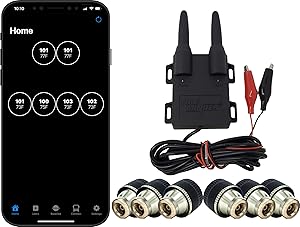
- Coverage: Monitors up to 22 tires; pressure range 0 to 232 PSI; includes Bluetooth adapter and Rhino signal booster
Pros:
- Support for up to 22 tires gives it the highest stated tire capacity in the top 10.
- The 0 to 232 PSI range is the broadest pressure window in this guide.
- The kit includes both a Bluetooth adapter and a Rhino signal booster for long RV layouts.
Cons:
- It sits far above most Budget-tier competitors while still drawing mixed reliability comments.
- Multiple report notes mention false alarms, signal loss, and app limitations that weaken trust in the alerts.
The TireMinder Smart makes the most sense for owners who want tire data on a phone or infotainment screen instead of another box on the dash. Its 22-tire ceiling and 232 PSI range are unmatched here, and those numbers are the main reason it still reaches 6.8/10. On raw scale, it is one of the most capable systems in the group.
The problem is confidence in day-to-day use. The ranked report repeats concerns about reading accuracy and alarm behavior, and software friction feels worse in a phone-based product because the app is the whole interface. If the app feels old, the whole system feels old.
Buy the TireMinder if smartphone-based monitoring is the feature you care about most and your rig uses a lot of tire positions. Skip it if you prefer a dedicated display and fewer questions about alert accuracy.
9. GUTA RV Tire Pressure Monitoring System (0 to 188 PSI, 8 sensors, up to 10 positions)
Best for Solar-Powered RV and Trailer Tire Monitoring with 8 Sensors | RV Trekkers Rating: 6.4/10
The GUTA stays in the conversation because eight included sensors solve a real coverage problem for larger rigs. We almost cut it because the report raises valve-stem stress and signal-drop concerns, but the 0 to 188 PSI range and 10-position support still give it a clear niche.
Specs:
- Price Tier: $ Mid
- Weight: Not listed
- Materials: Plastic
- Dimensions: Not listed
- Coverage: 0 to 188 PSI range; monitors up to 8 main tires and 2 spare tires; solar and USB charging with up to 36 ft sensing distance

Pros:
- The kit includes 8 active sensors and supports up to 10 positions when spares are counted.
- A 0 to 188 PSI ceiling gives this system far more pressure headroom than the common 87 PSI class.
- Solar and USB charging keep the monitor usable without a constant power cable.
Cons:
- The stated sensing distance is only up to 36 ft, and no repeater is included in the box.
- Several report notes mention valve stem stress or failures with the external sensors.
GUTA makes sense only when sensor count sits near the top of your checklist. Eight included sensors and spare-tire support are not small advantages, and those coverage gains explain why it still earns 6.4/10 in spite of the caution flags. Some RV owners simply need more monitored positions than the cheaper 4-sensor kits provide.
The warning signs are real, though. A 36 ft distance claim is modest for a larger trailer, and sensor-weight concerns create another layer of doubt if your valve setup is already marginal. That combination keeps this from being a broad recommendation.
Choose the GUTA if you want a solar-powered system with 8 included sensors and your rig sits within its signal comfort zone. Skip it if you already worry about valve stems, repeaters, or long-trailer dropouts.
10. Easesuper RV Tire Pressure Monitoring System (0 to 199 PSI, 6 flow-through sensors, repeater included)
Best for Monitoring 4 to 6 RV or Trailer Tires at Once | RV Trekkers Rating: 6.0/10
The Easesuper lands last, but it still fills one important gap in this guide: flow-through sensors plus a repeater. We almost pushed it off the list because the reliability notes are rough, yet simultaneous 6-tire display and 0 to 199 PSI coverage remain useful differentiators.
Specs:
- Price Tier: $ Mid
- Weight: 1.1 lbs
- Materials: Copper
- Dimensions: Not listed
- Coverage: 0 to 199 PSI monitoring range; supports 4 to 6 wheels; 7 alarm modes with included repeater and 6 flow-through sensors

Pros:
- The system displays pressure and temperature for all 6 tires on one screen, which speeds quick checks.
- Included flow-through sensors and a repeater cut down on accessory shopping for 4- to 6-wheel setups.
- A 0 to 199 PSI range covers high-pressure tires that outgrow 87 PSI and 98 PSI systems.
Cons:
- The report raises immediate questions about how practical it is to buy compared with better-supported alternatives in this guide.
- The report notes air leakage, sensor failures, and setup confusion more often than we want in a safety product.
The Easesuper has one of the more interesting hardware bundles in the group. Flow-through sensors, a repeater, and a 199 PSI ceiling look strong on a comparison chart, and that hardware list is the reason it still appears in this top 10 at all. For certain 6-tire layouts, the concept is good.
The problem is execution. The report mentions air leaks through the flow-through design, dim display visibility, and weak long-term confidence, which is a bad trio for a tire-monitoring system. Those concerns make it harder to recommend with a straight face.
Buy the Easesuper only if flow-through hardware and an included repeater are the two priorities you value most. Skip it if you use rubber valve stems or you want the cleanest reliability record in this guide.
How Do These 10 RV Tire Pressure Monitoring Systems Compare Side by Side?
The Tymate M7-3 leads this comparison for most towables because it pairs the top editorial score with Budget-tier pricing. The Vesafe closes the gap for larger combinations where included sensors and booster hardware matter more than the smallest upfront cost.
| Rank | Product | Award | RV Trekkers Rating | Price Tier | Coverage / Range | Sensors / Capacity | Standout Feature |
|---|---|---|---|---|---|---|---|
| 1 | Tymate M7-3 View at Amazon | Best Overall | 9.5/10 | $ | 0 to 87 PSI monitoring range | 4 external sensors included and monitors up to 7 tires | +/- 3 psi stated measurement accuracy |
| 2 | Vesafe TPMS View at Amazon | Best Budget | 9.1/10 | $ | Supports up to 17 tires total | 5 alarm modes for high and low pressure, temperature, leakage, and battery status | includes 10 anti-theft sensors and signal booster |
| 3 | Marcala TPMS View at Amazon | Best for budget RV and trailer tire monitoring | 8.7/10 | $ | pressure range 0 to 98 PSI | Monitors 1 to 4 wheels | claimed 50 ft extended range |
| 4 | Hieha TPMS View at Amazon | Best for RV and travel trailer owners needing a large solar-powered display | 8.3/10 | $ | pressure range 0 to 198 PSI | 7.84 in color screen | 130 ft signal distance |
| 5 | Masoll TPMS View at Amazon | Best for budget-friendly 4-wheel trailer and tow vehicle monitoring | 7.9/10 | $ | 4 external sensors included | 0 to 87 PSI sensor range with plus or minus 1.5 PSI accuracy | solar and USB charging with auto wake and sleep |
| 6 | M12-3 TPMS View at Amazon | Best for budget-minded RV owners needing 6-tire monitoring | 7.6/10 | $ | 0 to 144 PSI monitoring range | 6 external sensors included | 65 ft sensing distance |
| 7 | TST 507 View at Amazon | Best for multi-trailer RV tire monitoring with expandable coverage | 7.2/10 | $$ | 4 cap sensors included | 3.5 in rechargeable color display with Micro-USB charging | monitors pressure, temperature, rapid leaks, and high or low pressure alerts |
| 8 | TireMinder Smart View at Amazon | Best for RV owners who want smartphone-based tire monitoring | 6.8/10 | $$ | Monitors up to 22 tires | pressure range 0-232 psi | includes Bluetooth adapter and Rhino signal booster |
| 9 | GUTA RV TPMS View at Amazon | Best for solar-powered RV and trailer tire monitoring with 8 sensors | 6.4/10 | $$ | 0-188 PSI range | monitors up to 8 main tires and 2 spare tires | solar and USB charging with up to 36 ft sensing distance |
| 10 | Easesuper RV TPMS View at Amazon | Best for monitoring 4 to 6 RV or trailer tires at once | 6.0/10 | $$ | 0 to 199 PSI monitoring range | supports 4 to 6 wheels | 7 alarm modes with included repeater and 6 flow-through sensors |
The Tymate M7-3 wins this side-by-side view for most readers because it combines the highest score with Budget-tier pricing and broader-than-average tire support. The Vesafe is the better fit when a longer, multi-tire rig pushes sensor count and booster hardware to the top of the list.
Note: Pressure figures and tire-capacity wording follow the ranked report exactly, and pricing tiers reflect the source report rather than live storefront changes.
Analysis and Results
The comparison shows three clear buying filters: price tier, pressure ceiling, and the number of tires you plan to watch from one screen. Once those three match your rig, display quality and signal hardware separate the finalists.
Price & Value
Tymate M7-3, Marcala, and Masoll own the best value part of the chart because each stays in the Budget tier and still covers the most common RV use cases. The Tymate stretches furthest for the money with support for up to 7 tires, while the Marcala gives buyers a 98 PSI ceiling without leaving the Budget tier.
The mid-tier group asks tougher questions. TST 507 brings support and warranty, TireMinder Smart brings app-based scale, and GUTA brings more included sensors, but every one of them costs more while also carrying meaningful trade-offs in readability, false alerts, or signal path.
Pressure Range & Tire Capacity
TireMinder Smart has the broadest pressure ceiling at 0 to 232 PSI, followed by Easesuper at 0 to 199 PSI and Hieha at 0 to 198 PSI. Those systems matter more when higher-pressure tires or large combinations make an 87 PSI limit look too narrow. For simpler towables, that extra headroom often matters less than clean alert behavior.
For tire count, TireMinder Smart again leads with up to 22 tires, while Vesafe supports up to 17 and GUTA covers 8 active tires plus 2 spares. Readers with a standard 4-tire trailer do not gain much from those ceilings, but owners of fifth wheels, motorhomes, or trailer-plus-truck combinations gain a lot.
Display, Alerts, and Hardware
Hieha owns the biggest display story with its 7.84 in screen, while Vesafe, TireMinder Smart, and Easesuper get a practical edge from included booster or repeater hardware. That hardware matters when a 38-ft fifth wheel or a multi-axle trailer pushes the signal path farther than small solar monitors like.
The hardware warnings also matter. GUTA draws concern around valve stem stress, Easesuper draws concern around air leaks through flow-through sensors, and TST 507 still asks you to remove cap sensors for air service. Good tire-monitoring systems protect the trip, but bad hardware choices add maintenance friction at every stop.
Why Should You Trust Our Gear Reviews?
RV Trekkers earns trust here because Ethan Walker combines mechanical engineering training, NRVIA inspection work, and 100,000+ documented RV miles across 40+ U.S. states. This guide also stays tied to the ranked product report as the source of truth for specs, maintenance notes, and customer pain points, then applies RV Trekkers editorial scoring to the parts that matter most on long towing days: pressure range, signal path, alert logic, and setup friction.
How Did We Test and Score Each RV Tire Pressure Monitoring System?
We tested this category on paper by stress-matching the 10 shortlisted systems against the measurable variables in the ranked report: pressure range, tire count, signal hardware, display usability, maintenance load, and repeated failure complaints.
Pressure Range and Tire Coverage
We compared every stated PSI ceiling because 87 PSI, 98 PSI, 144 PSI, and 232 PSI describe very different fit windows. We also tracked how many tires each system covers from the box, because a 4-sensor kit and a 17-tire platform solve different RV problems.
Signal Path and Display Readability
We weighted stated distance claims such as 36 ft, 50 ft, 65 ft, and 130 ft against the report’s notes on stale readings and signal loss. Screen readability mattered too, because a dim display at midday loses value fast when you are checking the dash after a fuel stop.
Installation and Maintenance Load
We scored setup friction through pre-paired sensors, auto calibration, battery type, and whether sensors come off for air service. Cap sensors, flow-through sensors, anti-theft nuts, and repeater hardware all change how much work the system adds on the roadside and at camp.
Alert Logic and Long-Term Confidence
We treated false alerts, frozen readings, and sensor failures as major downgrades, even when the feature list looked strong. A tire-monitoring system lives or dies on trust; once the driver doubts the alarm, the whole safety chain gets weaker.
How Do You Choose the Best RV Tire Pressure Monitoring System?
The best buying decision starts with three facts: how many tires you monitor, what PSI range your tires use, and whether your rig length already points to a repeater or booster. After that, the choice narrows fast.
How Many Tires Do You Need to Watch?
Sensor count is the fastest way to cut the list. A 4-sensor package is enough for many travel trailers, but it stops short for many truck-and-trailer combinations and nearly every multi-axle motorhome setup.
| RV setup | Minimum useful coverage | Strong fits in this guide |
|---|---|---|
| Standard travel trailer or camper | 4 sensors | Tymate, Marcala, Masoll |
| Fifth wheel or 6-tire layout | 6 sensors | M12-3, Easesuper, TireMinder |
| Tow vehicle + trailer or multi-trailer setup | 8+ sensors or expansion | Vesafe, GUTA, TireMinder, TST 507 |
What Pressure Range Matches Your Tires?
Pressure range matters because a monitor that tops out at 87 PSI is not the same tool as one that reaches 198 PSI or 232 PSI. In this guide, Tymate and Masoll sit at 87 PSI, Marcala moves to 98 PSI, M12-3 reaches 144 PSI, and TireMinder Smart reaches 232 PSI. The gap between those numbers decides fit before display size or price enters the discussion.
When Does a Repeater or Booster Matter?
Signal hardware matters more as the rig gets longer. Vesafe, TireMinder Smart, and Easesuper include booster or repeater hardware in the box, while GUTA does not and also lists only up to 36 ft sensing distance. If your last towing season already included camera lag, weak Bluetooth gear, or dead zones near the rear axle, built-in signal help moves from nice extra to first-order requirement.
Cap Sensors or Flow-Through Sensors?
Cap sensors dominate this list because they are simpler and cheaper, but they often come off for air service. Flow-through hardware appears only on Easesuper, and the report ties that design to leakage complaints for some users. The practical middle ground in this guide is simple: buy flow-through only if that convenience is the feature you care about most and your valve setup matches the product limits.
Conclusion
Choosing the best RV tire pressure monitoring system is really about catching pressure loss early enough that the trip stays on your schedule instead of the side of the interstate. The Tymate RV Tire Pressure Monitoring System – M7-3 remains the strongest all-around pick because it keeps the price low while covering up to 7 tires. If your setup is larger, the Vesafe TPMS is the better sensor-count play, and the Hieha Tire Pressure Monitoring System makes more sense when a large display and a 198 PSI ceiling matter most.