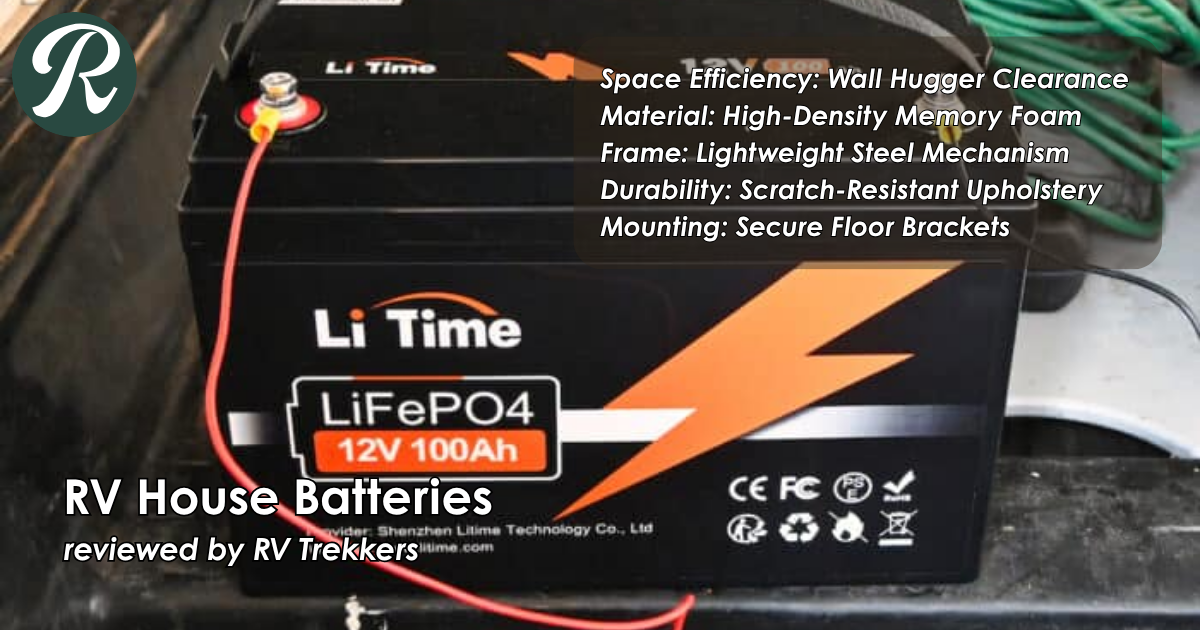
The best RV house battery keeps the RV electrical system running after shore power drops out, and it does that by storing energy for lights, vent fans, water pumps, furnace blowers, and inverter-fed appliances. This guide stays inside one topic: the RV power system, the battery bank, and the 10 deep-cycle storage units from the selected-products report that fit real travel-trailer, fifth-wheel, and off-grid camping use.
The Weize Deep Cycle AGM 12 Volt 100Ah Battery ranks first for balanced AGM value, while the Renogy Deep Cycle AGM 12 Volt 100Ah Battery is the stronger budget runner-up for buyers who care about wider temperature range and a longer warranty. Both 100Ah batteries target common RV house-battery jobs, and every RV Trekkers score below is an editorial rating based on performance, build quality, value, ease of use, and safety features rather than any retailer star system.
Contents
- What Is an RV House Battery?
- What Are the Quick Picks for the Best RV House Battery of 2026?
- Which Best RV House Battery Earns Each Spot in Our Ranking?
- 1. Weize Deep Cycle AGM 12 Volt 100Ah Battery (100Ah, AGM, 3% self-discharge)
- 2. Renogy Deep Cycle AGM 12 Volt 100Ah Battery (100Ah, AGM, 1100A max discharge)
- 3. LiTime 12V 100Ah RV Lithium Battery (100Ah, LiFePO4, 1.28kWh)
- 4. UPG Universal Power Group UB121000 12V 100Ah Battery (100Ah, AGM, sealed design)
- 5. dumfume 12V 100Ah LiFePO4 Lithium Battery (100Ah, LiFePO4, 6000+ cycles)
- 6. Vmaxtanks VMAXSLR125 AGM Sealed Deep Cycle 12V 125AH Battery (125Ah, AGM, 8-10 year float life)
- 7. Interstate Batteries 12V 110 AH SLA/AGM Deep Cycle Battery (110Ah, AGM, Group 29)
- 8. 12V 100Ah AGM Sealed Lead Acid Battery UB121000 Group 27 (100Ah, AGM, Group 27)
- 9. Redodo 12V 100Ah LiFePO4 Battery (100Ah, LiFePO4, 4000-15000 cycles)
- 10. 100Ah 12V Lithium-Ion (LiFePO4) Battery – Battle Born Batteries (100Ah, LiFePO4, internal BMS)
- How Do These 10 RV House Batteries Compare Side by Side?
- What Do the Comparison Results Say About the Best RV House Battery?
- Why Should You Trust Our Gear Reviews?
- How Did We Evaluate the Best RV House Battery Field?
- How Do You Choose the Best RV House Battery?
- What Is the Final Verdict?
What Is an RV House Battery?
An RV house battery is a deep-cycle power-storage unit that feeds the living-side electrical loads in an RV instead of cranking the engine.
In plain terms, this battery sits inside the coach power system and supports the 12V side of the rig. The key parts include the battery case, the terminals, the internal cells or lead plates, and, on lithium models, the battery management system that guards against overcharge, over-discharge, short circuit, and temperature stress.
This roundup stays focused on house batteries, not starter batteries. The shortlist splits into 5 AGM units and 5 LiFePO4 units, so it covers both the familiar lead-acid route and the lighter lithium route.
TL;DR: Weize is the best overall RV house battery for most buyers who want a proven 100Ah AGM at a budget price. LiTime is the better pick when 22.1-lb weight savings matters more than AGM familiarity, and Vmaxtanks adds 125Ah reserve for heavier off-grid use.
What Are the Quick Picks for the Best RV House Battery of 2026?
These 10 batteries cover the main RV house-battery lanes: budget AGM, lighter lithium, higher reserve, and premium protection.
1. Best Overall: Weize Deep Cycle AGM 12 Volt 100Ah Battery (100Ah, AGM, 3% self-discharge) ($ Budget)
↓ Jump to Review
2. Best Budget: Renogy Deep Cycle AGM 12 Volt 100Ah Battery (100Ah, AGM, 1100A max discharge) ($ Budget)
↓ Jump to Review
3. Best for reliable, lightweight off-grid power in RVs and marine applications: LiTime 12V 100Ah RV Lithium Battery (100Ah, LiFePO4, 22.1 lbs) ($ Mid)
↓ Jump to Review
4. Best for budget-conscious solar and off-grid power systems: UPG Universal Power Group UB121000 12V 100Ah (100Ah, AGM, sealed design) ($ Mid)
↓ Jump to Review
5. Best for budget-conscious RV and off-grid power systems: dumfume 12V 100Ah LiFePO4 Lithium Battery (100Ah, LiFePO4, 6000+ cycles) ($ Budget)
↓ Jump to Review
6. Best for Off-Grid RV and Solar Power Systems: Vmaxtanks VMAXSLR125 AGM Sealed deep Cycle 12V 125AH Battery (125Ah, AGM, 8-10 year float life) ($ Mid)
↓ Jump to Review
7. Best for off-grid and RV power systems: Interstate Batteries 12V 110 AH SLA/AGM Deep Cycle Battery (110Ah, AGM, Group 29) ($ Mid)
↓ Jump to Review
8. Best for RV and marine deep cycle applications: 12V 100Ah AGM Sealed Lead Acid Battery UB121000 Group 27 (100Ah, AGM, spill-proof) ($ Mid)
↓ Jump to Review
9. Best for Versatile Off-Grid Power Applications: Redodo 12V 100Ah LiFePO4 Battery (100Ah, LiFePO4, 4000-15000 cycles) ($ Mid)
↓ Jump to Review
10. Best Premium: 100Ah 12V Lithium-Ion (LiFePO4) RV – Battle Born Batteries (100Ah, LiFePO4, internal BMS) ($ Premium)
↓ Jump to Review
Which Best RV House Battery Earns Each Spot in Our Ranking?
The top of this ranking favors balanced 100Ah batteries, then branches into lighter lithium packs, heavier AGM reserve, and premium protection-focused options.
1. Weize Deep Cycle AGM 12 Volt 100Ah Battery (100Ah, AGM, 3% self-discharge)
Best Overall | RV Trekkers Rating: 9.5/10
Weize takes the top spot because it covers the most common RV house-battery job: a maintenance-free 100Ah AGM battery at a budget-tier price without strange fitment or charging demands.
Specs:
- Price Tier: $ Budget
- Weight: 57 lbs
- Materials: Lead-Acid, AGM, rugged ABS container
- Dimensions: 12.99 in L x 6.73 in W x 8.43 in H
- Battery Detail: 1150A max discharge current and 3% monthly self-discharge

Pros:
- The 3% monthly self-discharge rate helps this battery sit through 30-day storage stretches better than many basic AGM units.
- The 57-lb case is 6.9 lbs lighter than the Renogy AGM and 18 lbs lighter than the 75-lb Vmaxtanks in this guide.
- The 12.99 x 6.73 x 8.43 in footprint fits the common 100Ah replacement lane for RV battery trays.
Cons:
- The 57-lb case still feels heavy compared with the 22.1-lb LiTime and the 22.05-lb dumfume lithium options.
- The source report notes mixed long-term charge-retention results and a hazmat return limit on non-defective returns.
Weize wins because it balances budget pricing, a common 100Ah capacity target, and familiar AGM charging behavior without pushing buyers into a lithium conversion. Its 57-lb mass is not light, but it is still easier to manage than the 63.9-lb Renogy or the 75-lb Vmaxtanks. That broad fit is the main reason we scored it 9.5 — no other battery here covers as many normal RV house-power situations at this price tier.
We almost skipped it because heavy AGM blocks with hazardous-material return limits turn any bad unit into a bigger headache. The 57-lb case adds clear installation burden in a front compartment, but the sealed design still keeps routine use cleaner and simpler than a flooded battery setup.
The real trade-off is long-term certainty. The report flags mixed longevity feedback and some early failures, so this is not the right battery bank choice for buyers chasing the longest cycle life or the lowest tray weight. Buy this if you want a proven, maintenance-free AGM house battery for a normal 12V RV setup. Skip this if 57 lbs or hazmat return rules sound like a bad match.
2. Renogy Deep Cycle AGM 12 Volt 100Ah Battery (100Ah, AGM, 1100A max discharge)
Best Budget | RV Trekkers Rating: 9.1/10
Renogy earns the budget slot because it adds a wider published discharge range and a 2-year prorated warranty while keeping the familiar 100Ah AGM format.
Specs:
- Price Tier: $ Budget
- Weight: 63.9 lbs
- Materials: Lead-Acid, AGM
- Dimensions: 13.1 in L x 6.9 in W x 8.6 in H
- Battery Detail: 1100A max discharge current and -4 to 140 degrees F discharge range

Pros:
- The published -4 to 140 degrees F discharge range is the clearest temperature figure among the AGM batteries in this roundup.
- The 2-year prorated warranty is 1 year longer than the Weize and UPG warranty terms listed in the source report.
- The 1100A max discharge current keeps the battery in play for heavier 12V appliance demand than many entry-level sealed batteries.
Cons:
- The 63.9-lb case is 6.9 lbs heavier than the top-ranked Weize and 41.8 lbs heavier than LiTime.
- The source report says the M8 terminals may require hardware changes for standard 3/8 in cable setups.
Renogy stays near the top because it handles the classic RV trade-off well: you get 100Ah, AGM simplicity, and more explicit safety and temperature guidance than the average budget battery. The score lands at 9.1 because the published discharge range and longer warranty push confidence higher, even though the usable depth of discharge remains more limited than the lithium options.
Fair warning: this is a dense battery. The 63.9-lb weight and M8 terminal setup can add installation friction in a cramped battery box, especially for owners expecting more standard hardware.
The drawback sits in daily use below 50% state of charge. Renogy asks owners to avoid deeper discharge to protect cycle life, and that reduces usable reserve compared with lithium power packs. Buy this if you want an AGM house battery with clearer temperature guidance and stronger warranty coverage than the Weize. Skip this if your cables already assume 3/8 in studs or you want to drain deeper than 50%.
3. LiTime 12V 100Ah RV Lithium Battery (100Ah, LiFePO4, 1.28kWh)
Best for reliable, lightweight off-grid power in RVs and marine applications | RV Trekkers Rating: 8.7/10
LiTime stands out because it cuts house-battery weight to 22.1 lbs while adding 1.28kWh storage, a built-in 100A BMS, and a cycle-life claim that stretches far past AGM territory.
Specs:
- Price Tier: $ Mid
- Weight: 22.1 lbs
- Materials: Lithium Iron Phosphate (LiFePO4)
- Dimensions: 13 in L x 6.77 in W x 8.5 in H
- Battery Detail: Up to 15000 deep cycles and built-in 100A BMS

Pros:
- The 22.1-lb shell is 34.9 lbs lighter than the Weize AGM and 41.8 lbs lighter than the Renogy AGM.
- The battery claims up to 15000 deep cycles at lighter depth-of-discharge use, which is far beyond the lifespan language in the AGM group.
- The built-in 100A BMS adds overcharge, over-discharge, short-circuit, and temperature protection in one compact case.
Cons:
- The standard model lacks low-temperature charging protection or self-heating, and the report says charging below 32 degrees F is a problem.
- The battery requires a LiFePO4-compatible charger in the 14.2 to 14.6V range, which adds setup checks many AGM owners never deal with.
LiTime earns third because it changes the ownership experience more than any AGM battery here. Carrying a 22.1-lb power pack instead of a 57-lb or 63.9-lb block saves strain every time the battery tray comes apart, and the 1.28kWh capacity still fits the standard 100Ah conversation. That weight-to-capacity balance is why we scored it 8.7 — it feels like a real RV upgrade, not just a chemistry change.
We almost pushed it higher, then the cold-weather limitation stopped us. The low 22.1-lb weight is a major install advantage in a tight compartment, but the lack of low-temperature charge protection keeps it out of the top two.
The bigger question is system readiness. This lithium pack makes the most sense when the charger, solar controller, and cold-weather plan already line up with LiFePO4 rules. Buy this if tray weight and long cycle life matter more than AGM familiarity. Skip this if your RV spends mornings below freezing or still uses generic lead-acid charging hardware.
4. UPG Universal Power Group UB121000 12V 100Ah Battery (100Ah, AGM, sealed design)
Best for budget-conscious solar and off-grid power systems | RV Trekkers Rating: 8.3/10
UPG makes the list because it keeps the 100Ah AGM formula simple, sealed, and flexible for RV, marine, and solar use, even though the current source report does not publish a live price.
Specs:
- Price Tier: $ Mid
- Weight: 60 lbs
- Materials: Sealed Lead Acid, Absorbent Glass Mat, high-strength calcium alloy grid
- Dimensions: 12.17 in L x 6.61 in W x 9.16 in H
- Battery Detail: Maintenance-free VRLA design with flexible mounting

Pros:
- The 12.17-in length is 0.82 in shorter than the Weize and 0.93 in shorter than the Renogy, which helps in tighter battery boxes.
- The sealed AGM design supports float, cyclic, and everyday use without water checks or spill concerns.
- The source report calls out UL recognition and a USA-based support team, which is more support detail than several rivals provide.
Cons:
- The 60-lb case remains far heavier than the 22-lb lithium options in this guide.
- The source report lists the price as unavailable, so buyers lose one of the easiest comparison points before checkout.
UPG works best for buyers who still want AGM chemistry but care about installation flexibility and a shorter case. The 8.3 score comes from that mix of sealed design, strong application range, and clean 100Ah spec sheet, balanced against mixed durability feedback and the missing current price data.
We almost skipped it because a missing live price dulls the value story. The calcium-alloy-grid construction and sealed AGM format fit a practical off-grid setup, but the report also warns against equalization-stage charger settings, so setup details still matter.
This battery makes sense for RV owners who already understand sealed AGM charging and want a compact 100Ah block with broad use cases. Skip it if you want the lightest battery bank, the deepest discharge profile, or a source report with complete price visibility.
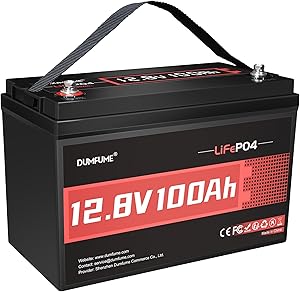
5. dumfume 12V 100Ah LiFePO4 Lithium Battery (100Ah, LiFePO4, 6000+ cycles)
Best for budget-conscious RV and off-grid power systems | RV Trekkers Rating: 7.9/10
dumfume earns its place because it pairs 22.05-lb carry weight with 1.28kWh capacity and a 6000+ cycle claim at a budget-tier price.
Specs:
- Price Tier: $ Budget
- Weight: 22.05 lbs
- Materials: ABS casing with Lithium Iron Phosphate cells
- Dimensions: 12.8 in L x 6.5 in W x 8.46 in H
- Battery Detail: Built-in 100A BMS and 6000+ deep cycles at 80% DOD
Pros:
- The 22.05-lb case is the lightest battery in this roundup by 0.05 lbs over LiTime.
- The battery claims 6000+ cycles at 80% DOD and 15000+ cycles at 60% DOD, which is strong longevity for a budget-tier lithium pack.
- The 4S4P expansion support gives buyers a path to larger battery-bank builds without changing brands at the first upgrade.
Cons:
- The report says charging performance drops below 5 degrees C, and the case is not waterproof.
- The source report flags mixed charge-retention feedback and some weak customer-service experiences.
The appeal is easy to see: this is one of the least expensive ways to get into a light lithium house battery without giving up 100Ah capacity. That 22.05-lb weight and 1.28kWh energy figure are the main reasons we scored it 7.9 — it packs a lot of storage into a carry-friendly shell, but the cold-weather and service questions hold it back.
We almost skipped it because budget lithium often saves money in exactly the areas that show up later, like documentation, support, or weather sealing. The 22.05-lb weight and ABS casing help keep installation manageable, but that does not erase the cold-charge limits.
This battery fits mild-climate RV owners who want lighter off-grid power without premium pricing. It is less convincing for buyers who camp in wet or freezing conditions and expect polished support. Buy this if low carry weight and lithium value lead the list. Skip this if you need waterproof confidence or dependable charging below 5 degrees C.
6. Vmaxtanks VMAXSLR125 AGM Sealed Deep Cycle 12V 125AH Battery (125Ah, AGM, 8-10 year float life)
Best for Off-Grid RV and Solar Power Systems | RV Trekkers Rating: 7.6/10
Vmaxtanks ranks for buyers who want more AGM reserve than the 100Ah crowd, because it brings 125Ah capacity, military-grade custom plates, and an 8-10 year float-service claim.
Specs:
- Price Tier: $ Mid
- Weight: 75 lbs
- Materials: Lead-Acid, AGM
- Dimensions: 12.9 in W x 6.8 in D x 8.7 in H
- Battery Detail: Group 31 AGM with military-grade custom plates

Pros:
- The 125Ah rating is the highest published capacity among the AGM batteries in this guide.
- The 8-10 year float-service claim is the strongest longevity statement in the AGM group.
- The sealed design avoids fumes and spills while still aiming at heavier off-grid reserve than the 100Ah options.
Cons:
- The 75-lb case is the heaviest battery in this roundup and 52.9 lbs heavier than LiTime.
- The source report says smart-charger discipline matters here, which adds setup pressure for casual owners.
Vmaxtanks is the battery for buyers who want extra AGM reserve and trust heavier hardware more than lighter lithium chemistry. The added 25Ah over the standard 100Ah field is not trivial in a house-power setup, and the score lands at 7.6 because the reserve and build claims are strong even though the handling burden is real.
Hauling a 75-lb block into a battery tray is not a casual swap. We almost pushed it lower for that alone. That physical burden matters just as much as the spec sheet when an RV battery compartment has limited access.
The other caution is charging precision. The report says overcharging or deep discharging hurts longevity, so this battery rewards owners who already run a smart charger and monitor storage closely. Buy this if you want higher-capacity AGM reserve for a solar-fed RV or cabin-style setup. Skip this if weight, lifting strain, or charger babysitting already irritates you.
7. Interstate Batteries 12V 110 AH SLA/AGM Deep Cycle Battery (110Ah, AGM, Group 29)
Best for off-grid and RV power systems | RV Trekkers Rating: 7.2/10
Interstate stays in the conversation because it offers 110Ah capacity, a professional-grade positioning, and a familiar AGM layout from a battery-focused brand.
Specs:
- Price Tier: $ Mid
- Weight: 71.5 lbs
- Materials: Sealed Lead Acid (AGM)
- Dimensions: 13.31 in L x 6.69 in W x 8.54 in H
- Battery Detail: Group 29 case and 12-month performance warranty

Pros:
- The 110Ah rating gives 10Ah more reserve than the standard 100Ah batteries around it.
- The 71.5-lb case still stays 3.5 lbs lighter than the 75-lb Vmaxtanks despite the added capacity.
- The source report points to a 7-point quality protocol, which is more manufacturing detail than many rivals share.
Cons:
- The 12-month warranty is shorter than the 2-year Renogy coverage and far shorter than the lithium warranties in this guide.
- The 71.5-lb case remains brutally heavy for solo battery swaps in cramped RV compartments.
Interstate lands in the middle because the extra 10Ah and the battery-brand reputation help, but the warranty and weight keep the overall value in check. That is why the score sits at 7.2 — it looks dependable enough for a conservative AGM buyer, yet it does not separate itself enough to challenge the leaders.
We almost skipped it because the numbers create an awkward middle lane. The 71.5-lb weight and insert-terminal layout can make installation more labor intensive than the spec sheet first suggests.
This is a sensible pick for buyers who want a 110Ah AGM from a known battery company and do not mind a shorter warranty. Buy it if extra reserve matters more than price-per-pound efficiency. Skip it if you want lighter hardware, deeper lithium-style discharge, or longer coverage.
8. 12V 100Ah AGM Sealed Lead Acid Battery UB121000 Group 27 (100Ah, AGM, Group 27)
Best for RV and marine deep cycle applications | RV Trekkers Rating: 6.8/10
This Group 27 AGM battery makes the list because it covers standard RV house loads well, even though the source report flags mixed lifespan results and a missing live price.
Specs:
- Price Tier: $ Mid
- Weight: 63.93 lbs
- Materials: Lead-Acid, AGM
- Dimensions: 12.17 in D x 6.61 in W x 9.16 in H
- Battery Detail: Maintenance-free, spill-proof 100Ah Group 27 case

Pros:
- The report says it powers lights, a furnace, and a water pump well, which matches normal RV house-battery demand.
- The 12.17 x 6.61 x 9.16 in case mirrors the UPG dimensions and fits a compact AGM replacement lane.
- The spill-proof AGM layout removes electrolyte checks and supports flexible mounting.
Cons:
- The 63.93-lb case is only 0.03 lbs heavier than Renogy, so the lifting burden stays high.
- The report flags voltage-drop issues on higher-wattage inverter loads and says the included terminal bolts may be too short.
This battery works for simpler coach loads, and that narrower use case shapes the 6.8 rating. It keeps the familiar AGM strengths, but the source report also points to shorter service life in some installs and weaker performance when larger inverter loads enter the picture.
We almost skipped it because the details sound like a battery that behaves well right up until the system gets more demanding. The short terminal-bolt note is exactly the kind of installation detail that can slow a battery swap.
The takeaway is clear: this is a reasonable fit for lights, furnace duty, and moderate RV power draw. It is less convincing for buyers building around larger inverter loads or long service intervals. Buy this if you want a plain 100Ah AGM for ordinary coach circuits. Skip this if you already know your battery bank feeds high-draw appliances.
9. Redodo 12V 100Ah LiFePO4 Battery (100Ah, LiFePO4, 4000-15000 cycles)
Best for Versatile Off-Grid Power Applications | RV Trekkers Rating: 6.4/10
Redodo stays relevant because it mixes moderate 25.35-lb weight, a broad 4000-15000 cycle claim, and 4S4P expansion support in a versatile lithium package.
Specs:
- Price Tier: $ Mid
- Weight: 25.35 lbs
- Materials: Lithium Iron Phosphate cells
- Dimensions: 13 in W x 6.77 in D x 8.43 in H
- Battery Detail: Built-in 100A BMS and 10-year lifetime claim

Pros:
- The 25.35-lb case is 38.55 lbs lighter than the 63.9-lb Renogy AGM and 49.65 lbs lighter than Vmaxtanks.
- The 4000-15000 cycle range and 10-year lifetime claim point to far longer service than the AGM field.
- The battery supports series and parallel builds up to 4S4P, which gives flexible battery-bank expansion.
Cons:
- The source report says this battery lacks built-in low-temperature charging protection.
- Its premium-tier pricing sits well above the budget lithium dumfume and the budget AGM Weize.
Redodo feels like a lithium battery that checks many of the right boxes, then loses ground on value and winter readiness. The 6.4 score reflects that split: the weight savings, long-life claim, and expansion options look strong, but the price and missing low-temp safeguard make the package less convincing than the higher-ranked lithium options.
The lower carry weight is a clear install advantage over a 60-plus-pound AGM block, especially in a narrow front bay. We almost ranked it higher for that alone, but cold-weather planning is part of RV ownership, and this battery leaves more of that work to the owner.
This battery fits buyers who want a mid-priced lithium pack with good expansion headroom and a modest carry burden. It is a weaker fit for shoulder-season campers who wake up to freezing battery-bay temperatures. Buy this if you want lighter lithium power and future 4S4P growth. Skip this if low-temperature charging protection is non-negotiable.
10. 100Ah 12V Lithium-Ion (LiFePO4) Battery – Battle Born Batteries (100Ah, LiFePO4, internal BMS)
Best Premium | RV Trekkers Rating: 6.0/10
Battle Born lands in the premium slot because it combines internal BMS protection, high and low temperature safeguards, and a fast-charging LiFePO4 design, even though the asking price is far above the rest of the field.
Specs:
- Price Tier: $ Premium
- Weight: 31 lbs
- Materials: Lithium Iron Phosphate chemistry with cylindrical cells
- Dimensions: 6.86 in D x 12.76 in W x 8.95 in H
- Battery Detail: Internal BMS with temperature, voltage, and short-circuit protection

Pros:
- The built-in BMS covers low-temperature, high/low-voltage, and short-circuit protection in one premium package.
- The battery claims 3000-5000 deep discharge cycles and 10-15 years of service life.
- The source report says charging is up to 5 times faster than traditional lead-acid batteries.
Cons:
- Its premium-tier pricing is far above the Weize and dumfume options in this guide.
- The report notes that a BMS cutoff can require an MPPT controller jump-start, and terminal placement may complicate fuse installs.
Battle Born is a premium product in the strictest sense: it brings real protection hardware and long-life lithium positioning, but the price pushes it into a much smaller buyer pool. That is why the score stops at 6.0 — the safety story is good, yet the dollars-per-amp-hour equation is the toughest in this roundup.
We almost dropped it off the list because the price is the first thing anyone notices. The 31-lb case is still more manageable than a 60-lb AGM brick, but the terminal layout may require extra planning before adding a catastrophic fuse or tight cable bend. Premium parts do not erase install geometry.
This battery makes sense for buyers who put premium protections and brand positioning ahead of pure value. It makes less sense for shoppers who just want the most usable RV house battery capacity for the least money. Buy this if you accept the price and want the full protection package. Skip this if budget, simple MPPT behavior, or fuse clearance already drives the decision.
How Do These 10 RV House Batteries Compare Side by Side?
Weize wins the broadest value case, LiTime wins the weight battle, and Vmaxtanks brings the most AGM reserve.
| # | Product | Award | RV Trekkers Rating | Price Tier | Chemistry | Capacity | Weight | Longevity Claim | Charging / Cold Note |
|---|---|---|---|---|---|---|---|---|---|
| → 1 | Weize 100Ah AGM View at Amazon | Best Overall | 9.5/10 | $ | AGM | 100Ah | 57 lbs | 3% monthly self-discharge | Standard AGM storage guidance |
| 2 | Renogy 100Ah AGM View at Amazon | Best Budget | 9.1/10 | $ | AGM | 100Ah | 63.9 lbs | 2-year prorated warranty | -4 to 140 degrees F discharge range |
| 3 | LiTime 100Ah RV Lithium View at Amazon | Best lightweight off-grid pick | 8.7/10 | $$ | LiFePO4 | 100Ah / 1.28kWh | 22.1 lbs | Up to 15000 cycles | Avoid charging below 32 degrees F |
| 4 | UPG UB121000 View at Amazon | Best solar/off-grid AGM value | 8.3/10 | $$ | AGM | 100Ah | 60 lbs | — | No equalization-stage charger setting |
| 5 | dumfume 100Ah LiFePO4 View at Amazon | Best budget lithium value | 7.9/10 | $ | LiFePO4 | 100Ah / 1.28kWh | 22.05 lbs | 6000+ cycles at 80% DOD | Performance requires 5 degrees C or higher |
| 6 | Vmaxtanks VMAXSLR125 View at Amazon | Best higher-capacity AGM | 7.6/10 | $$ | AGM | 125Ah | 75 lbs | 8-10 year float service life | Smart charger recommended |
| 7 | Interstate DCM0100 View at Amazon | Best branded 110Ah AGM | 7.2/10 | $$ | AGM | 110Ah | 71.5 lbs | 12-month warranty | Standard AGM use and recycle guidance |
| 8 | UB121000 Group 27 View at Amazon | Best for moderate coach loads | 6.8/10 | $$ | AGM | 100Ah | 63.93 lbs | 1-year warranty | Voltage drop on larger inverters noted |
| 9 | Redodo 100Ah LiFePO4 View at Amazon | Best versatile lithium | 6.4/10 | $$ | LiFePO4 | 100Ah | 25.35 lbs | 4000-15000 cycles, 10-year lifetime | No built-in low-temp charging protection |
| 10 | Battle Born 100Ah LiFePO4 View at Amazon | Best Premium | 6.0/10 | $$$ | LiFePO4 | 100Ah | 31 lbs | 3000-5000 cycles | Internal high/low temp protection |
Weize wins this comparison for most RV owners because it combines a 9.5/10 editorial score, Budget pricing, and a plain 100Ah AGM format that fits common battery-bank upgrades. LiTime is the smarter buy when tray weight matters more than AGM familiarity.
Note: Capacities, weights, and charging notes match the selected-products report. UPG and UB121000 Group 27 were listed without a current live price in the source. Prices and tiers were reviewed in March 2026 and are subject to change.
What Do the Comparison Results Say About the Best RV House Battery?
The table shows 4 clear decision points: chemistry, tray weight, reserve capacity, and cold-weather charging rules.
Chemistry & Weight
The chemistry split changes the whole ownership experience. LiTime, dumfume, and Redodo all sit between 22.05 lbs and 25.35 lbs, while the AGM field starts at 57 lbs and climbs to 75 lbs. That gap matters in tight RV battery compartments where access and cable slack are limited.
The AGM side still has appeal because the charging behavior feels more familiar to owners running older converters or lead-acid profiles. Weize and Renogy stay popular because they ask less from the charging system, even though they ask much more from your back.
Capacity & Reserve
Reserve separates the middle of the list more than price does. Vmaxtanks leads the AGM field at 125Ah, while Interstate follows at 110Ah and the rest of the leaderboard clusters around 100Ah. That makes Vmaxtanks the better match for buyers who want more lead-based reserve without moving to lithium chemistry.
The lithium group keeps reserve flatter, but the lower carry weight changes how usable that reserve feels in a real RV. LiTime delivers the same 100Ah headline as many AGM units while shedding more than 34 lbs compared with Weize. For many rigs, that payload relief matters as much as another 10Ah or 25Ah.
Longevity & Value
The long-life story belongs to lithium. LiTime and Redodo publish the broadest cycle-life claims, and dumfume also gives a strong 6000+ cycle figure at 80% DOD. That is the main reason those batteries stay relevant even when their prices climb above entry-level AGM units.
AGM value still matters because purchase price and system simplicity are real constraints. Weize keeps the value crown because it combines Budget pricing with the highest score in the list. Renogy trails closely because its longer warranty and published discharge range offset some of the extra weight.
Charging Limits & Cold Mornings
Charging rules are where several batteries separate fast. Renogy publishes the most explicit AGM temperature range, while LiTime, dumfume, and Redodo all carry some version of cold-weather caution. For RV owners who chase shoulder seasons, that caution belongs near the top of the checklist, not in the footnotes.
Battle Born brings the strongest built-in protection story, but the premium price makes the value equation harsh. LiTime stays the more balanced lithium pick because the weight and cycle-life upside are huge, even though it still needs a warmer charging plan than many owners expect.
Why Should You Trust Our Gear Reviews?
You can trust this guide as an editorial comparison built from the selected-products report and published product specs rather than retailer star data.
This guide focuses on the details that matter most for RV battery selection: tray fit, charging compatibility, reserve planning, warranty terms, and the practical difference between a 22-lb lithium pack and a 75-lb AGM block.
How Did We Evaluate the Best RV House Battery Field?
We evaluated these batteries against 4 RV-house-power checks drawn from the selected-products report: fit, carry burden, charging rules, and reserve planning.
Tray Fit & Carry Burden
We compared every published dimension against common RV battery-tray constraints and the tighter fitment limits often seen in travel trailers. If a battery is longer, taller, or wider than the common 100Ah lane, it loses ease-of-use points fast.
Weight got the same treatment. A 22-lb lithium pack and a 75-lb AGM brick create very different handling burdens, so we treated published weight as a primary ownership metric instead of a side note. Missing weight data would have been a hard deduction, which is why every battery with a published number gained or lost ground here.
Charging Rules & Storage Behavior
We checked the charging notes like an owner preparing for a real season of use. That meant looking at low-temperature limits, self-discharge claims, smart-charger requirements, equalization warnings, and depth-of-discharge guidance.
This is where several batteries separated. Renogy’s -4 to 140 degrees F discharge range, Weize’s 3% monthly self-discharge, and the lithium warnings about subfreezing charging all shape day-to-day ownership more than a flashy product title does.
Reserve Planning for Real RV Loads
We compared batteries through common coach-load scenarios rather than vague “off-grid” language. The baseline use case was a night of lights, furnace cycling, water pump use, and device charging, followed by the heavier case of inverter use layered on top.
That lens helped clarify why 125Ah matters on Vmaxtanks, why 110Ah gives Interstate some middle-ground appeal, and why several 100Ah batteries still dominate once weight and price enter the conversation. House batteries do not live in a vacuum. They live inside a battery bank that has to carry real loads after sunset.
Ownership Friction After Install
We also scored what happens after the lugs are tight: warranty terms, hardware oddities, customer-service notes, and the small issues that consume an afternoon in camp. Short terminal bolts, M8 post fitment, hazmat return limits, and MPPT restart quirks all belong in the scoring because they shape the ownership experience.
This is the part many reviews skip. A house battery is not just a chemistry lesson. It is something you lift, wire, store, monitor, and troubleshoot in dirt, heat, or cold. That is why the RV Trekkers ratings stay tied to practical use instead of one-line marketing claims.
How Do You Choose the Best RV House Battery?
The right battery matches 4 things: chemistry, tray weight, reserve target, and charging conditions.
Decide Between AGM and LiFePO4 First
AGM batteries fit owners who want familiar charging behavior and lower entry complexity. LiFePO4 batteries fit owners who want lower tray weight, longer cycle-life claims, and deeper-use potential.
| Battery type | What it does well | What it gives up | Best examples from this guide |
|---|---|---|---|
| AGM | Familiar charging, sealed design, lower entry cost | Heavy weight, lower usable depth of discharge | Weize, Renogy, Vmaxtanks |
| LiFePO4 | Lower carry weight, long cycle-life claims, built-in BMS | More charging-rule checks, more cold-weather caution | LiTime, dumfume, Redodo |
That first choice clears up most of the shortlist fast. If your converter and solar setup already support lithium, the 22-lb class looks very attractive. If your rig still runs old-school charging hardware, AGM remains the safer plug-and-play path.
Match Capacity and Weight to the Battery Bay
Capacity is only part of the answer. A 125Ah battery looks better on paper than a 100Ah battery, but that extra reserve arrives with more lifting strain when the battery is an AGM block. Vmaxtanks proves the point at 75 lbs.
For many RV owners, the better move is not the biggest number. It is the battery that fits the tray, the cables, and your body. LiTime and dumfume both keep the weight around 22 lbs, which changes installation and service more than a small capacity increase does.
Check Charging Limits, Terminals, and Warranty Before Buying
The most expensive battery mistake usually starts with one missed setup detail. The key checks are simple:
- Confirm terminal type and hardware size.
- Confirm low-temperature charging limits.
- Confirm charger or controller compatibility.
- Confirm warranty length and return restrictions.
Those 4 checks explain most of the movement in this ranking. Renogy gains points on warranty and published temperature range. LiTime loses points on cold-weather charging. Battle Born loses points on price and MPPT restart friction. The best RV house battery is the one that matches the whole system, not just the headline spec.
What Is the Final Verdict?
The best RV house battery for most buyers in this field is the Weize Deep Cycle AGM 12 Volt 100Ah Batterybecause it gives the broadest mix of score, price, capacity, and familiar AGM ownership.
The LiTime 12V 100Ah RV Lithium Battery is the smarter alternative when carry weight and long cycle life matter more than AGM simplicity. The Vmaxtanks VMAXSLR125 AGM Sealed deep Cycle 12V 125AH Battery is the higher-reserve AGM pick for heavier off-grid use. The Renogy Deep Cycle AGM 12 Volt 100Ah Battery stays close behind as the better budget choice for buyers who care about temperature range and longer coverage.
That is the real answer to the best RV house battery question: buy the battery that fits your tray, your charging hardware, and your camping temperatures instead of chasing one oversized spec line.