The best RV WiFi booster extends an existing campground or home wireless network farther into an RV without replacing the main router. This guide follows the RV internet stack from the upstream connection to the signal booster to the repeater, mesh node, antenna, Ethernet port, and PoE hardware that shape usable range.
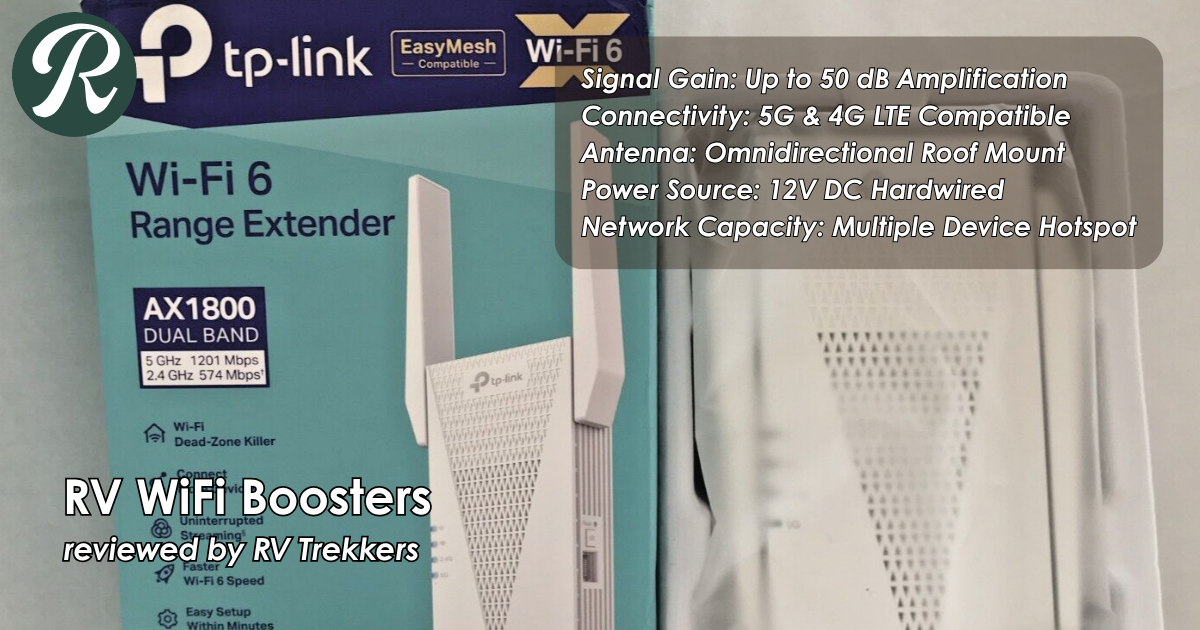
The TP-Link RE615X AX1800 WiFi 6 Range Extender ranks first because it pairs dual-band WiFi 6 with 2,100 sq. ft. of published coverage, 64-device support, and a Gigabit Ethernet port, while the 2026 AX1800 WiFi 6 Outdoor WiFi Extender is the budget outdoor pick for exposed installs with IP67 hardening and PoE. Both top picks use dual-band WiFi 6, but they solve different RV internet problems, and every RV Trekkers score below is an editorial rating based on performance, build quality, value, ease of use, and feature set.
Contents
- What Is an RV WiFi Booster?
- What Are the Quick Picks for the Best RV WiFi Booster of 2026?
- Which Best RV WiFi Booster Earns Each Spot in Our Ranking?
- 1. TP-Link RE615X AX1800 WiFi 6 Range Extender (AX1800, 2,100 sq. ft., Gigabit Ethernet)
- 2. 2026 AX1800 WiFi 6 Outdoor WiFi Extender (WiFi 6, IP67, PoE, multi-mode)
- 3. WAVLINK AC600 Outdoor WiFi Extender (AC600, IP67, PoE, 3-in-1 modes)
- 4. NETGEAR WiFi Mesh Range Extender EX5000 (AC1200, 1,000 sq. ft., 15 devices)
- 5. Mugatol AX3000 Outdoor WiFi 6 Extender (AX3000, IP67, 5 antennas, PoE)
- 6. ASUS RP-AX56 AX1800 Repeater & Range Extender (AX1800, 2,200 sq. ft., AiMesh)
- 7. 1200Mbps Dual Band WiFi Extender (12,880 sq. ft., 1200Mbps, 105 devices)
- 8. Amazon eero 6 mesh wifi add-on extender (Wi-Fi 6, 1,500 sq. ft., eero-only)
- 9. C. Crane CC Vector Extended Long Range WiFi Receiver System (15 dBi antenna, dual-band, 40 Mbps)
- 10. KING KF1001 Falcon Automatic Directional WiFi Antenna (auto-aiming antenna, dual-band router, app setup)
- How Do These 10 Best RV WiFi Booster Options Compare Side by Side?
- What Do the Comparison Results Say About the Best RV WiFi Booster?
- Why Should You Trust Our Gear Reviews?
- How Did We Evaluate the Best RV WiFi Booster Options?
- How Do You Choose the Right RV WiFi Booster?
- What Is the Final Verdict on the Best RV WiFi Booster?
What Is an RV WiFi Booster?
An RV WiFi booster is a repeater or range extender that rebroadcasts an existing wireless signal so laptops, TVs, phones, and work gear stay connected farther from the source.
In RV terms, that networking device sits between a weak upstream connection and the gadgets inside the coach. The shortlist here includes 3 main subtypes: wall-plug repeaters such as the TP-Link and NETGEAR units, weather-rated outdoor access points such as the 2026 and Mugatol models, and directional antenna systems such as C. Crane and KING. The working parts matter too: antennas, Ethernet ports, PoE injectors, mesh radios, and setup apps all change how the wireless system behaves once the RV is parked.
This roundup stays on one topic: boosters that extend an existing WiFi network. It does not cover cellular hotspots, travel routers, or passive ventilation-style fixes that do nothing for campground internet.
TL;DR: TP-Link RE615X is the best RV WiFi booster for most rigs, the 2026 AX1800 is the better outdoor budget pick, and C. Crane is the specialist for distant source signals. Match the booster to outlet style, weather exposure, and source signal strength before buying.
What Are the Quick Picks for the Best RV WiFi Booster of 2026?
These 10 boosters are the only shortlisted models that cleared the ranking filters for this keyword.
1. Best Overall: TP-Link RE615X AX1800 WiFi 6 Range Extender (AX1800, 2,100 sq. ft., Gigabit Ethernet) ($ Budget)
↓ Jump to Review
2. Best Budget: 2026 AX1800 WiFi 6 Outdoor WiFi Extender (WiFi 6, IP67, PoE) ($ Budget)
↓ Jump to Review
3. Best for extending WiFi to remote outdoor areas like RVs, campsites, and large yards: WAVLINK AC600 Outdoor WiFi Extender (AC600, IP67, PoE) ($ Budget)
↓ Jump to Review
4. Best for extending WiFi coverage in small to medium-sized areas: NETGEAR WiFi Mesh Range Extender EX5000 (AC1200, 1,000 sq. ft., 15 devices) ($ Budget)
↓ Jump to Review
5. Best for extending WiFi coverage in large outdoor areas and challenging environments: Mugatol AX3000 Outdoor WiFi 6 Extender (AX3000, IP67, 5 antennas) ($ Budget)
↓ Jump to Review
6. Best for seamless expansion of existing ASUS AiMesh WiFi networks: ASUS RP-AX56 AX1800 Repeater & Range Extender (AX1800, 2,200 sq. ft., AiMesh) ($ Budget)
↓ Jump to Review
7. Best for extending WiFi coverage in large homes and outdoor areas: 1200Mbps Dual Band WiFi Extender (12,880 sq. ft., 1200Mbps, 105 devices) ($ Budget)
↓ Jump to Review
8. Best for extending existing eero Wi-Fi 6 networks: Amazon eero 6 mesh wifi add-on extender (Wi-Fi 6, 1,500 sq. ft., eero app) ($ Budget)
↓ Jump to Review
9. Best for extending WiFi to distant outbuildings or RVs: C. Crane CC Vector Extended Long Range WiFi Receiver System (15 dBi antenna, dual-band, 40 Mbps) ($ Mid)
↓ Jump to Review
10. Best Premium: KING KF1001 Falcon Automatic Directional WiFi Antenna (auto-aiming antenna, dual-band router, app setup) ($ Premium)
↓ Jump to Review
Which Best RV WiFi Booster Earns Each Spot in Our Ranking?
TP-Link wins the broad middle of the market, while the rest split into outdoor, mesh-specific, long-range, and premium niches.
1. TP-Link RE615X AX1800 WiFi 6 Range Extender (AX1800, 2,100 sq. ft., Gigabit Ethernet)
Best Overall | RV Trekkers Rating: 9.5/10
The TP-Link RE615X takes the top spot because it blends AX1800 speed, 2,100 sq. ft. of coverage, 64-device support, and a Gigabit Ethernet port in one compact wall-plug body. That is the cleanest all-around fit for most RV owners who just want weak campground WiFi to reach deeper into the rig.
Specs:
- Price Tier: $ Budget
- Weight: 13.44 ounces
- Materials: Plastic housing
- Dimensions: 4.2 in W x 1.6 in D x 6.3 in H
- Deployment: EasyMesh support and 1 Gigabit Ethernet port

Pros:
- The AX1800 radio reaches up to 2,100 sq. ft. and supports up to 64 devices.
- The 1 Gigabit Ethernet port gives 1 wired link for a TV, laptop dock, or access-point mode.
- The 13.44-ounce shell stays light enough for a wall outlet while adding EasyMesh support.
Cons:
- The 6.3-inch-tall body is large enough to crowd 1 adjacent outlet in a tight RV receptacle.
- Current firmware leaves 1 notable gap because wired backhaul is not fully supported in mesh mode.
The core value is balance. TP-Link gives this repeater 1.8 Gbps of total bandwidth, a 64-device ceiling, and a coverage claim that fits the living area, bedroom, and patio edge of many trailers and fifth-wheels. That blend of range, device load, and wired flexibility is the main reason we scored it 9.5.
We almost skipped it because plug-in boosters often feel flimsy and oversized at the same time. This one still sticks out from the outlet, and the plastic body feels bulkier than its 13.44-ounce weight suggests, but the Tether app and signal indicator give it a cleaner ownership story than most bargain repeaters. On a late check-in when the park router sits two rows away, that easier setup matters.
Fair warning: this is a coverage extender, not a miracle box for bad upstream internet. Smart roaming still depends on client-device behavior, and the mesh story is not as complete as a full node. Buy this if you want the most complete indoor RV WiFi booster at a budget-tier price. Skip this if you want exposed outdoor mounting or a true wired-backhaul mesh add-on.
2. 2026 AX1800 WiFi 6 Outdoor WiFi Extender (WiFi 6, IP67, PoE, multi-mode)
Best Budget | RV Trekkers Rating: 9.1/10
The 2026 AX1800 outdoor unit wins the budget pick because it packages WiFi 6, IP67 hardening, PoE, and multiple operating modes in a chassis built for rain, dust, and fixed outdoor mounting. It is the smarter choice when the weak zone sits outside the coach instead of inside it.
Specs:
- Price Tier: $ Budget
- Weight: 5.36 lbs
- Materials: ABS plastic, fiberglass tube high-gain antennas
- Dimensions: —
- Deployment: IP67 enclosure with active/passive PoE and AP, Router, Repeater, Mesh, and WISP modes

Pros:
- The WiFi 6 radio delivers 1,201 Mbps on 5GHz plus 574 Mbps on 2.4GHz.
- The IP67 shell adds 15kV ESD and 6kV lightning protection for exposed installs.
- PoE works with both 802.3af/at active power and passive power over 1 cable.
Cons:
- The 5.36-lb housing is heavier than every plug-in extender in this guide.
- The included power hardware is not waterproof, so 1 extra weatherproof box often enters the install.
This unit earns its score because the hardware list is long and the trade-offs are honest. A weatherproof shell, dual-band WiFi 6, and reported support for up to 256 devices put it in a different class from a basic wall-plug repeater, and customer reports of up to 700 meters in line of sight show why it ranked ahead of the other outdoor models.
We almost skipped it because the setup story is messy. The body feels more like mounted equipment than a casual extender, the antenna cluster looks serious on first install, and vague instructions raise the barrier for less technical owners. Still, when the campground source sits by the office and your picnic table is out in the weather, that rugged layout makes sense.
The real catch is install complexity, not raw hardware. Mesh support leans toward other WAVLINK gear, and the PoE adapter still needs protection even though the outdoor shell does not. Buy this if your RV WiFi booster has to live outside and feed a patio, campsite, or detached work zone. Skip this if you want a simple wall-plug setup inside the coach.
3. WAVLINK AC600 Outdoor WiFi Extender (AC600, IP67, PoE, 3-in-1 modes)
Best for extending WiFi to remote outdoor areas like RVs, campsites, and large yards | RV Trekkers Rating: 8.7/10
The WAVLINK AC600 takes this niche because it gives outdoor RV setups a cheaper weather-rated repeater with PoE and multiple modes. It is not the fastest booster here, but it covers the classic campsite-edge problem better than most low-cost units.
Specs:
- Price Tier: $ Budget
- Weight: —
- Materials: IP67-rated weatherproof and heat-resistant enclosure
- Dimensions: —
- Deployment: PoE power with Repeater, Router, AP, and AP+Repeater modes

Pros:
- The outdoor housing carries IP67 sealing plus 15kV ESD and 6kV lightning protection.
- The repeater reaches up to 150 meters, which covers many RV pads, yards, and shop runs.
- The 3 main modes give 1 enclosure several jobs: repeater, router, and access point.
Cons:
- The listing leaves 1 major spec conflict because it mixes 2.4+5G language with 2.4GHz-only speed data.
- The feature set drops 3 advanced router tools: MAC filtering, transmit power control, and client lists.
The AC600 story is about affordable outdoor deployment. The report gives it a 300Mbps 2.4GHz speed claim, PoE power, and a weatherproof shell, which is enough hardware for RV owners who want to push a signal toward a fire ring, a side tent, or a parked tow vehicle without spending much.
We almost skipped it because conflicting spec language is a real red flag. The enclosure still looks and feels purpose-built for outdoor use, and that sturdy shell inspires more trust than many no-name plug-ins, but the speed story is less clean than it should be. In a damp campsite where the router sits under an awning, that hardening matters more than fancy copy.
This model stays in the value lane only if you accept the gaps. Customer service concerns, lighter feature depth, and uncertain dual-band wording keep it below the stronger outdoor WiFi 6 options. Buy this if low-cost outdoor coverage is the goal. Skip this if you want the clearest spec sheet or the strongest 5GHz story.
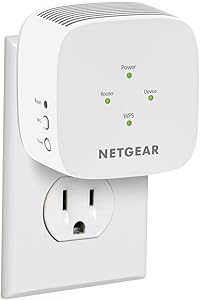
4. NETGEAR WiFi Mesh Range Extender EX5000 (AC1200, 1,000 sq. ft., 15 devices)
Best for extending WiFi coverage in small to medium-sized areas | RV Trekkers Rating: 8.3/10
The EX5000 earns this slot because it is compact, familiar, and easier to fit in a smaller RV or apartment-style setup than the larger repeaters. It is the right answer when the weak zone is one room away, not half a field away.
Specs:
- Price Tier: $ Budget
- Weight: 5.4 ounces
- Materials: —
- Dimensions: 2.55 in L x 2.85 in W x 2.85 in H
- Deployment: Compact wall plug with WPS setup
Pros:
- The AC1200 radio covers up to 1,000 sq. ft. for up to 15 devices.
- The 5.4-ounce body is the lightest published plug-in extender in this guide.
- The WPS button cuts the setup path to 1 quick press on compatible routers.
Cons:
- The 1,000-sq.-ft. claim is the smallest published coverage number in the top 10.
- The report flags 1 recurring problem after setup: disconnections for some users.
This is the modest, realistic option in the lineup. A 1,000-sq.-ft. claim and 15-device ceiling fit a short trailer, a bunkhouse dead zone, or an RV parked beside a house where the main router is not too far away. That modest footprint and low cost are why it still scores 8.3 even with the smaller coverage envelope.
We almost skipped it because the category is crowded and NETGEAR could have won with a newer WiFi 6 unit instead. Even so, the little square body feels tidy in hand, it does not dominate the outlet, and the small shape is easier to live with in a narrow RV wall cavity or cabinet plug than the taller TP-Link.
Range is the trade-off. This repeater is not built for wide outdoor reaches, and the mixed stability feedback keeps it below the top 3. Buy this if you want a small RV WiFi booster for a short indoor hop. Skip this if the dead zone sits outside, across a yard, or across several campsites.
5. Mugatol AX3000 Outdoor WiFi 6 Extender (AX3000, IP67, 5 antennas, PoE)
Best for extending WiFi coverage in large outdoor areas and challenging environments | RV Trekkers Rating: 7.9/10
The Mugatol AX3000 sits here because it brings the strongest published wireless class among the outdoor repeaters plus a 5-antenna layout built for broad open-air coverage. It is the spec-heavy outdoor choice for larger lots and tougher placement conditions.
Specs:
- Price Tier: $ Budget
- Weight: 2.95 lbs
- Materials: IP67 waterproof casing
- Dimensions: 14.8 in L x 11.61 in W x 3.23 in H
- Deployment: Passive PoE with 5 high-gain omnidirectional antennas

Pros:
- The AX3000 radio reaches up to 2402Mbps on 5GHz and 573Mbps on 2.4GHz.
- The 5 high-gain antennas are paired with a reported 200-300 meter coverage radius.
- The outdoor shell adds IP67 sealing plus 15kV ESD and 6kV lightning resistance.
Cons:
- The PoE converter is not waterproof, so 1 protected enclosure still enters the install.
- The 14.8 x 11.61 x 3.23-inch body is one of the largest hardware pieces in this guide.
On pure paper specs, Mugatol is impressive. AX3000 WiFi 6, support for up to 128 devices, and a stated 200-300 meter radius tell the story of a network appliance that belongs on a pole, wall, or outbuilding more than on a living-room outlet. That outdoor reach is the main reason it kept a 7.9 score.
We almost ranked it higher because the spec sheet reads like a premium contender. Then the ownership friction shows up. The enclosure feels sturdy and the antenna array looks serious, but the non-waterproof power hardware and the large footprint complicate a clean RV install when every cabinet and exterior bay already fights for space.
This is the right pick when wide outdoor coverage matters more than tidy packaging. It also assumes you have room, mounting patience, and a decent source signal to feed it. Buy this if you want a high-output outdoor extender for a large campsite or property edge. Skip this if you value a compact install or an all-weather power path out of the box.
6. ASUS RP-AX56 AX1800 Repeater & Range Extender (AX1800, 2,200 sq. ft., AiMesh)
Best for seamless expansion of existing ASUS AiMesh WiFi networks | RV Trekkers Rating: 7.6/10
The ASUS RP-AX56 earns this spot because it makes the most sense for people who already own ASUS networking gear and want one SSID across the coach and the base router. Inside that ecosystem, it is cleaner than a generic repeater.
Specs:
- Price Tier: $ Budget
- Weight: 0.42 pounds
- Materials: Plastic (report-inferred)
- Dimensions: —
- Deployment: AiMesh-compatible repeater with wired or wireless backhaul options

Pros:
- The AX1800 radio splits into 574 Mbps on 2.4GHz and 1201 Mbps on 5GHz.
- ASUS publishes up to 2,200 sq. ft. of coverage, which is 100 sq. ft. above the TP-Link claim.
- AiMesh gives 1 SSID path for routers and repeaters inside the ASUS ecosystem.
Cons:
- The 2-year warranty is shorter than the 2-year-plus-lifelong-support package on the 2026 outdoor model.
- The report flags 1 recurring annoyance outside AiMesh: intermittent connectivity drops.
ASUS built this repeater around ecosystem fit more than universal appeal. The strong AX1800 numbers, the option for wired or wireless backhaul, and the single-network-name experience are the reasons it stayed ahead of the cheaper generic plug-in units. That same ecosystem lock-in is also why it did not crack the top 5.
We almost skipped it because “best for ASUS” is a narrow lane. Still, if your rig parks beside a house with an ASUS router or you already run AiMesh in a home base, the interface feels familiar and the setup flow is less clunky than mixing brands. The plastic shell is plain, but that plain look works fine in an interior cabinet.
This is not an outdoor repeater and it is not a universal slam dunk. Its best case is simple: existing ASUS gear, indoor use, and a desire for mesh-like roaming. Buy this if your RV WiFi booster is joining an ASUS network. Skip this if you want weatherproof hardware or brand-agnostic outdoor range.
7. 1200Mbps Dual Band WiFi Extender (12,880 sq. ft., 1200Mbps, 105 devices)
Best for extending WiFi coverage in large homes and outdoor areas | RV Trekkers Rating: 7.2/10
This generic 1200Mbps extender stays in the top 10 because the raw coverage claim is huge and the price stays low. It is the numbers-first option for shoppers who want a cheap repeater with a loud box headline.
Specs:
- Price Tier: $ Budget
- Weight: 5.6 ounces
- Materials: —
- Dimensions: 6.8 in x 3.66 in x 2 in
- Deployment: Plug-in repeater with smart indicator lights and WPA/WPA2 security

Pros:
- The published reach stretches to 12,880 sq. ft. for up to 105 devices.
- Dual-band throughput is rated at 1,200 Mbps across 2.4GHz and 5GHz.
- The 5.6-ounce body stays light enough to move between 2 outlets without much hassle.
Cons:
- The report leaves 1 major blind spot because Ethernet port speed is not published.
- This unit skips WiFi 6, so it trails 5 newer boosters in wireless standard.
The appeal here is obvious: big coverage numbers and a low asking price. If you read only the box headline, 12,880 sq. ft. and 105-device support look stronger than anything else in the list. That huge claim is also why we kept the score down at 7.2 instead of chasing the headline.
We almost skipped it because generic repeaters often sound broader than they feel once they hit a real wall, cabinet, or aluminum-sided coach. The body looks ordinary and the indicator lights make placement easier, but the overall package feels more like a value-box extender than a confidence-inspiring network tool when you first plug it in.
This one works best as a low-cost experiment, not a no-questions-asked recommendation. Missing port detail, no WiFi 6, and softer network-management depth hold it back. Buy this if price and a broad coverage claim drive the search. Skip this if you want the cleanest data sheet or stronger brand confidence.
8. Amazon eero 6 mesh wifi add-on extender (Wi-Fi 6, 1,500 sq. ft., eero-only)
Best for extending existing eero Wi-Fi 6 networks | RV Trekkers Rating: 6.8/10
The eero 6 extender belongs in this list only for current eero owners. In that narrow lane, it is clean, app-driven, and easy to fold into an existing mesh network without replacing the whole system.
Specs:
- Price Tier: $ Budget
- Weight: 10.1 ounces
- Materials: Plastic, electronic components
- Dimensions: 3.9 in x 3.8 in x 2.4 in
- Deployment: eero app setup for existing eero Wi-Fi 6 systems only

Pros:
- The node adds up to 1,500 sq. ft. of Wi-Fi 6 coverage to an existing eero system.
- The hardware supports internet speeds up to 500 Mbps for streaming and work traffic.
- The 10.1-ounce housing is compact enough to blend into a cabinet, shelf, or side table.
Cons:
- This box has 0 standalone value because it requires 1 existing eero router.
- The extender includes 0 Ethernet ports, which removes 1 wired-device or backhaul option.
eero keeps the experience simple. Setup runs through the app, software updates arrive automatically, and the small enclosure does not dominate a tight interior space. That easy ownership story is the main reason it still lands at 6.8 despite the limited use case.
We almost skipped it because ecosystem lock-in is the whole product. The rounded shell feels polished and home-friendly, which is great for a parked rig with a semi-permanent setup, but an RV buyer without an eero base system gets nothing from this box beyond extra cost and confusion.
The subscription angle and missing Ethernet port lower the value. This is a fine add-on for the right household and a weak fit for everyone else. Buy this if your network already starts with eero. Skip this if you want a standalone RV WiFi booster or any wired flexibility.
9. C. Crane CC Vector Extended Long Range WiFi Receiver System (15 dBi antenna, dual-band, 40 Mbps)
Best for extending WiFi to distant outbuildings or RVs | RV Trekkers Rating: 6.4/10
The C. Crane CC Vector earns its place because it solves a different problem from the rest of the list: grabbing a faraway WiFi source and rebroadcasting it to devices in a new location. It is a specialty directional system, not a casual repeater.
Specs:
- Price Tier: $ Mid
- Weight: 3.3 lbs
- Materials: Heavy-duty antenna with stainless hardware
- Dimensions: 8 in D x 10 in W x 15 in H
- Deployment: 15 dBi directional parabolic antenna with 2 Ethernet jacks

Pros:
- The 15 dBi antenna reaches about 0.5 mile in common use and up to 3 miles with clear line of sight.
- The system repeats a fresh signal for 4 common device groups: laptops, phones, TVs, and consoles.
- Two Ethernet jacks give 2 hardwired connection points for a router or fixed device.
Cons:
- The price sits far above the TP-Link top pick.
- The 40 Mbps data ceiling is lower than the faster WiFi 6 repeaters in this guide.
This system makes sense only when distance is the problem. A directional antenna, line-of-sight placement, and a rebroadcasted local signal make it far more specialized than a plug-in extender, and that unusual capability is why it stayed ahead of the premium KING despite the lower score. If the office WiFi is far away and new wired internet is off the table, few products here do what this one does.
We almost skipped it because the whole concept asks more from the buyer. The antenna hardware feels more industrial than consumer-friendly, the stainless pieces look built for mounting, and the system wants deliberate placement instead of a quick outlet swap. In a metal-sided shop, barn, or RV pad that blocks normal repeaters, that extra effort is exactly the point.
The trade-off is speed and price. This is a long-range capture system with a narrower use case, not the best daily booster for every rig. Buy this if your RV internet problem starts with distance and line of sight. Skip this if you just want stronger WiFi one room or one campsite over.
10. KING KF1001 Falcon Automatic Directional WiFi Antenna (auto-aiming antenna, dual-band router, app setup)
Best Premium | RV Trekkers Rating: 6.0/10
The KING Falcon lands in the premium slot because it is purpose-built for RV roof mounting and automatic network targeting. It is the most RV-specific design in the list, but that focused design comes with the highest price.
Specs:
- Price Tier: $ Premium
- Weight: 2.7 lbs
- Materials: —
- Dimensions: —
- Deployment: Automatic directional antenna with dual-band Wi-FiMax router and mobile app setup

Pros:
- The system pairs 1 automatic directional antenna with 1 dual-band Wi-FiMax router for in-coach networking.
- The router supports up to 300 Mbps upstream traffic when the source signal is strong enough.
- The 2-year parts and labor warranty is longer than the 1-year coverage on the eero extender.
Cons:
- This is the highest-priced model in the top 10.
- The report flags 1 recurring hardware concern around the antenna cable attachment.
KING designed this kit around the RV use case instead of adapting a home repeater. Automatic aiming, an included router, and app-based control make the ownership story more polished than many long-range solutions, and that RV-first design is the main reason it still holds a 6.0 score despite the premium cost.
We almost ranked it higher because the idea is strong. Then the price and mixed signal feedback show up. The roof gear looks clean compared with a DIY antenna lash-up, and the app-led setup feels easier than manual directional alignment, but everything still rides on the strength of the outside network you are trying to catch.
This is a convenience-heavy premium system, not a universal value play. The best use case is a serious RV owner who wants a permanent roof solution and accepts the cost. Buy this if you want the most RV-specific WiFi booster in the list. Skip this if price, raw value, or easy replacement hardware sit higher on your list.
How Do These 10 Best RV WiFi Booster Options Compare Side by Side?
TP-Link is the best all-around RV WiFi booster for most rigs, while the 2026 outdoor model is the better fit for exposed installs and C. Crane is the specialist for distant source signals.
| # | Product | Award | RV Trekkers Rating | Price | Wireless Class | Coverage / Range | Device Load | Deployment Hardware |
|---|---|---|---|---|---|---|---|---|
| → 1 | TP-Link RE615X View at Amazon | Best Overall | 9.5/10 | $ | AX1800 WiFi 6 | 2,100 sq. ft. | 64 devices | Gigabit Ethernet, EasyMesh |
| 2 | 2026 AX1800 Outdoor View at Amazon | Best Budget | 9.1/10 | $ | WiFi 6 (1201 + 574 Mbps) | Up to 700 meters line of sight | 256 devices | IP67, active/passive PoE |
| 3 | WAVLINK AC600 Outdoor View at Amazon | Best for remote outdoor areas | 8.7/10 | $ | AC600 / 2.4GHz 300Mbps | Up to 150 meters | — | IP67, PoE, 3-in-1 modes |
| 4 | NETGEAR EX5000 View at Amazon | Best for small to medium areas | 8.3/10 | $ | AC1200 dual-band | 1,000 sq. ft. | 15 devices | WPS wall plug |
| 5 | Mugatol AX3000 Outdoor View at Amazon | Best for large outdoor coverage | 7.9/10 | $ | AX3000 WiFi 6 | 200-300 meter radius | 128 devices | IP67, passive PoE, 5 antennas |
| 6 | ASUS RP-AX56 View at Amazon | Best for ASUS AiMesh | 7.6/10 | $ | AX1800 WiFi 6 | 2,200 sq. ft. | — | AiMesh, wired/wireless backhaul |
| 7 | 1200Mbps Dual Band Extender View at Amazon | Best for large homes and outdoor areas | 7.2/10 | $ | Dual-band 1200Mbps | 12,880 sq. ft. | 105 devices | Plug-in body, smart indicator |
| 8 | eero 6 add-on extender View at Amazon | Best for existing eero networks | 6.8/10 | $ | AX1800 Wi-Fi 6 | 1,500 sq. ft. | — | eero app, no Ethernet |
| 9 | C. Crane CC Vector View at Amazon | Best for distant RVs | 6.4/10 | $$ | Dual-band with 15 dBi antenna | 0.5 mile typical / 3 miles max LOS | — | 2 Ethernet jacks, directional antenna |
| 10 | KING Falcon View at Amazon | Best Premium | 6.0/10 | $$$ | Dual-band Wi-FiMax router | — | — | Automatic directional antenna, app setup |
TP-Link wins this comparison for most RV owners because it balances indoor coverage, device count, and wired flexibility without outdoor-install complexity. The 2026 AX1800 is the stronger choice for exposed mounting, while C. Crane is the one for long-distance signal capture.
Note: Coverage, range, device ceilings, and hardware details match the selected-products report. Missing published values are shown as —. Prices were analyzed in March 2026 and are subject to change.
Read our deep-dive review on the top-ranked TP-Link RE615X ↓
What Do the Comparison Results Say About the Best RV WiFi Booster?
The comparison splits the field into 4 buying lanes: mainstream indoor extension, weatherproof outdoor coverage, ecosystem-specific mesh add-ons, and directional signal-capture systems.
Coverage and Range
TP-Link RE615X wins the indoor middle ground because 2,100 sq. ft. and 64 devices is a strong match for the way most RV owners use a repeater. ASUS RP-AX56 posts a slightly larger 2,200-sq.-ft. number, but that advantage matters less once AiMesh dependence enters the equation.
The biggest raw range numbers belong to C. Crane CC Vector, Mugatol AX3000, and the 2026 AX1800 Outdoor. Those products belong to a different class of wireless hardware. C. Crane CC Vector stretches farthest on line of sight, while 2026 AX1800 Outdoor lands the most balanced outdoor mix of range and value.
Outdoor Deployment and Hardware
2026 AX1800 Outdoor and Mugatol AX3000 lead the outdoor conversation because both bring IP67 sealing, PoE, and lightning-related protection into the same package. WAVLINK AC600 Outdoor follows closely because the price stays low and the shell is still built for weather.
The premium KING Falcon takes a different path with permanent RV-specific hardware. That route is cleaner on the roof and easier to control from an app, but KING Falcon loses on value because the price jumps far above the outdoor pole-mount options.
Mesh Integration and Setup Simplicity
TP-Link RE615X and NETGEAR EX5000 are the easiest universal indoor repeaters to understand. One uses the Tether app and EasyMesh, the other leans on WPS and a smaller wall-plug format. eero 6 add-on extender is simpler still for current eero users, but it disappears from consideration if the buyer does not already own an eero base system.
ASUS RP-AX56 wins only inside one ecosystem. That is a strength and a weakness at the same time. For ASUS owners, ASUS RP-AX56 is cleaner than a generic booster. For everyone else, the narrow compatibility story reduces its practical value.
Price and Value Pressure
TP-Link RE615X is the value leader because it holds the highest editorial score at the budget tier without hiding behind vague claims. 2026 AX1800 Outdoor follows because the hardware list is long and the price still stays in the budget bucket, even with PoE and weatherproofing.
The weakest value stories belong to C. Crane CC Vector and KING Falcon. Both solve real RV internet problems, but both demand more money and more setup discipline. The right buyer gets a purpose-built solution. The average buyer gets a bigger bill than the problem requires.
Why Should You Trust Our Gear Reviews?
RV Trekkers evaluates RV connectivity gear through the lens of full-time travel, mechanical systems, and campsite setup constraints.
Ethan Walker is a mechanical engineer, NRVIA Certified RV Inspector, and full-time RV family lead who has logged 100,000+ documented miles across 40+ U.S. states. He has lived in a 38-foot fifth-wheel since 2020, tows with a 2022 Ford F-350 Super Duty, and writes from the perspective of someone who has dealt with bad park WiFi, weak patio signal, and real equipment trade-offs instead of generic home-network copy.
How Did We Evaluate the Best RV WiFi Booster Options?
We evaluated each booster on coverage claims, installation hardware, network flexibility, RV fit, and the trade-offs surfaced in the selected-products report.
Coverage Claims and Device Load
We started with the numbers buyers look at first: published square footage, line-of-sight range, and device ceilings. That split the field into 3 tiers right away. Plug-in repeaters such as TP-Link RE615X and NETGEAR EX5000 cover shorter indoor gaps. Outdoor units such as 2026 AX1800 Outdoor and Mugatol AX3000 stretch farther. Directional systems such as C. Crane CC Vector target a separate long-distance problem.
We also treated oversized claims carefully. The 12,880-sq.-ft. headline on the generic 1200Mbps unit is huge, but the surrounding data is thinner than the higher-ranked options. A larger claim with weaker detail did not outrank a smaller claim with cleaner hardware and better context.
Installation Hardware and Exposure
We compared where each device belongs once the RV is parked. Plug-in repeaters work inside the coach or beside a nearby home. Outdoor hardware matters when the signal dies at the awning, picnic table, or detached office. That is why IP67 sealing, PoE, antenna style, and lightning protection moved so much weight in the ranking.
The install story also includes the ugly parts. Non-waterproof PoE converters, oversized plug bodies, and permanent roof mounting all raise the ownership bar. Those details do not show up in a one-line marketing claim, but they change the buying decision fast.
Compatibility and Control
We scored compatibility next because some boosters are broad and others are tied to one ecosystem. TP-Link RE615X works as a general indoor extender. ASUS RP-AX56 is stronger inside AiMesh. eero 6 add-on extender has real value only for eero households. Those compatibility rules define the audience more than the box art does.
Control options mattered too. App setup, signal indicators, Ethernet ports, and multiple operating modes all improve daily use once the repeater is in service. A booster that looks good on paper but hides important controls or setup steps falls quickly in this kind of ranking.
Value and Ownership Friction
We finished with the parts buyers feel after the install: price, warranty, published completeness, and recurring weak points in the report. Missing dimensions, vague instructions, and power hardware that still needs weather protection all count as friction.
That final pass is why TP-Link RE615X and 2026 AX1800 Outdoor stayed near the top. Their trade-offs are easier to see and easier to live with than the more niche premium systems.
How Do You Choose the Right RV WiFi Booster?
The right RV WiFi booster matches 4 things: where the weak signal starts, how far the source router sits, what hardware you already own, and how much install complexity you accept.
Match the Booster Style to the Real Signal Problem
The first choice is device type, not brand. A plug-in repeater, an outdoor access point, and a directional antenna solve 3 different internet problems.
| RV internet situation | Booster style | Best examples from this guide |
|---|---|---|
| Weak signal inside the coach | Plug-in repeater | TP-Link RE615X, NETGEAR EX5000 |
| Weak signal at the awning or campsite edge | Outdoor PoE extender | 2026 AX1800 Outdoor, WAVLINK AC600, Mugatol AX3000 |
| Existing brand-specific mesh network | Ecosystem add-on | ASUS RP-AX56, eero 6 extender |
| Faraway campground or outbuilding WiFi source | Directional capture system | C. Crane CC Vector, KING Falcon |
That table is the fastest filter in the whole article. Most buying mistakes happen because the buyer picks the wrong device type before comparing the right products.
Check Mounting, Power, and Weather Exposure
A wall-plug body is simple, but it belongs indoors. Outdoor repeaters use PoE and weatherproof shells because the signal problem often sits outside the RV. That difference changes the install plan before performance even enters the conversation.
The 3 outdoor finalists here also prove that “weatherproof” does not mean every included part is weatherproof. Both the 2026 model and Mugatol call out power-related limits around the PoE hardware. Read those details before buying, not after drilling holes.
Verify Ecosystem Compatibility Before You Pay
Two models in this list are narrow by design: ASUS RP-AX56 and eero 6 add-on extender. They make good sense in the right home network and weak sense outside it. The same logic applies to a router with mesh ambitions, app control, or one-brand roaming features.
If the RV spends part of the year parked beside a house, existing home gear matters more than buyers expect. One compatible node is cheaper than replacing an entire network with hardware that does not talk well to the base router.
Decide Whether Raw Range or Better Daily Value Matters More
Long-range systems cost more because the hardware is different. Directional antennas, roof-mounted kits, and large outdoor APs belong to buyers with a specific problem and a defined install plan. Everyone else usually gets better value from a strong indoor repeater or a simpler weatherproof unit.
Use this rule of thumb: if the source network is already close and just fades inside the RV, buy value. If the source network is far away and line of sight is the problem, pay for the specialty hardware instead of hoping a small repeater changes physics.
What Is the Final Verdict on the Best RV WiFi Booster?
The best RV WiFi booster in this field is the TP-Link RE615X AX1800 WiFi 6 Range Extender because it gives most RV owners the strongest mix of indoor coverage, 64-device headroom, wired flexibility, and easy setup at a budget-tier price.
The 2026 AX1800 WiFi 6 Outdoor WiFi Extender is the better choice for exposed outdoor installs, while the C. Crane CC Vector Extended Long Range WiFi Receiver System is the long-distance specialist for rare range-heavy setups. If your network already lives inside ASUS or eero, the ASUS RP-AX56 AX1800 Repeater & Range Extender and Amazon eero 6 mesh wifi add-on extender stay relevant for that ecosystem-only lane.
That is the real answer to the best RV WiFi booster question: buy the wireless extender, outdoor repeater, or directional antenna that matches your signal problem, your install space, and your upstream network instead of chasing the biggest claim on the box.