Best RV battery solar searches usually point to 2 product lanes: solar maintainers that keep a parked 12V battery alive and solar-ready house batteries that store energy for lights, pumps, fridges, and inverter loads. This guide answers that mixed buyer intent first, then moves from the broader RV power system to the exact maintainer panels, LiFePO4 batteries, and AGM deep-cycle units that made the final shortlist.
Our top pick is the POWOXI Upgraded 7.5W Solar Battery Charger Maintainer, and the best battery value is the ECO-WORTHY 12V 100Ah LiFePO4 Battery. Both serve 12V RV electrical setups, both stay storage-friendly at 2.2 lbs and 23.15 lbs, and both solve the same problem from different sides: keeping a coach battery healthy instead of stranded.
Contents
- What Is an RV Battery Solar Setup?
- Which Quick Picks Define the Best RV Battery Solar of 2026?
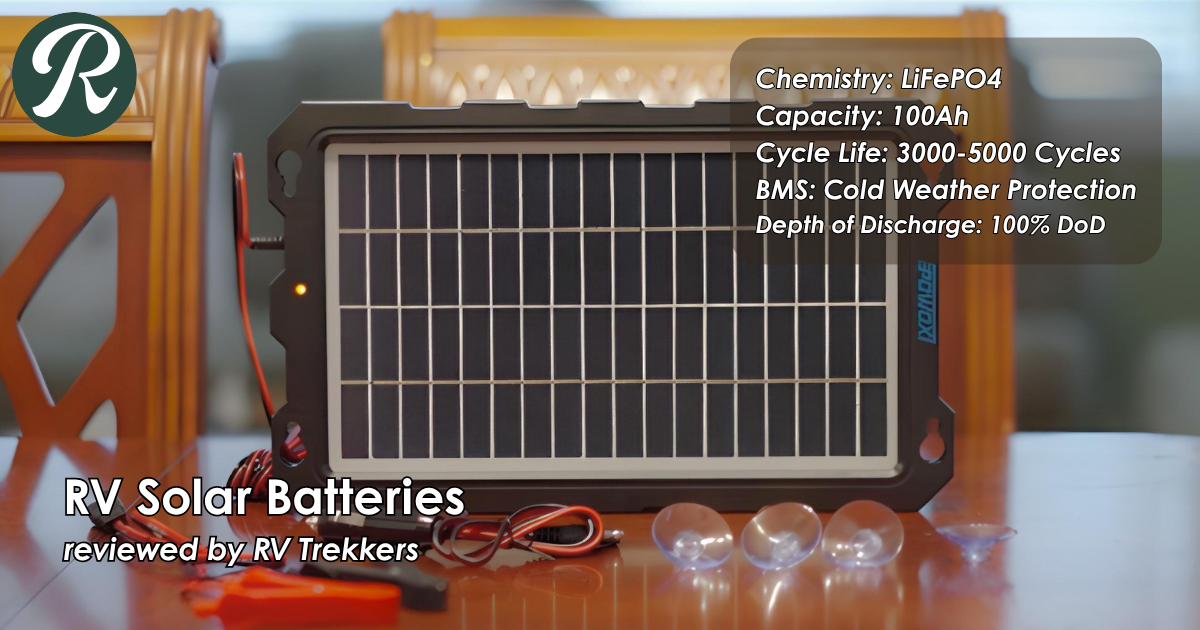
- 1. POWOXI Upgraded 7.5W Solar Battery Charger Maintainer (7.5W panel, 12V output, 0.41A)
- 2. ECO-WORTHY 12V 100Ah LiFePO4 Battery (1280Wh, 100A BMS, Bluetooth 5.1)
- 3. Dyness 12V 100Ah LiFePO4 Battery (1280Wh, Group 24, Bluetooth 5.0)
- 4. HumsiENK 12V 100Ah LiFePO4 Battery (100Ah, IP67, 15000 cycles)
- 5. Voltset 20W Solar Battery Charger Kit (20W panel, 18V max voltage, 10A controller)
- 6. FEENCE 12V 100Ah LiFePO4 Battery (1280Wh, 100A BMS, 4S/8P support)
- 7. Renogy Deep Cycle AGM 12V 100Ah Battery (100Ah, 1100A max discharge, sub-3% self-discharge)
- 8. WEIZE 12V 100Ah AGM Battery (Group 31, 1150A max discharge, 3% self-discharge)
- 9. OPTIMA D34M BLUETOP AGM Battery (750 CCA, 55Ah, dual terminals)
- 10. GOLDENMATE 12V 100Ah LiFePO4 Battery (100Ah, IP67, Bluetooth plus display)
- How Do These 10 RV Battery Solar Picks Compare Side by Side?
- What Do the Comparison Results Show?
- Why Should You Trust Our Gear Reviews?
- How Did We Evaluate RV Battery Solar Picks?
- How Do You Choose the Best RV Battery Solar Setup?
- What Is the Final Verdict?
What Is an RV Battery Solar Setup?
An RV battery solar setup is a 12V power system built around a solar panel or maintainer plus a battery bank that stores energy for RV house loads.
In practice, that system can be a small trickle charger for storage days, a LiFePO4 house battery with a battery management system, or a sealed AGM unit that trades weight for simpler compatibility. The parts that matter most are the panel, charge controller, cells, terminals, and the protection electronics that keep the charging system stable.
TL;DR: POWOXI is the best solar maintainer for parked rigs, ECO-WORTHY is the best budget lithium battery for solar-ready RV power, and Renogy is the safest AGM fallback when charger compatibility matters more than weight.
Which Quick Picks Define the Best RV Battery Solar of 2026?
The strongest quick picks split into 2 clear jobs: solar maintenance for stored RV batteries and deep-cycle storage for off-grid battery banks.
1. Best Overall: POWOXI Upgraded 7.5W Solar Battery Charger Maintainer (7.5W panel, 12V output, 0.41A max current) ($ Budget)
↓ Jump to Review
2. Best Budget: ECO-WORTHY 12V 100Ah LiFePO4 Battery (1280Wh energy, 100A BMS, Bluetooth 5.1) ($ Budget)
↓ Jump to Review
3. Best for Compact Group 24 Upgrades: Dyness 12V 100Ah LiFePO4 Battery (1280Wh energy, 20.9 lbs, Bluetooth 5.0) ($ Budget)
↓ Jump to Review
4. Best for Lightweight House Power: HumsiENK 12V 100Ah LiFePO4 Battery (19.73 lbs, IP67, 15000 cycles) ($ Budget)
↓ Jump to Review
5. Best for Parked RV Battery Maintenance: Voltset 20W Solar Battery Charger Kit (20W panel, 10A controller, SAE connectors) ($ Budget)
↓ Jump to Review
6. Best for Budget Battery Banks: FEENCE 12V 100Ah LiFePO4 Battery (1280Wh energy, 100A BMS, 4S/8P support) ($ Budget)
↓ Jump to Review
7. Best for AGM Backup Power: Renogy Deep Cycle AGM 12V 100Ah Battery (100Ah capacity, 1100A max discharge, sub-3% self-discharge) ($ Budget)
↓ Jump to Review
8. Best for Low-Cost AGM Storage: WEIZE 12V 100Ah AGM Battery (Group 31, 1150A max discharge, 60 lbs) ($ Budget)
↓ Jump to Review
9. Best for Dual-Purpose Starting and Deep Cycle Use: OPTIMA D34M BLUETOP AGM Battery (750 CCA, 55Ah, dual terminals) ($ Mid)
↓ Jump to Review
10. Best for Bluetooth and Display Monitoring: GOLDENMATE 12V 100Ah LiFePO4 Battery (100Ah, IP67, Bluetooth plus display) ($ Budget)
↓ Jump to Review
1. POWOXI Upgraded 7.5W Solar Battery Charger Maintainer (7.5W panel, 12V output, 0.41A)
Best Overall | RV Trekkers Rating: 9.5/10
The POWOXI wins because it solves the simplest and most common RV battery solar problem: keeping a parked 12V battery from sagging during storage. It is a maintainer, not a recovery charger, and that narrow role is exactly why it leads this list.
Specs:
- Price Tier: $ Budget
- Weight: 2.2 lbs
- Materials: Solar silicon, low-iron tempered glass, ABS+PC frame
- Dimensions: 14.76 x 1.89 x 9.06 in
- Solar Output: 7.5W panel, 12V output, 0.41A max current

Pros:
- The 2.2 lb panel is 1.8 lbs lighter than the 4 lb Voltset kit, so it fits quick storage setups with less hassle.
- The 7.5W output and built-in protection system match the slow-charge job that parked 12V RV batteries face over multi-day storage.
- The panel includes 2 connection paths, cigarette lighter and alligator clips, which reduces install friction on smaller rigs.
Cons:
- The 0.41A ceiling is too low for heavily depleted batteries or larger parasitic loads.
- The output drops fast behind tinted glass or weak winter sun, which limits placement options.
The best part of this panel is balance. At 7.5W, it gives more support than the tiniest dash panels in this category, and the tempered glass face plus compact format fit the simple maintenance role well.
The 0.41A output is modest on paper, but that narrow maintenance role is also why it scored 9.5. It is built to offset standby drain on a parked trailer battery rather than act as a recovery charger.
Buy this if your RV spends long stretches parked and your main goal is battery maintenance, not fast charging. Skip it if your battery bank already has a heavier standby draw or you want a true rooftop solar charging system.
2. ECO-WORTHY 12V 100Ah LiFePO4 Battery (1280Wh, 100A BMS, Bluetooth 5.1)
Best Budget | RV Trekkers Rating: 9.1/10
The ECO-WORTHY is the best budget battery in this roundup because it gives a solar-ready RV battery bank the modern essentials: 1280Wh of LiFePO4 storage, a 100A BMS, and Bluetooth monitoring in a Group 24 case. That mix covers more real RV use than most budget batteries manage.
Specs:
- Price Tier: $ Budget
- Weight: 23.15 lbs
- Materials: Lithium iron phosphate cells, plastic housing, metal M8 terminals
- Dimensions: 10.24 x 6.61 x 8.43 in
- Battery Platform: 12.8V 100Ah, 1280Wh, built-in 100A BMS with low-temperature cutoff

Pros:
- At 23.15 lbs, it cuts about 40.75 lbs from the 63.9 lb Renogy AGM while keeping a full 100Ah format.
- The 100A BMS covers overcharge, over-discharge, overcurrent, short-circuit, and temperature protection in one battery case.
- Bluetooth 5.1 monitoring gives live voltage, current, and capacity data without adding a second monitor to the electrical bay.
Cons:
- The non-returnable hazmat status raises the risk on a battery in this class.
- The 100A BMS limits heavier inverter loads compared with larger lithium batteries or 200A systems.
This battery stands out as a handling upgrade. The Group 24 shell is far easier to manage than a 60-pound AGM, and the M8 terminal hardware suits common RV battery-cable connections.
Fair warning: the app and BMS behavior are not spotless, and a few buyers report shutdowns that need a manual reset. Even with that caveat, the 23.15 lb weight, low-temp cutoff, and 1280Wh storage are the core reasons it earned a 9.1 score — the value per pound is strong.
Choose this if you want a lighter house battery for an RV solar setup and you accept a 100A ceiling. Skip it if your inverter pulls harder than that or if non-returnable battery orders make you uneasy.
3. Dyness 12V 100Ah LiFePO4 Battery (1280Wh, Group 24, Bluetooth 5.0)
Best for compact Group 24 RV battery upgrades | RV Trekkers Rating: 8.7/10
The Dyness is here because compact fit matters in older RV battery trays. Its 10.19 x 6.61 x 8.22 in body stays tight, and the 20.9 lb weight keeps installation far easier than any AGM brick on this page.
Specs:
- Price Tier: $ Budget
- Weight: 20.9 lbs
- Materials: LiFePO4 battery cells, plastic battery case
- Dimensions: 10.19 x 6.61 x 8.22 in
- Battery Platform: 12.8V 100Ah, 1280Wh, 100A smart BMS with low-temp protection

Pros:
- At 20.9 lbs, it is 2.25 lbs lighter than the ECO-WORTHY and 39.1 lbs lighter than the WEIZE AGM.
- The Group 24 footprint makes tray swaps easier in battery boxes that reject taller or longer Group 31 cases.
- The app shows 4 live metrics, voltage, state of charge, current, and temperature, from the Bluetooth connection.
Cons:
- Bluetooth pairing complaints show up often enough to undercut the convenience pitch.
- The non-returnable hazmat status adds friction if the app or charging behavior turns inconsistent.
What stands out here is fit. The compact case suits tighter front compartments better than longer Group 31 options, and the smooth plastic shell keeps the design straightforward.
App feedback is mixed and there is no deep analytics story. Even so, the tray-friendly size and 20.9 lb carry weight still push it to an 8.7 rating because those two details solve a real RV fit problem.
Buy this if your existing box or tray is closer to Group 24 dimensions and every inch matters. Skip it if app polish matters more than compact fit.
4. HumsiENK 12V 100Ah LiFePO4 Battery (100Ah, IP67, 15000 cycles)
Best for lightweight RV and boat house power upgrades | RV Trekkers Rating: 8.3/10
The HumsiENK stands out for combining low weight, IP67 weather resistance, and Bluetooth in one 100Ah battery. It is the easiest battery in this lineup to picture in a portable solar kit or a smaller trailer compartment.
Specs:
- Price Tier: $ Budget
- Weight: 19.73 lbs
- Materials: LiFePO4 cells, plastic battery case
- Dimensions: 10.2 x 6.6 x 8.2 in
- Battery Platform: 12V 100Ah, max 1280Wh, 100A BMS, low-temp cutoff, IP67

Pros:
- At 19.73 lbs, it is the lightest battery in the top half of this roundup.
- The IP67 rating adds more weather confidence than the open-ended durability language on several budget lithium rivals.
- The battery includes low-temp cutoff and Bluetooth monitoring, which keeps 2 high-value protections in one budget-tier package.
Cons:
- The Bluetooth range is short enough that some RV storage bays block stable app use.
- The case height creates fitment surprises in a few boxes despite the compact Group 24 class size.
This is the battery to prioritize when portability matters most. At 19.73 lbs, it is unusually light for a 100Ah pack, and the top handles should be easier to manage than on heavier LiFePO4 units.
Lighter cases can raise durability questions, but the IP67 shell, 19.73 lb carry weight, and low-temp cutoff still explain the 8.3 score. That package is hard to match in this tier.
Take this route if you want the easiest-to-carry house battery in the shortlist. Skip it if your battery box has tight height limits or if stable long-range Bluetooth access is part of your plan.
5. Voltset 20W Solar Battery Charger Kit (20W panel, 18V max voltage, 10A controller)
Best for maintaining parked vehicle and small equipment batteries | RV Trekkers Rating: 7.9/10
The Voltset is the step-up maintainer for owners who want more wattage than the POWOXI and are willing to carry more hardware. Its 20W panel and included controller fit longer storage windows better than ultra-light dash panels.
Specs:
- Price Tier: $ Budget
- Weight: 4 lbs
- Materials: Aluminum, monocrystalline silicon, tempered glass
- Dimensions: 15 x 13.58 x 1.69 in
- Solar Output: 20W maximum power, 12V output, 18V max voltage, 10A controller

Pros:
- The 20W panel gives 12.5W more output than the 7.5W POWOXI, which improves maintenance headroom on stored RV batteries.
- The included 10A controller, bracket, O-ring terminals, and alligator clips cover 4 common hookup pieces in one kit.
- The IP67 weather-resistant build fits outdoor parking better than windshield-only solar maintainers.
Cons:
- The 4 lb kit is bulkier than compact panels and asks for more storage space between trips.
- LED status feedback is inconsistent enough to create doubt during first setup.
This kit leans more toward a hardware-style install than a simple accessory. The tempered panel, bracket hardware, and included controller give it a sturdier setup than flatter trickle chargers.
The 20W output is appealing on paper, but short cable complaints and hazy LED language pull it back down. The bigger panel and included controller still justify the 7.9 score, though it asks more setup patience than the winner.
Buy this if your parked RV needs more solar maintenance headroom than a 7.5W panel gives. Skip it if you want the smallest possible kit or the simplest status feedback.
6. FEENCE 12V 100Ah LiFePO4 Battery (1280Wh, 100A BMS, 4S/8P support)
Best for budget RV, solar, and trolling motor battery banks | RV Trekkers Rating: 7.6/10
The FEENCE makes sense for buyers building a larger bank on a lean budget. It keeps the familiar 100Ah and 1280Wh baseline but adds series and parallel flexibility that cheaper one-off batteries often lack.
Specs:
- Price Tier: $ Budget
- Weight: 23.65 lbs
- Materials: Lithium iron phosphate cells, plastic battery case, M8 terminals
- Dimensions: 13 x 6.8 x 8.4 in
- Battery Platform: 12V 100Ah, 1280Wh, 100A BMS, supports up to 4S/8P

Pros:
- The 4S and 8P expansion support gives this battery more bank-building flexibility than fixed single-use packs.
- At 23.65 lbs, it stays far lighter than the 60 lb to 63.9 lb AGM batteries in this roundup.
- The built-in 100A BMS and low-temperature cutoff keep the battery aligned with solar and RV use instead of starter-duty abuse.
Cons:
- Some long-term charge-retention complaints weaken confidence in multi-battery bank builds.
- Warranty support feedback is uneven, which matters more when 2 to 4 batteries are wired together.
The FEENCE’s main appeal is expandability. Its straightforward housing matters less than the series-parallel flexibility that many RVers want once they outgrow a single 100Ah battery.
A bank-ready battery with shaky support creates a real downside. Even so, the 4S/8P capability and 23.65 lb weight are the two details that keep its 7.6 rating intact. Few budget batteries open that much growth room.
Choose this if you already think in battery-bank terms and want room to scale. Skip it if you want the cleanest long-term support record in the group.
7. Renogy Deep Cycle AGM 12V 100Ah Battery (100Ah, 1100A max discharge, sub-3% self-discharge)
Best for maintenance-free RV and off-grid AGM backup power | RV Trekkers Rating: 7.2/10
The Renogy is the safest AGM fallback here because it keeps the traditional deep-cycle formula intact: 100Ah capacity, maintenance-free sealed construction, and a lower-friction fit with older RV charging systems. That makes it relevant even in a lithium-heavy list.
Specs:
- Price Tier: $ Budget
- Weight: 63.9 lbs
- Materials: Lead-acid AGM
- Dimensions: 13.1 x 6.9 x 8.6 in
- Battery Platform: 12V 100Ah, 1100A max discharge for 5 seconds, below 3% self-discharge

Pros:
- The sealed 100Ah AGM design stays compatible with many stock RV converters and chargers that dislike lithium profiles.
- The below-3% monthly self-discharge rate suits seasonal parking better than many older flooded batteries.
- The battery supports up to 4 parallel units, which gives larger AGM banks a simple upgrade path.
Cons:
- At 63.9 lbs, it is the heaviest product in the main battery group.
- The M8 terminal format adds one more fit check before installing existing lugs or disconnect hardware.
This battery is exactly what it looks like: a dense, old-school reserve block for RV house power. That weight is both the appeal and the penalty of AGM storage.
Its 63.9 lb weight is a rough lift in a narrow front compartment, but its compatibility story still matters, especially for owners with stock charging gear. The maintenance-free design and low self-discharge are the reasons it still holds a 7.2 score. It is heavy, but it is predictable.
Buy this if your RV charger setup is older and you want AGM simplicity over lithium weight savings. Skip it if every pound and every amp-hour per pound matter to your solar build.
8. WEIZE 12V 100Ah AGM Battery (Group 31, 1150A max discharge, 3% self-discharge)
Best for budget RV and backup power setups | RV Trekkers Rating: 6.8/10
The WEIZE earns a place for one reason: low-cost AGM storage in a full-size Group 31 body. It is not refined, but it gives budget shoppers a maintenance-free deep-cycle option that still fits RV and solar backup use.
Specs:
- Price Tier: $ Budget
- Weight: 60 lbs
- Materials: Sealed lead acid AGM, ABS case, calcium-alloy grid, zinc-plated M8 bolts
- Dimensions: 12.99 x 6.73 x 8.34 in
- Battery Platform: 12V 100Ah Group 31 AGM, 1150A max discharge, about 3% self-discharge

Pros:
- The 100Ah Group 31 format keeps capacity at the full-size deep-cycle level instead of dropping to a smaller reserve class.
- The 60 lb case is 3.9 lbs lighter than the Renogy while staying in the same general AGM category.
- The sealed construction removes watering and acid-spill chores from basic RV maintenance.
Cons:
- The battery is still very heavy for buyers who move power gear often.
- Hazmat return limits and mixed durability feedback make the low price feel less secure.
This is the battery for buyers who just want a low-cost, full-size AGM block and already accept the bulk that comes with it. The ABS shell and included hardware keep the design straightforward.
Budget AGM value can disappear fast when a battery dies early and shipping is messy. The 100Ah Group 31 body and low buy-in keep the 6.8 score alive. The formula works, but the downside risk is plain.
Choose it if price is the main filter and AGM compatibility still matters. Skip it if you want lighter carry weight or a stronger long-term durability profile.
9. OPTIMA D34M BLUETOP AGM Battery (750 CCA, 55Ah, dual terminals)
Best for dual-purpose boat and RV power in compact battery compartments | RV Trekkers Rating: 6.4/10
The OPTIMA belongs here because not every RV battery solar setup is a pure house bank. Some owners want one battery for starting and accessory duty, and that is the narrow lane this 55Ah AGM fills.
Specs:
- Price Tier: $ Mid
- Weight: 43.5 lbs
- Materials: Sealed AGM lead acid battery with 99.99% pure lead internal components
- Dimensions: 10.06 x 6.88 x 7.94 in
- Dual-Purpose Output: 12V, 750 CCA, 870 MCA, 55Ah C20 capacity, 120-minute reserve

Pros:
- The 750 CCA output covers a starting job that none of the 100Ah LiFePO4 batteries on this page are built to handle.
- The 43.5 lb case is 20.4 lbs lighter than the Renogy AGM and easier to fit in shorter compartments.
- Dual SAE and 5/16 in stud posts give 2 connection styles for mixed starting and accessory circuits.
Cons:
- The 55Ah capacity is far lower than the 100Ah batteries that dominate this list.
- The mid-tier pricing is steep for a battery with less house-power reserve.
This is a specialist battery. The compact shell and cleaner terminal layout make the dual-purpose design easier to understand than many AGM alternatives.
The 55Ah capacity is a short leash for real overnight RV house loads, but the 750 CCA output and dual-purpose layout still explain the 6.4 rating. It does a job the pure deep-cycle batteries do not touch.
Buy this if one compact battery must cover starting and accessory use. Skip it if your main goal is longer off-grid runtime from a solar-fed house bank.
10. GOLDENMATE 12V 100Ah LiFePO4 Battery (100Ah, IP67, Bluetooth plus display)
Best for lightweight trolling motor and portable RV power setups | RV Trekkers Rating: 6.0/10
The GOLDENMATE rounds out the list with a useful mix of Bluetooth, onboard display, and IP67 sealing. It ranks last because the support and app story feel rougher than the better lithium options above it.
Specs:
- Price Tier: $ Budget
- Weight: 29.3 lbs
- Materials: LiFePO4 battery cells, plastic housing, M8 terminals
- Dimensions: 12.91 x 6.77 x 8.35 in
- Battery Platform: 12.8V 100Ah, built-in 100A BMS, IP67, Bluetooth monitoring

Pros:
- The built-in display and Bluetooth give 2 monitoring paths instead of forcing every check through one phone app.
- The IP67 housing adds more weather resistance than many basic budget lithium cases.
- At 29.3 lbs, it still cuts about 30.7 lbs from the 60 lb WEIZE AGM.
Cons:
- The 1-year warranty is shorter than the 3-year to 5-year coverage on several rivals in this roundup.
- App connection complaints and support-code issues weaken confidence in the monitoring package.
The display is the detail that makes this battery interesting. It adds quick-glance value that phone-only batteries miss, and it gives this model a clearer monitoring pitch than many budget lithium rivals.
The short warranty and uneven app feedback hold it back. The dual monitoring angle and IP67 protection still keep it relevant, but those limitations are why it scored only 6.0. The concept is stronger than the follow-through.
Take it if you want a lightweight battery with both screen and app data in one case. Skip it if warranty length and smoother software matter more than the onboard display.
How Do These 10 RV Battery Solar Picks Compare Side by Side?
The best RV battery solar picks divide into 3 functional groups: maintenance panels for storage, lithium batteries for lighter deep-cycle capacity, and AGM batteries for charger-friendly backup power.
| # | Product | Award | RV Trekkers Rating | Price Tier | Type | Capacity / Output | Weight | Key Protection |
|---|---|---|---|---|---|---|---|---|
| → 1 | POWOXI Upgraded 7.5W View at Amazon | Best Overall | 9.5/10 | $ | Solar maintainer | 7.5W, 12V, 0.41A | 2.2 lbs | Built-in protection system |
| 2 | ECO-WORTHY 100Ah LiFePO4 View at Amazon | Best Budget | 9.1/10 | $ | LiFePO4 battery | 12.8V, 100Ah, 1280Wh | 23.15 lbs | 100A BMS, low-temp cutoff, Bluetooth 5.1 |
| 3 | Dyness 100Ah LiFePO4 View at Amazon | Best for compact Group 24 upgrades | 8.7/10 | $ | LiFePO4 battery | 12.8V, 100Ah, 1280Wh | 20.9 lbs | 100A BMS, low-temp protection, Bluetooth 5.0 |
| 4 | HumsiENK 100Ah LiFePO4 View at Amazon | Best for lightweight house power | 8.3/10 | $ | LiFePO4 battery | 12V, 100Ah, 1280Wh | 19.73 lbs | 100A BMS, low-temp cutoff, IP67 |
| 5 | Voltset 20W Kit View at Amazon | Best for parked battery maintenance | 7.9/10 | $ | Solar maintainer kit | 20W, 12V, 10A controller | 4 lbs | Controller, reverse-polarity and short-circuit protection |
| 6 | FEENCE 100Ah LiFePO4 View at Amazon | Best for budget battery banks | 7.6/10 | $ | LiFePO4 battery | 12V, 100Ah, 1280Wh | 23.65 lbs | 100A BMS, low-temp cutoff, 4S/8P support |
| 7 | Renogy 100Ah AGM View at Amazon | Best for AGM backup power | 7.2/10 | $ | AGM battery | 12V, 100Ah, 1100A max discharge | 63.9 lbs | Sealed AGM, below 3% self-discharge |
| 8 | WEIZE 100Ah AGM View at Amazon | Best for low-cost AGM storage | 6.8/10 | $ | AGM battery | 12V, 100Ah, 1150A max discharge | 60 lbs | Sealed AGM, about 3% self-discharge |
| 9 | OPTIMA D34M BLUETOP View at Amazon | Best for dual-purpose use | 6.4/10 | $$ | AGM battery | 12V, 55Ah, 750 CCA | 43.5 lbs | Sealed AGM, dual terminals |
| 10 | GOLDENMATE 100Ah LiFePO4 View at Amazon | Best for Bluetooth and display monitoring | 6.0/10 | $ | LiFePO4 battery | 12.8V, 100Ah, 100A BMS | 29.3 lbs | IP67, Bluetooth, onboard display |
Note: Capacities, wattage, weight, and protection details follow the selected-products report for this keyword. Prices and hazmat return policies can shift over time.
What Do the Comparison Results Show?
The table shows one clear split: solar maintainers win on storage convenience, while lithium batteries win on deep-cycle energy density and AGM batteries stay relevant for charger-friendly compatibility.
Solar Maintenance Power
The two solar panels answer a different problem from the batteries, and that distinction matters. POWOXI is the cleaner low-draw maintainer at 7.5W and 2.2 lbs, while Voltset adds 20W and a 10A controller for rigs that sit longer or carry more standby draw. That means panel shoppers are choosing between simplicity and extra charging headroom, not between two versions of the same tool.
Battery Chemistry and Install Weight
The chemistry divide is blunt. HumsiENK, Dyness, and ECO-WORTHY keep 100Ah-class storage in the 19.73 lb to 23.15 lb band, while Renogy and WEIZE jump to 60 lbs and 63.9 lbs for AGM compatibility. That 40-pound gap changes tray fit, lift effort, tongue-box strain, and how willing an owner feels about pulling the battery out for seasonal storage.
Protection, Monitoring, and Cold-Weather Value
The strongest lithium picks separate themselves through protection layers, not just raw capacity. ECO-WORTHY and Dyness pair Bluetooth data with low-temp protection, HumsiENK adds IP67 sealing, and GOLDENMATE adds an onboard display. By contrast, Renogy and WEIZE lean on sealed AGM simplicity, which is less sophisticated but easier to match with older RV charging hardware.
Why Should You Trust Our Gear Reviews?
These rankings come from RV Trekkers, not from retailer star averages. This guide prioritizes fit, weight, charging compatibility, monitoring features, and protection details pulled from the shortlisted products for this keyword because RV battery solar gear usually fails around weak terminals, bad fit, charger mismatch, and storage drain.
How Did We Evaluate RV Battery Solar Picks?
We evaluated these RV battery solar picks by separating storage-maintenance jobs from deep-cycle battery jobs and then comparing fit, carry weight, monitoring behavior, and charging protection using the selected-products report for this keyword.
Storage Drain Checks
For maintainer panels, the main question was whether the published output and included hardware fit a stored-RV use case or demanded more setup attention than a parked trailer usually needs.
Tray Fit and Lift Effort
We compared the published battery dimensions against common Group 24 and Group 31 spaces. In practical terms, 19.73 lbs is far easier to manage than 63.9 lbs before cables and tray fit enter the picture.
BMS and Monitoring Review
We compared which batteries offer live data through Bluetooth or an onboard display and which ones rely on simpler sealed designs. That matters because a battery bank without voltage, temperature, or state-of-charge visibility is harder to manage once an inverter, solar controller, or converter enters the system.
Protection and Storage Friction
We compared low-temperature cutoff, IP67 sealing, return-policy friction noted in the shortlist, and self-discharge behavior because those details shape real ownership more than marketing headlines do. A battery with strong specs but weaker support or vague cold-weather protection creates more friction than a lower-scoring product with clearer limits.
How Do You Choose the Best RV Battery Solar Setup?
The right RV battery solar setup starts with the job, then narrows by chemistry, fit, protection, and the amount of storage drain your rig carries between trips.
Start with the Job: Maintainer or House Battery?
The first choice is not brand. It is function. A parked RV with modest standby draw needs a solar maintainer such as POWOXI or Voltset, while an off-grid trailer running a water pump, vent fan, or inverter needs a true deep-cycle battery.
| Setup Type | Best Match in This Guide | Best Use |
|---|---|---|
| Solar maintainer panel | POWOXI, Voltset | Stored RV battery upkeep |
| LiFePO4 house battery | ECO-WORTHY, Dyness, HumsiENK, FEENCE, GOLDENMATE | Lighter deep-cycle solar storage |
| AGM house battery | Renogy, WEIZE | Older chargers and maintenance-free backup power |
| Dual-purpose AGM | OPTIMA D34M | Starting plus moderate accessory loads |
How Much Weight and Space Does Your Battery Box Accept?
Fit is where many buyers make the wrong call. In this shortlist, the compact Group 24 lithium batteries cluster around 10.19 to 10.24 inches long and 19.73 to 23.15 lbs, while the larger AGM batteries push close to 13 inches long and 60 to 63.9 lbs. If the tray is tight or the battery slides into a front compartment at shoulder height, lighter lithium storage changes the install experience fast.
Which Protection Features Matter Most?
The strongest buying filter after fit is protection. Look for the safeguards that match the way the RV actually lives:
- Low-temperature cutoff matters for winter storage and cold-morning charging.
- Bluetooth or display monitoring matters for owners who want live state-of-charge data.
- IP67 sealing matters for damp compartments, portable use, or exposed installs.
- Sealed AGM construction matters for older converters and low-drama maintenance.
Where Does the Real Trade-Off Sit?
The real trade-off is not lithium versus AGM in the abstract. It is lighter weight and smarter electronics versus simpler compatibility and lower setup friction. A LiFePO4 battery brings more energy density, faster handling, and a modern BMS, while an AGM battery brings simpler charger behavior and fewer questions about app pairing or BMS resets.
What Is the Final Verdict?
The best RV battery solar setup in this roundup starts with the POWOXI Upgraded 7.5W Solar Battery Charger Maintainer for parked-battery upkeep, moves to the ECO-WORTHY 12V 100Ah LiFePO4 Battery for the strongest budget lithium storage, and falls back to the Renogy Deep Cycle AGM 12V 100Ah Battery when charger compatibility matters more than lift weight.
That conclusion loops back to the original query for one reason: best RV battery solar buyers are usually solving either storage drain or off-grid energy storage, not both with the same product. Pick the panel when the battery is already good, pick the lithium pack when the whole battery bank needs an upgrade, and pick AGM only when the rest of the electrical system rewards that simpler path.