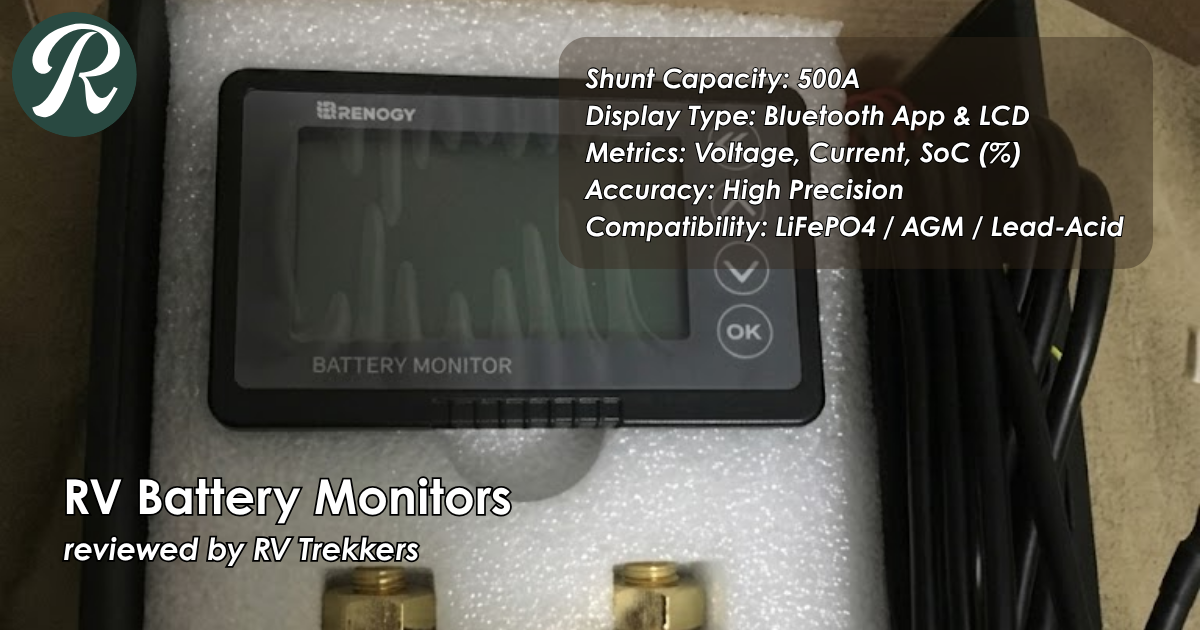
Best RV battery monitor shopping gets easier once you separate simple plug-in voltmeters from shunt-based battery-bank monitors and Bluetooth shunts that track amps, watts, and state of charge. This guide answers that buyer intent first, then moves from the monitor itself to the battery-bank hardware around it and finally to the exact meters and shunts that made the shortlist.
Our top pick is the bayite DC 6.5-100V 0-100A LCD Display Digital Current Voltage Power Energy Meter, while the budget winner is the Innova 3721 Battery and Charging System Monitor. Both picks stay in the Budget tier and both give live voltage visibility, but the bayite adds 0 to 100A shunt tracking while the Innova stays focused on 12V negative-ground accessory-port checks. Every RV Trekkers rating below is an editorial score from our team, not a retailer star average.
Contents
- What Is an RV Battery Monitor?
- Which Quick Picks Define the Best RV Battery Monitor of 2026?
- Which Best RV Battery Monitor Picks Deserve a Full Review?
- 1. bayite DC 6.5-100V 0-100A LCD Meter (6.5-100V, 100A shunt, LCD)
- 2. Innova 3721 Battery and Charging System Monitor (12V negative ground, plug-in LCD)
- 3. Renogy 500A Battery Monitor with Shunt (10V-120V, 500A, 20 ft cable)
- 4. AiLi Battery Monitor Voltmeter Ammeter (8V-80V, 100A, 999Ah)
- 5. Victron Energy SmartShunt (6.5V-70V, 500A, Bluetooth)
- 6. DC 0-200V 0-300A Battery Monitor Meter (0-200V, 300A, 9-in-1)
- 7. ANCEL BM300 Pro Battery Monitor (6V-24V, Bluetooth 5.3, IP67)
- 8. FOXWELL BT630 Smart Shunt (10V-120V, 600A, Bluetooth)
- 9. QWORK Battery Monitor Voltmeter Ammeter (8V-80V, 100A, 6.5 ft cable)
- 10. Redodo Battery Monitor with Shunt (8V-120V, 500A, programmable alarms)
- How Do These RV Battery Monitors Compare Side by Side?
- What Do the Comparison Results Show?
- Why Should You Trust Our Gear Reviews?
- How Did We Evaluate These RV Battery Monitors?
- How Do You Choose the Best RV Battery Monitor for Your Rig?
- What Is the Final Verdict?
What Is an RV Battery Monitor?
An RV battery monitor is a display, shunt, or app-based electrical meter that shows battery voltage, current flow, power use, energy, or state of charge inside an RV power system.
In practice, that monitoring system can be a plug-in voltmeter, a panel-mount shunt monitor, or a Bluetooth smart shunt. The parts that matter most are the display, the current shunt, the cable run, the alarm logic, and the app or buttons that turn raw battery data into something useful at camp.
The contrast matters because a voltage-only gauge answers a smaller question than a full battery-bank monitor. A receptacle tester like the Innova is fast and simple, while a shunt-based unit like the Renogy, Victron, or FOXWELL sees charge and discharge current in a way a basic dash voltmeter cannot.
TL;DR: The bayite is the best low-cost all-around RV battery monitor, the Innova is the easiest plug-in check for 12V rigs, and the Renogy plus Victron are better fits for larger battery banks that need shunt-based tracking.
Which Quick Picks Define the Best RV Battery Monitor of 2026?
The best quick picks split into three lanes: fast plug-in checks, hardwired display monitors, and Bluetooth smart shunts for larger battery banks.
1. Best Overall: bayite DC 6.5-100V 0-100A LCD Meter (6.5-100V, 100A shunt, 1% stated accuracy) ($ Budget)
↓ Jump to Review
2. Best Budget: Innova 3721 Battery and Charging System Monitor (12V negative ground, plug-in design, LCD + LEDs) ($ Budget)
↓ Jump to Review
3. Best for RV and Off-Grid Battery Bank Monitoring: Renogy 500A Battery Monitor with Shunt (10V-120V, 500A shunt, 20 ft cable) ($ Budget)
↓ Jump to Review
4. Best for Budget RV Battery State-of-Charge Monitoring: AiLi Battery Monitor Voltmeter Ammeter (8V-80V, 100A, 999Ah capacity) ($ Budget)
↓ Jump to Review
5. Best for RV and Off-Grid Battery Monitoring Without a Dedicated Display: Victron Energy SmartShunt (6.5V-70V, 500A, Bluetooth app) ($ Budget)
↓ Jump to Review
6. Best for Budget RV and Solar Battery Monitoring: DC 0-200V 0-300A Battery Monitor Meter (0-200V, 300A, 9-in-1 metrics) ($ Budget)
↓ Jump to Review
7. Best for Monitoring Multiple RV, Marine, and Mixed-Voltage Vehicle Batteries: ANCEL BM300 Pro Battery Monitor (6V-24V, Bluetooth 5.3, IP67) ($ Budget)
↓ Jump to Review
8. Best for Bluetooth Monitoring of RV and Off-Grid Battery Banks: FOXWELL BT630 Smart Shunt (10V-120V, 600A, +/-0.4% stated accuracy) ($ Budget)
↓ Jump to Review
9. Best for Budget RV and Golf Cart Battery Monitoring: QWORK Battery Monitor Voltmeter Ammeter (8V-80V, 100A, 6.5 ft cable) ($ Budget)
↓ Jump to Review
10. Best for RV and Off-Grid Battery State-of-Charge Monitoring: Redodo Battery Monitor with Shunt (8V-120V, 500A, programmable alarms) ($ Budget)
↓ Jump to Review
Which Best RV Battery Monitor Picks Deserve a Full Review?
The full reviews show where each monitor fits, because an RV electrical meter that works in a dash socket is solving a different problem than a 500A or 600A smart shunt in a battery bay.
1. bayite DC 6.5-100V 0-100A LCD Meter (6.5-100V, 100A shunt, LCD)
Best Overall | RV Trekkers Rating: 9.5/10
The bayite wins because it gives the broadest mix of useful battery data at an accessible entry point. It is a simple way here to see voltage, current, active power, and cumulative energy on one screen.
Specs:
- Price Tier: $ Budget
- Weight: 0.44 lbs
- Materials: Plastic display housing and metal current shunt
- Dimensions: 3.33 x 1.75 x 0.96 in
- Electrical Range: DC 6.5 to 100V, 0 to 100A, 1% stated accuracy

Pros:
- The screen shows voltage, current, power, and energy at the same time instead of forcing you through 2 or 3 menus.
- The included 100A shunt keeps the upfront cost lower than many 500A smart-shunt systems.
- The 6.5V to 100V range covers common 12V, 24V, and 48V RV or solar setups in one meter.
Cons:
- The 100A ceiling is a real limit if your inverter-backed battery bank can push far past 100A.
- The unit is for indoor use only, which rules out exposed installs near wet exterior compartments.
The bayite earns the top spot because its 6.5V to 100V operating range and included 100A shunt cover a lot of small and mid-size RV electrical jobs for very little money. That broad range is the main reason we scored it 9.5/10, because few budget meters show four live metrics at once with a stated 1% accuracy target.
The screen-and-shunt layout feels simple in the hand, and the low-profile face suits tight wall cutouts where a deeper monitor gets awkward. We almost skipped it because the report flags mixed durability and viewing-angle complaints, yet the amount of data on that little LCD still makes it the most balanced value pick here.
Buy this if you want a low-cost panel meter for battery, charger, inverter, or solar monitoring inside a dry compartment. Skip it if your rig needs outdoor mounting, cleaner mounting clips, or current tracking above 100A.
2. Innova 3721 Battery and Charging System Monitor (12V negative ground, plug-in LCD)
Best Budget | RV Trekkers Rating: 9.1/10
The Innova is the easiest monitor on this page to use because it plugs into a 12V receptacle and starts showing charging-system voltage right away. If you want a fast answer without opening a battery bay, this is the simple pick.
Specs:
- Price Tier: $ Budget
- Weight: 0.2 lbs
- Materials: Plastic housing with metal plug contacts
- Dimensions: 10 x 1 x 6.5 in
- System Fit: 12V negative ground, cigarette lighter or power receptacle, LCD with bar graph and LEDs

Pros:
- The plug-in design gets you a live voltage reading in under 1 connection with no shunt wiring.
- The pivoting head gives more than 1 viewing angle for odd RV dash layouts.
- The 12V-focused layout is good for quick battery and alternator checks during a drive day.
Cons:
- The monitor only works on 12V negative-ground systems, so it cannot cover 24V or 48V battery banks.
- It does not track current, amp hours, or 100A-plus loads the way a shunt-based monitor does.
This is the one we would hand to an RVer who only wants a clean yes-or-no view of charging voltage from the driver seat. The 12V plug-in design is the main reason we scored it 9.1/10, because it removes almost all install friction that comes with a hardwired display or smart shunt.
The plastic body is light, the plug contacts are familiar, and the pivoting head is useful when the outlet points toward your knee instead of your eyes. We had real hesitation about the extra bar graph and color LEDs because the report says those indicators are less trustworthy than the raw LCD voltage number.
Choose this if your RV has a live 12V accessory socket and you want fast charging checks on travel days. Skip it if you need battery-bank state-of-charge tracking, 24V support, or current data beyond plain voltage.
3. Renogy 500A Battery Monitor with Shunt (10V-120V, 500A, 20 ft cable)
Best for RV and off-grid battery bank monitoring | RV Trekkers Rating: 8.7/10
The Renogy is the strongest display-based shunt monitor for bigger RV battery banks because it pairs a 500A shunt with a long 20 ft cable and programmable voltage alarms. It is aimed at owners who want deeper battery-bank data without moving to phone-only monitoring.
Specs:
- Price Tier: $ Budget
- Weight: 0.17 lbs
- Materials: Plastic LCD interface, metal shunt, shielded cable
- Dimensions: 3.9 x 2.4 x 0.7 in
- Electrical Range: 10V to 120V, up to 500A, 20 ft shielded cable, +/-1% stated accuracy

Pros:
- The 500A shunt covers battery banks and inverter loads that would overwhelm a 100A inline meter.
- The 20 ft shielded cable gives more freedom when the display and battery compartment are far apart.
- The monitor shows voltage, current, power, capacity, and alarms on one dedicated screen.
Cons:
- The install is more technical because a 500A shunt usually needs extra lugs or heavier wiring than the box includes.
- The report flags unclear instructions, and that can turn a 20 ft cable run into a longer afternoon than planned.
The Renogy sits in the sweet spot for RV owners who have outgrown a simple voltage gauge but still want a local display instead of an app. The 500A rating and 20 ft cable are the main reasons we scored it 8.7/10, because those two numbers make it far more usable in larger coaches than a short-cable 100A panel meter.
In a battery bay, the long shielded cable feels like breathing room rather than clutter, especially when the display has to land inside the living space instead of next to the bank. We almost pushed it higher, but the report is blunt about the weak instructions and the setup headaches that first-time shunt users run into.
Buy this if you want a hardwired monitor for a serious 12V, 24V, or 48V battery bank with room for remote mounting. Skip it if you want plug-and-play simplicity or built-in Bluetooth from day one.
4. AiLi Battery Monitor Voltmeter Ammeter (8V-80V, 100A, 999Ah)
Best for budget RV battery state-of-charge monitoring | RV Trekkers Rating: 8.3/10
The AiLi stands out because it adds amp-hour and battery-percentage tracking at a price that stays close to the simpler meters. For shoppers who want more than raw voltage without paying for a premium ecosystem, it is a strong middle option.
Specs:
- Price Tier: $ Budget
- Weight: 0.44 lbs
- Materials: Plastic housing with metal shunt and hardware
- Dimensions: 3.86 x 2.13 x 0.82 in
- Electrical Range: 8V to 80V, 0 to 100A, up to 999Ah battery capacity

Pros:
- The meter tracks voltage, current, remaining amp hours, and battery percentage instead of stopping at 1 or 2 values.
- The 8V to 80V range covers small 12V coach batteries and larger battery banks in one display.
- The up-to-999Ah capacity setting fits many RV, camper, and boat battery-bank layouts.
Cons:
- The 100A limit makes it a weaker choice for large inverter systems than a 500A shunt monitor.
- The report says setup, button labels, and battery-percentage calibration can drift if the first programming pass is off.
This model makes sense when battery percentage matters more to you than phone connectivity. The 999Ah capacity support is the main reason we scored it 8.3/10, because it gives a budget-priced shunt monitor more room to fit real RV battery banks than the average low-cost panel gauge.
The display has the sort of sharp backlight glow that stands out in a dark cabin, and that lines up with the report’s warning that the backlight can feel too bright near sleeping spaces. We almost dropped it a spot because the instructions and small labels sound like a chore, though the core data set is still better than most cheap inline meters.
Choose this if you want amp-hour and percentage tracking on a budget and you do not need an app. Skip it if you are running more than 100A or if bright backlighting near the bed will annoy you.
5. Victron Energy SmartShunt (6.5V-70V, 500A, Bluetooth)
Best for RV and off-grid battery monitoring without a dedicated display | RV Trekkers Rating: 7.9/10
The Victron is the cleanest app-first choice in this group because it puts a 500A smart shunt and detailed battery history into a compact display-free package. It is the right pick when you trust your phone more than a wall-mounted panel.
Specs:
- Price Tier: $ Budget
- Weight: 0.73 lbs
- Materials: Metal shunt with insulated housing
- Dimensions: 2.13 x 4.72 x 1.81 in
- Electrical Range: 6.5V to 70V, 500A shunt, Bluetooth app with VE.Direct and auxiliary connection

Pros:
- The 500A shunt supports high-draw battery banks without adding a separate screen inside the coach.
- Bluetooth monitoring shows voltage, current, state of charge, and history through the Victron app.
- The compact 0.73 lb body fits tight electrical bays where a big display panel would be harder to place.
Cons:
- Bluetooth range is a repeated complaint, and a metal battery box can cut usable distance fast.
- There is no local display, so 1 phone or another Victron device is part of the workflow every time.
The SmartShunt is here because many RV owners want cleaner installs and richer data, not another glowing screen on the wall. The 500A rating plus the in-app history are the main reasons we scored it 7.9/10, because the monitor gives deep battery-bank insight without asking for a panel cutout.
The hardware itself looks compact and tidy, but the whole experience depends on the phone connection and how much metal sits between you and the bay. We almost ranked it above the Renogy, yet the report’s Bluetooth-range complaints are hard to ignore when you want a reading from inside the trailer on a cold night.
Buy this if you already like app-based control and want a serious smart shunt with Victron compatibility. Skip it if you want a local display, longer wireless reach, or a monitor that works without touching your phone.
6. DC 0-200V 0-300A Battery Monitor Meter (0-200V, 300A, 9-in-1)
Best for budget RV and solar battery monitoring | RV Trekkers Rating: 7.6/10
The DC 9-in-1 monitor earns attention because it measures more categories than almost anything else here for very little money. If you want a budget display that reaches into higher-voltage solar and battery projects, it has a wide brief.
Specs:
- Price Tier: $ Budget
- Weight: 0.62 lbs
- Materials: Plastic housing with LCD display and metal shunt
- Dimensions: Not listed on the product page
- Electrical Range: 0 to 200V, 0 to 300A, 9-in-1 voltage/current/power/impedance/capacity tracking

Pros:
- The 0 to 200V and 0 to 300A range is wider than the 100A inline meters and fits more solar-system layouts.
- The screen can show 9 battery and power metrics instead of limiting you to voltage and current.
- The 300A shunt keeps it relevant for heavier RV and off-grid loads than a 100A monitor can handle.
Cons:
- The dimensions are not listed, which adds risk when you are trying to cut a panel opening on the first pass.
- The report calls out weak push-lock terminals and poor direct-sun readability, and both problems matter in RV installs.
This is the bargain pick for shoppers who want range and data density, not polish. The 0 to 200V ceiling is the main reason we scored it 7.6/10, because very few low-cost meters in this group stretch into that higher-voltage territory while also supporting a 300A shunt.
The push-lock terminal style sounds fussy on paper, and you can almost feel the frustration of trying to seat short wires in a cramped compartment while the screen washes out in bright daylight. We nearly left it lower because the source report points to early failures and one-way style tracking limits that make the extra metrics feel less reassuring.
Choose this if you want wide-range monitoring for a budget RV or solar setup and you can tolerate some install tinkering. Skip it if you need firm connector quality, easier wiring, or a display that stays clear in full sun.
7. ANCEL BM300 Pro Battery Monitor (6V-24V, Bluetooth 5.3, IP67)
Best for monitoring multiple RV, marine, and mixed-voltage vehicle batteries | RV Trekkers Rating: 7.2/10
The ANCEL is the best fit for people juggling several batteries across several vehicles because the app can monitor up to 4 devices. It is more of a multi-vehicle battery watcher than a full shunt-based house-bank command center.
Specs:
- Price Tier: $ Budget
- Weight: Not specified by manufacturer
- Materials: Reinforced composite shell
- Dimensions: 4.33 x 0.98 x 5.12 in
- System Fit: 6V to 24V, Bluetooth 5.3, IP67 waterproof, 1 mA average current draw

Pros:
- The 6V, 12V, and 24V support covers more vehicle types than a monitor locked to 12V only.
- The app can watch up to 4 batteries, which helps if your RV, tow vehicle, and boat all need attention.
- The 1 mA average current draw and IP67 rating suit permanent installs better than many dash-style meters.
Cons:
- The report flags Bluetooth-range inconsistency, so remote checks are only as good as the signal path.
- This is not a 500A or 600A smart shunt, so it is a weaker fit for deep battery-bank current analysis.
The BM300 Pro solves a different problem than the Renogy or Victron, and that is exactly why it made the list. The 4-device app support is the main reason we scored it 7.2/10, because it gives owners of multiple mixed-voltage batteries one compact monitor style instead of several separate checkers.
The reinforced shell sounds more durable than the average thin plastic puck, and the sealed design makes more sense near a tongue box or humid storage bay. We almost pushed it down further, though, because the source report keeps circling back to app quirks and connection drops when you move too far away.
Buy this if you want one Bluetooth monitor style for several 6V, 12V, or 24V batteries across different rigs. Skip it if you need shunt-based amp-hour tracking for a dedicated RV house bank.
8. FOXWELL BT630 Smart Shunt (10V-120V, 600A, Bluetooth)
Best for Bluetooth monitoring of RV and off-grid battery banks | RV Trekkers Rating: 6.8/10
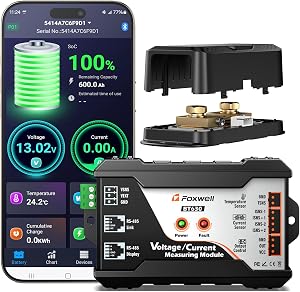
The FOXWELL is the big-range Bluetooth option because it combines a 600A smart shunt, 10V to 120V coverage, and app-based trend tracking in one package. On paper, it is one of the strongest data tools in the whole group.
Specs:
- Price Tier: $ Budget
- Weight: 0.92 lbs
- Materials: Heat-resistant fiberglass housing, metal shunt, protective cover
- Dimensions: 4.33 x 2.55 x 1.1 in
- Electrical Range: 10V to 120V, up to 600A, +/-0.4% stated accuracy
Pros:
- The 600A ceiling is the highest current rating in this roundup and suits larger inverter-backed battery banks.
- The 10V to 120V range covers common RV systems plus larger off-grid electrical setups.
- The app shows live voltage, current, power, SOC, temperature, and time remaining instead of only 1 or 2 readouts.
Cons:
- The report says installation guidance is weak, and that is a bigger problem on a 600A shunt than on a plug-in voltmeter.
- There is no built-in display, so all monitoring depends on Bluetooth and the app.
If you care about raw monitoring capability first, the FOXWELL looks like a bargain. The 600A rating and +/-0.4% stated accuracy are the main reasons we scored it 6.8/10, because those figures are strong for a budget-tier Bluetooth shunt aimed at big battery banks.
The protective cover and fiberglass housing sound more reassuring than the bare-shunt look of some low-cost rivals, and that extra physical security matters around busy battery compartments. We almost ranked it higher, yet the report’s repeated notes about poor instructions, calibration confusion, and uneven support keep it from feeling like an easy recommendation.
Choose this if you want high-range app-based shunt monitoring and are comfortable sorting out setup yourself. Skip it if you want polished instructions, a local screen, or a longer brand track record.
9. QWORK Battery Monitor Voltmeter Ammeter (8V-80V, 100A, 6.5 ft cable)
Best for budget RV and golf cart battery monitoring | RV Trekkers Rating: 6.4/10
The QWORK is a low-cost remote-display battery gauge for owners who want basic shunt data and a little more cable length than the smallest panel meters provide. It is a useful value pick, but it asks for patience during setup.
Specs:
- Price Tier: $ Budget
- Weight: 0.55 lbs
- Materials: Plastic display housing; metal shunt/sampler
- Dimensions: Panel cutout requires 2.15 in diameter; overall product dimensions not specified by manufacturer
- Electrical Range: 8V to 80V, 0 to 100A, 6.5 ft custom cable, backlit LCD

Pros:
- The 6.5 ft cable gives more mounting flexibility than a very short display lead.
- The screen shows voltage, current, consumed amp hours, and battery percentage on one backlit panel.
- The 8V to 80V range keeps it usable for many RV, boat, and golf-cart battery systems.
Cons:
- The 100A limit makes it less capable for high-draw inverter systems than the 300A, 500A, or 600A picks above.
- The report describes poor instructions, mixed accuracy, and resets after months of use, which weakens long-term confidence.
The QWORK lands near the bottom because it is useful but not especially refined. The 6.5 ft cable is the main reason we scored it 6.4/10, because that extra reach gives budget-minded RV owners a cleaner display-mounting path than many very short-wire monitors offer.
The backlit LCD sounds easy enough to read in a shaded cabin, but the setup notes in the source report feel rough in the same way many translated budget manuals do. We almost skipped it once the durability complaints showed up, though the core mix of voltage, current, and amp-hour data still has value at this price.
Buy this if you want a low-cost remote-display gauge and can spend time on calibration. Skip it if you want app control, better documentation, or confidence above 100A.
10. Redodo Battery Monitor with Shunt (8V-120V, 500A, programmable alarms)
Best for RV and off-grid battery state-of-charge monitoring | RV Trekkers Rating: 6.0/10
The Redodo is a straightforward 500A display monitor with broad chemistry support and useful alarms. It stays on the list because the feature set is solid, even if the setup experience looks less polished than the higher-ranked picks.
Specs:
- Price Tier: $ Budget
- Weight: 1.48 lbs
- Materials: Plastic display housing; metal shunt; shielded control cable
- Dimensions: 3.7 x 0.7 x 2.2 in
- Electrical Range: 8V to 120V, up to 500A, programmable high and low voltage alarm

Pros:
- The 500A shunt and 8V to 120V range fit 12V, 24V, and 48V RV or solar battery systems.
- The display tracks voltage, current, power, energy, remaining time, and state of charge in real time.
- Programmable high and low voltage alarms add a useful warning layer for battery protection.
Cons:
- The monitor has no Bluetooth or app access, so every check happens at the display.
- The report notes setup confusion and delicate control-cable ends, which is not ideal around tight battery boxes.
The Redodo makes sense for owners who want a broad-range shunt monitor with alarms and do not care about wireless control. The 500A range and alarm functions are the main reasons we scored it 6.0/10, because the hardware is useful even if the documentation and cable confidence lag behind the leaders.
The adjustable backlit screen sounds nicer than the fixed-glow displays on some cheaper meters, and that matters when you are checking the battery bank late after a 300-mile drive into camp. We almost moved it up a slot, yet the report’s warnings about fragile cable ends and weaker instructions make it harder to trust during install.
Choose this if you want a 500A display monitor with alarms for a multi-voltage battery bank. Skip it if you want Bluetooth, cleaner documentation, or tougher-feeling control cabling.
How Do These RV Battery Monitors Compare Side by Side?
The table shows a clear split between voltage-only convenience tools, mid-range display meters, and higher-amp smart shunts built for larger battery banks.
| Rank | Product | Award | RV Trekkers Rating | Price Tier | Voltage Range | Current Range | Monitoring Style | Weight |
|---|---|---|---|---|---|---|---|---|
| 1 | bayite DC 6.5-100V 0-100A LCD Meter View at Amazon | Best Overall | 9.5/10 | $ | 6.5V-100V | 0A-100A | LCD display + shunt | 0.44 lbs |
| 2 | Innova 3721 Battery and Charging System Monitor View at Amazon | Best Budget | 9.1/10 | $ | 12V negative ground | — | Plug-in LCD + bar graph + LEDs | 0.2 lbs |
| 3 | Renogy 500A Battery Monitor with Shunt View at Amazon | Best for RV and off-grid battery bank monitoring | 8.7/10 | $ | 10V-120V | 0A-500A | LCD display + 20 ft cable + shunt | 0.17 lbs |
| 4 | AiLi Battery Monitor Voltmeter Ammeter View at Amazon | Best for budget RV battery state-of-charge monitoring | 8.3/10 | $ | 8V-80V | 0A-100A | LCD display + shunt + amp-hour tracking | 0.44 lbs |
| 5 | Victron Energy SmartShunt View at Amazon | Best for monitoring without a dedicated display | 7.9/10 | $ | 6.5V-70V | 0A-500A | Bluetooth app + smart shunt | 0.73 lbs |
| 6 | DC 0-200V 0-300A Battery Monitor Meter View at Amazon | Best for budget RV and solar battery monitoring | 7.6/10 | $ | 0V-200V | 0A-300A | LCD display + 9-in-1 metrics + shunt | 0.62 lbs |
| 7 | ANCEL BM300 Pro Battery Monitor View at Amazon | Best for mixed-voltage monitoring | 7.2/10 | $ | 6V-24V | — | Bluetooth 5.3 app monitor | — |
| 8 | FOXWELL BT630 Smart Shunt View at Amazon | Best for Bluetooth monitoring of battery banks | 6.8/10 | $ | 10V-120V | 0A-600A | Bluetooth app + smart shunt | 0.92 lbs |
| 9 | QWORK Battery Monitor Voltmeter Ammeter View at Amazon | Best for budget RV and golf cart monitoring | 6.4/10 | $ | 8V-80V | 0A-100A | LCD display + 6.5 ft cable + shunt | 0.55 lbs |
| 10 | Redodo Battery Monitor with Shunt View at Amazon | Best for RV and off-grid SOC monitoring | 6.0/10 | $ | 8V-120V | 0A-500A | LCD display + shunt + alarms | 1.48 lbs |
Note: The selected-products report classifies all 10 winners in the Budget tier. Missing manufacturer values remain shown as — instead of being guessed.
What Do the Comparison Results Show?
The results show that the best choice depends less on price tier and more on current range, install style, and whether you want a local display or a phone-based monitor.
Display Convenience vs Battery-Bank Depth
The bayite and Innova rise to the top because both remove friction, but they do it in different ways. The bayite adds shunt-based current and power data, while the Innova sacrifices depth to give you a simple plug-in check from the dash.
Wider Range for Larger Systems
The Renogy, Victron, FOXWELL, and Redodo serve bigger battery banks because they move into 500A and 600A territory. That jump matters when an inverter, solar controller, or heavy DC load makes a 100A meter feel too small.
App-Based Monitoring vs Local Screens
The Victron, ANCEL, and FOXWELL lean into Bluetooth control, while the Renogy, AiLi, QWORK, and Redodo stay screen-first. The trade-off is straightforward: app monitors reduce wall clutter, but screen-based monitors keep working when the phone is not in your hand.
Install Friction and Documentation
The source report repeatedly rewards clean installs and punishes weak instructions. That pattern helps explain why the Renogy beats the FOXWELL even though the FOXWELL has a higher 600A ceiling, and why simple products like the bayite and Innova stay so high in the rankings.
Why Should You Trust Our Gear Reviews?
You can trust this review because RV Trekkers ties every recommendation to the ranked source report, keeps the pros and cons intact, and filters each monitor through real RV electrical use instead of storefront copy.
Ethan Walker is an RV travel expert, mechanical engineer, and NRVIA Certified RV Inspector who has logged 100,000+ documented miles and traveled through 40+ U.S. states. That background matters here because battery monitors are not isolated gadgets; they sit inside a larger charging, inverter, converter, and battery-bank system where one weak link can waste a whole weekend.
We also keep the scoring grounded in the product report’s operating range, shunt capacity, cable length, chemistry compatibility, and repeated customer pain points. If a monitor has fragile cable ends, confusing calibration, weak Bluetooth range, or poor screen visibility, those trade-offs stay in the review.
How Did We Evaluate These RV Battery Monitors?
We evaluated these monitors by comparing their electrical range, install style, visibility, and review-backed pain points against the way RV owners actually check a battery bank during travel and camp use.
Voltage, Current, and Battery-Bank Fit
We started with the core numbers: voltage range, current range, and whether the unit used a shunt or a simple receptacle plug. That first cut separated the 12V dash-style Innova from the 500A and 600A shunt monitors that fit larger house-battery systems.
Display Readability and Cable Layout
We looked closely at cable length, control style, and display behavior because those details change the install. A 20 ft shielded cable from Renogy gives more freedom than a short-wire panel meter, while reports of harsh backlighting, narrow viewing angles, or washed-out sunlight screens matter when you pull into camp after dark and want a fast reading.
App Control, Alarms, and Setup Burden
We compared Bluetooth monitors and local displays on the same terms: usable data, connection stability, and setup clarity. A smart shunt sounds great on paper, but if the app drops out behind a metal compartment or the manual leaves the shunt wiring muddy, that friction belongs in the score.
How Do You Choose the Best RV Battery Monitor for Your Rig?
The best RV battery monitor matches your battery-bank size, your preferred viewing method, and the amount of install work you are willing to take on.
Which monitor type fits your system?
There are 3 practical monitor types in this roundup, and each solves a different problem.
| Monitor type | Best use in this lineup | Main trade-off | Example picks |
|---|---|---|---|
| Plug-in voltage monitor | Quick 12V dash or receptacle checks | No current or amp-hour tracking | Innova 3721 |
| Display-based shunt monitor | Fixed in-coach readout with battery-bank data | More wiring and calibration work | bayite, Renogy, AiLi, DC, QWORK, Redodo |
| Bluetooth smart shunt or app monitor | Cleaner install with phone-based history | Signal range and app quality matter more | Victron, ANCEL, FOXWELL |
Which specs matter most?
The 3 numbers that matter most are voltage range, current range, and cable or connectivity style. A 100A meter is enough for many small battery-monitor jobs, but a bigger RV with a serious inverter is better served by the 300A DC meter, the 500A Renogy or Victron, or the 600A FOXWELL.
Use this checklist before you buy:
- Match the current range to the battery bank, especially if the rig uses a larger inverter or heavy DC loads.
- Measure the display location and cable path, because a 20 ft cable, a 6.5 ft cable, and a plug-in head all install very differently.
- Decide whether you trust a wall display or a phone app more during real campground use.
When is Bluetooth better than a screen?
Bluetooth is better when you want cleaner walls, battery history, or app-based data from a tucked-away shunt. A screen is better when you want a local readout every time, especially in cold weather, at night, or when you do not want the battery monitor to depend on signal strength or app behavior.
What Is the Final Verdict?
The bayite is the best RV battery monitor for most owners because it balances useful data, simple hardware, and low cost better than anything else in this lineup. The Innova 3721 Battery and Charging System Monitor is the easy plug-in choice for 12V rigs, the Renogy 500A Battery Monitor with Shunt is the better pick for a larger screen-based battery-bank setup, and the Victron Energy SmartShunt is the cleaner app-first option when your best RV battery monitor decision comes down to smarter shunt data instead of one more display on the wall.