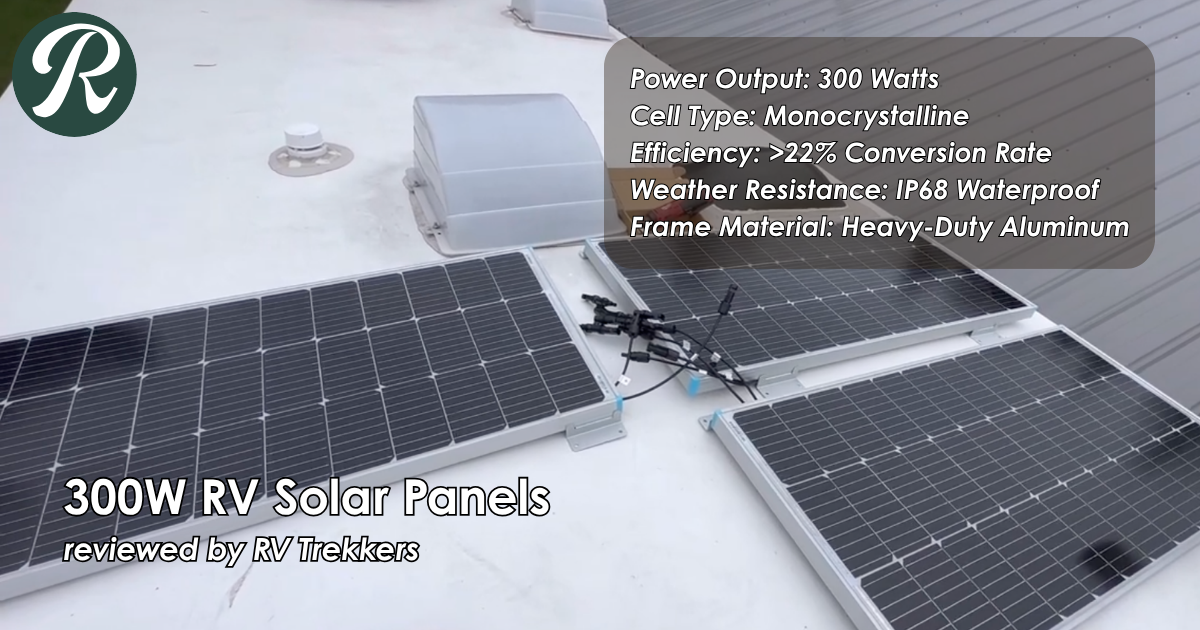
Best RV 300 watt solar panel searches usually point to one practical buying problem: finding a solar charging setup that gives an RV enough battery support without wasting roof space, storage room, or money on the wrong hardware. This guide stays inside that path from RV solar power to 300W-class charging setups to the suitcase panels, rigid modules, and starter kits that survived the final nine-product report.
The top pick is the Renogy 100 Watt 12 Volt Portable Solar Panel, and the best budget option is the SOLPERK Solar Panel Kit 20W 12V. Both work on 12V systems, but Renogy gives you a foldable 100W suitcase with a 20A waterproof controller while SOLPERK strips the buy-in down to a 20W kit with an 8A smart controller.
Contents
- What Is an RV 300 Watt Solar Panel?
- What Are the Quick Picks for the Best RV 300 Watt Solar Panel of 2026?
- 1. Renogy 100 Watt 12 Volt Portable Solar Panel (100W output, 12V system, 20A waterproof Voyager PWM charge controller)
- 2. SOLPERK Solar Panel Kit 20W 12V (20W max power, 12V system voltage, 8A smart charge controller included)
- 3. RICH SOLAR 100 Watt 12 Volt Premium Monocrystalline Solar Panel (100W maximum power, 12V DC nominal panel with 19.4V maximum voltage, 5.38A current and 3 ft cable with connectors)
- 4. HQST 2pcs 100W 12V Monocrystalline Solar Panel (100W maximum power per panel, 12V output, IP65 junction box and solar connectors)
- 5. Topsolar Solar Panel Kit 100 Watt 12 Volt Monocrystalline (100W maximum power, 19.5% panel efficiency, Vmp 23V and Imp 4.3A)
- 6. BLUETTI 100W Solar Panel (100W rated panel, up to 23.4% cell efficiency, IP67 water and dust resistance)
- 7. ALLPOWERS SP033 200W Portable Solar Panel (200W maximum power, 36.6V maximum voltage, 22% to 23% conversion efficiency)
- 8. BougeRV 9BB Cell 200 Watts Solar Panel (200W max power, 22.8% listed efficiency, 17.98V maximum voltage and 10.99A amperage capacity)
- 9. Newpowa PRO 100 Watt 12 Volt Monocrystalline Solar Panel (100W maximum power, 21.5% maximum efficiency, MC4 connectors with 3 ft pre-attached wires)
- How Do These 9 RV 300 Watt Solar Panel Options Compare Side by Side?
- What Do the Comparison Results Show?
- Why Should You Trust Our Gear Reviews?
- How Did We Score These RV 300 Watt Solar Panel Options?
- What Should You Look for in the Best RV 300 Watt Solar Panel?
- What Is the Final Verdict?
What Is an RV 300 Watt Solar Panel?
An RV 300 watt solar panel is either one higher-output photovoltaic module or a 300W-class charging setup built from smaller panels, a charge controller, and battery wiring sized for RV use.
That definition matters because this shortlist does not pretend every winner is a literal single 300W panel. The report only cleared 9 products, and most of them are 100W or 200W modules, portable suitcase panels, or starter kits that fit a broader RV solar charging system.
That split is where buyers get tripped up. A rigid roof panel, a foldable suitcase charger, and a compact power-station panel all live in the same solar category, but they solve different problems around roof loading, battery-bank charging, portability, and controller hardware.
TL;DR: Renogy is the best RV 300 watt solar panel pick for most buyers because it is the cleanest 12V-ready package in the report. RICH SOLAR and HQST make stronger modular roof-array foundations, while SOLPERK is the most budget-friendly complete kit.
What Are the Quick Picks for the Best RV 300 Watt Solar Panel of 2026?
These 9 picks cover the real buying lanes inside this keyword: portable suitcase panels, rigid roof modules, starter kits, and compact 200W options for buyers building toward a 300W-class RV solar setup.
1. Best Overall: Renogy 100 Watt 12 Volt Portable Solar Panel (100W output, 12V system, 20A waterproof Voyager PWM charge controller) ($ Budget)
↓ Jump to Review
2. Best Budget: SOLPERK Solar Panel Kit 20W 12V (20W max power, 12V system voltage, 8A smart charge controller included) ($ Budget)
↓ Jump to Review
3. Best for modular RV and off-grid battery charging setups: RICH SOLAR 100 Watt 12 Volt Premium Monocrystalline Solar Panel (100W maximum power, 12V DC nominal panel with 19.4V maximum voltage, 5.38A current and 3 ft cable with connectors) ($ Budget)
↓ Jump to Review
4. Best for compact RV and off-grid rooftop solar upgrades: HQST 2pcs 100W 12V Monocrystalline Solar Panel (100W maximum power per panel, 12V output, IP65 junction box and solar connectors) ($ Budget)
↓ Jump to Review
5. Best for budget 12V battery maintenance on RVs and small off-grid setups: Topsolar Solar Panel Kit 100 Watt 12 Volt Monocrystalline (100W maximum power, 19.5% panel efficiency, Vmp 23V and Imp 4.3A) ($ Budget)
↓ Jump to Review
6. Best for portable power station charging while camping: BLUETTI 100W Solar Panel (100W rated panel, up to 23.4% cell efficiency, IP67 water and dust resistance) ($ Budget)
↓ Jump to Review
7. Best for budget portable charging with MC4-compatible power stations: ALLPOWERS SP033 200W Portable Solar Panel (200W maximum power, 36.6V maximum voltage, 22% to 23% conversion efficiency) ($ Budget)
↓ Jump to Review
8. Best for fixed 200W RV roof installs with limited space: BougeRV 9BB Cell 200 Watts Solar Panel (200W max power, 22.8% listed efficiency, 17.98V maximum voltage and 10.99A amperage capacity) ($ Mid)
↓ Jump to Review
9. Best for compact RV roof installs and small off-grid 12V systems: Newpowa PRO 100 Watt 12 Volt Monocrystalline Solar Panel (100W maximum power, 21.5% maximum efficiency, MC4 connectors with 3 ft pre-attached wires) ($ Budget)
↓ Jump to Review
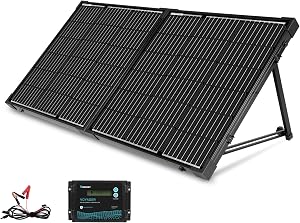
1. Renogy 100 Watt 12 Volt Portable Solar Panel (100W output, 12V system, 20A waterproof Voyager PWM charge controller)
Best Overall | RV Trekkers Rating: 9.5/10
Renogy takes the top spot because it is the cleanest out-of-box RV charging package in the report. The 93/100 ranking score pairs a foldable 100W suitcase panel with a 20A waterproof controller, so the core charging path is already assembled instead of split across multiple add-on orders.
Specs:
- Price Tier: $ Budget
- Weight: 26.6 lbs
- Materials: Aluminum frame, monocrystalline solar cells, glass panel surface, canvas protective case
- Dimensions: 24.8 x 20 x 2.8 in
- Solar Setup: 100W output; 12V system; 20A waterproof Voyager PWM charge controller; 22% efficiency
Pros:
- The 100W suitcase panel and 20A controller ship as one ready-to-use 12V kit, which cuts out at least 2 common add-on purchases.
- The 22% efficiency claim and adjustable kickstands make this package easier to reposition than a flat 100W roof panel.
- The 26.6 lb build is heavy, but it still gives more portable flexibility than a fixed rigid module.
Cons:
- The 26.6 lb weight is a lot for a portable 100W panel that may need repeated repositioning.
- The PWM controller leaves less charging-efficiency headroom than an MPPT-based setup.
The portable case is the reason this kit stays relevant for RV owners who do not want to drill into a roof on day one. A 24.8 x 20 in folded panel still takes up real storage space, but it gives you a way to chase sun from one campsite edge to another instead of parking the whole charging system on the roof and hoping for the best.
The materials tell the story before the battery clips ever touch a terminal. Glass, canvas, and an aluminum frame add more physical presence than a thin portable charger, and that sturdier format makes sense in a campground lane where dust, rough storage, and repeated setup are normal.
The trade-off is controller tech and weight. The PWM controller and the report’s warning about lower real-world 12V charging output are the two reasons this stopped at 9.5, yet the all-in-one kit is still the main reason it won. Skip it if you want MPPT efficiency or a lighter panel for frequent moves.
2. SOLPERK Solar Panel Kit 20W 12V (20W max power, 12V system voltage, 8A smart charge controller included)
Best Budget | RV Trekkers Rating: 9.1/10
SOLPERK wins the value lane because it gives buyers a full 20W kit, a smart controller, and an adjustable bracket for less money than several lighter-duty panels. It is still a battery-maintenance kit first, not a fast charger for a large RV bank.
Specs:
- Price Tier: $ Budget
- Weight: 3 lbs
- Materials: Aluminum frame, monocrystalline silicon cells, low-iron tempered glass
- Dimensions: 15 x 13.2 x 0.7 in
- Solar Setup: 20W max power; 12V system voltage; 8A smart charge controller included

Pros:
- The 20W panel output gives more charging margin than the 100W suitcase panel’s portability-focused package or any 4W to 12W maintainer panel.
- The 8A smart controller and included hardware remove at least 1 controller purchase from the build list.
- The 3 lb weight keeps this easier to handle than the 26.6 lb Renogy suitcase or the 22.9 lb BougeRV rigid panel.
Cons:
- The 20W panel is only a maintainer-class tool, not a realistic 300W replacement for an RV roof array.
- The report flags controller reliability and accessory quality, which matters more than the low entry price.
This kit is easy to understand because everything is small and direct. A 15 x 13.2 in panel, an adjustable bracket, and a controller in one box make more sense for a parked trailer or a battery tender role than for a full-time off-grid solar array.
The tempered-glass face and aluminum frame give it more substance than a dash panel, and that matters when the panel sits outside for weeks instead of one afternoon. It also helps that the report keeps the use case honest: battery maintenance, storage support, and light standby charging.
The mixed durability notes are why this did not beat Renogy. The 20W output, 8A smart controller, and low cost are the main reasons it still scored 9.1, but the long-term reliability questions keep it out of the top spot.
3. RICH SOLAR 100 Watt 12 Volt Premium Monocrystalline Solar Panel (100W maximum power, 12V DC nominal panel with 19.4V maximum voltage, 5.38A current and 3 ft cable with connectors)
Best for modular RV and off-grid battery charging setups | RV Trekkers Rating: 8.6/10
RICH SOLAR is the best foundation panel for buyers building a modular RV charging system one piece at a time. The 90/100 ranking score comes from solid output, standard mounting logic, and a format that is easier to expand in series or parallel than a suitcase kit.
Specs:
- Price Tier: $ Budget
- Weight: 13.2 lbs
- Materials: Aluminum, monocrystalline silicon, tempered glass
- Dimensions: 40.2 x 20.1 x 1.2 in
- Solar Setup: 100W maximum power; 12V DC nominal panel with 19.4V maximum voltage; 5.38A current and 3 ft cable with connectors

Pros:
- The 100W output and 19.4V maximum voltage make this a cleaner building block for a modular array than a portable 20W maintainer.
- The 13.2 lb weight is easier to roof-mount than the 22.9 lb BougeRV 200W rigid panel.
- The 3 ft connector leads and pre-drilled mounting format simplify expansion into 2-panel and 3-panel RV systems.
Cons:
- The report flags cracked glass, dented corners, and connector issues, which are serious on a rigid panel.
- Partial shade hits output hard, so the 100W rating is only useful on a well-planned roof or ground placement.
This is the kind of rigid panel that makes sense when a buyer is thinking about a real 300W-class roof array instead of a portable charger. A 40.2 x 20.1 in footprint is manageable on more RV roofs than a larger 200W slab, and the standard framed format is easier to pair with matching modules later.
The tempered-glass and aluminum construction also fit the fixed-install lane better than fabric-backed portable panels. It looks and reads like hardware meant to stay outside, not something you fold up after every stop.
The shipping and durability complaints are the main reasons it landed at 8.6 instead of pushing into the 9s. That install-friendly 100W format is still the main reason it scored well, and it is a smart buy if you want to build toward 200W or 300W in stages. Skip it if you want a one-box kit with a controller already included.
4. HQST 2pcs 100W 12V Monocrystalline Solar Panel (100W maximum power per panel, 12V output, IP65 junction box and solar connectors)
Best for compact RV and off-grid rooftop solar upgrades | RV Trekkers Rating: 8.2/10
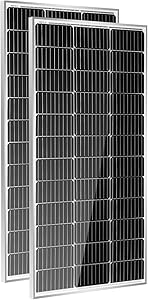
HQST earns its place because it gives you two compact 100W framed panels in one buy, which is the fastest path in this report toward a modular 200W-plus roof setup. The 88/100 ranking score reflects that rooftop value more than portable convenience.
Specs:
- Price Tier: $ Budget
- Weight: 12.13 lbs per panel
- Materials: Monocrystalline silicon cells, corrosion-resistant aluminum frame
- Dimensions: 38.2 x 22.7 x 1.18 in per panel
- Solar Setup: 100W maximum power per panel; 12V output; IP65 junction box and solar connectors; snow load 5400 Pa; wind load 2400 Pa
Pros:
- The 2-panel pack gives you 200W of nameplate output in one purchase, which is closer to a 300W-class build than any single 100W panel here.
- Each 12.13 lb panel is easier to place on a roof than a 22.9 lb single 200W rigid panel.
- The IP65 junction box and stated wind and snow load numbers give more install confidence than bare-bones flexible hardware.
Cons:
- The kit does not include a charge controller, brackets, or wiring hardware, so at least 3 supporting parts still sit on the shopping list.
- The report flags size differences versus older versions, which is a problem if you are expanding an existing array.
The case for HQST is simple: two smaller panels are easier to fit around vents, skylights, and AC shrouds than one large module. A 38.2 x 22.7 in panel still needs a plan, but the compact footprint is the exact reason this kind of bundle fits RV roof upgrades so well.
The corrosion-resistant aluminum frame and weather-rated junction box also point it toward permanent installation, not a travel-day charging accessory. This looks like rooftop hardware, and the report treats it that way.
The missing controller and the dimension mismatch risk are what held the score to 8.2. The 2 x 100W format is still the strongest reason to buy it, especially if your goal is to start at 200W and add another module later.
5. Topsolar Solar Panel Kit 100 Watt 12 Volt Monocrystalline (100W maximum power, 19.5% panel efficiency, Vmp 23V and Imp 4.3A)
Best for budget 12V battery maintenance on RVs and small off-grid setups | RV Trekkers Rating: 7.8/10
Topsolar stays relevant because it bundles a 100W panel, a controller, cables, and mounting brackets into a cheap starter package. The 85/100 ranking score reflects how much buying friction it removes, even though the included controller is the weak link.
Specs:
- Price Tier: $ Budget
- Weight: 15.84 lbs
- Materials: Monocrystalline silicon, tempered glass, aluminum frame
- Dimensions: 47.24 x 19.69 x 1.18 in
- Solar Setup: 100W maximum power; 19.5% panel efficiency; Vmp 23V and Imp 4.3A; includes 30A 12V or 24V PWM charge controller and 4 Z-brackets

Pros:
- The 100W panel, 30A controller, and 4 Z-brackets turn this into a more complete starter buy than a bare 100W module.
- The 15.84 lb panel is still lighter than the 22.9 lb BougeRV 200W rigid panel.
- The 23V Vmp gives buyers a clearer electrical starting point than vague controller-free listings.
Cons:
- The included PWM controller gets the most consistent quality complaints in the report.
- Shipping damage and missing accessories are recurring problems, which hurts a kit whose main selling point is completeness.
This kit is a classic starter-system purchase. The 47.24 x 19.69 in panel looks like real roof hardware, but the included brackets and controller are what make it attractive for RV owners who want one box instead of a parts spreadsheet.
That convenience comes with a catch. The panel itself gets better marks than the controller, and that split is exactly the kind of annoyance that shows up when a buyer wants a clean install but ends up replacing the weakest component in the box.
The complete parts list is the main reason this still scored 7.8. The shaky controller story is the reason it did not finish higher. Skip it if you want premium controller quality from the start.
6. BLUETTI 100W Solar Panel (100W rated panel, up to 23.4% cell efficiency, IP67 water and dust resistance)
Best for portable power station charging while camping | RV Trekkers Rating: 7.3/10
BLUETTI belongs here because it is the best pure portable panel in the report for buyers charging a power station at camp. The 84/100 ranking score comes from portability, strong efficiency claims, and broad camping appeal rather than from fixed RV battery-bank utility.
Specs:
- Price Tier: $ Budget
- Weight: 12.6 lbs
- Materials: Monocrystalline silicon
- Dimensions: 21 x 18.5 x 3 in
- Solar Setup: 100W rated panel; up to 23.4% cell efficiency; IP67 water and dust resistance; VOC 24.6V

Pros:
- The 100W rated panel and 23.4% efficiency claim make it one of the more serious portable chargers in this lineup.
- The 12.6 lb foldable format is much easier to carry than a 26.6 lb suitcase panel.
- The IP67 rating gives this more outdoor credibility than portable panels with weaker weather language.
Cons:
- The report ties the strongest use case to power stations, not direct RV house-battery charging.
- Real-world output can land well below the 100W label, especially when weather and angle go against you.
This is the portable-camp option, not the roof-array option. A 21 x 18.5 x 3 in folded panel with kickstands is easy to stash, easy to aim, and easy to pair with a battery box or portable station when shore power disappears for a weekend.
The limitation is just as clear. The report keeps circling back to power-station compatibility, cable questions, and kickstand quality, which tells you exactly where this panel shines and where it starts to drift away from a true RV 300W roof plan.
That focused use case is why it scored 7.3. The portable format and IP67 build make sense for camp charging, but this is not the most natural pick if your real goal is a permanent 300W-class RV solar array.
7. ALLPOWERS SP033 200W Portable Solar Panel (200W maximum power, 36.6V maximum voltage, 22% to 23% conversion efficiency)
Best for budget portable charging with MC4-compatible power stations | RV Trekkers Rating: 6.9/10
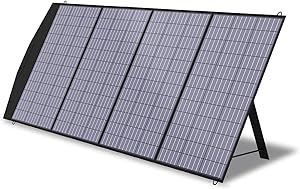
ALLPOWERS makes the list because 200W of portable output at this price gets attention fast. The 82/100 ranking score reflects that value story, but the report is just as clear about the weak kickstands, short cables, and lower-than-expected real-world output.
Specs:
- Price Tier: $ Budget
- Weight: 13.9 lbs
- Materials: Nylon, PET surface
- Dimensions: 25.6 x 20.3 x 2.4 in
- Solar Setup: 200W maximum power; 36.6V maximum voltage; 22% to 23% conversion efficiency; MC4 connectors
Pros:
- The 200W maximum power rating is the highest portable number in the report.
- The 13.9 lb foldable build is easier to carry than a 22.9 lb rigid 200W roof panel.
- The MC4 connectors make this easier to integrate with compatible power stations and controller setups.
Cons:
- The report says real-world output often falls short of the 200W label, which matters on a panel sold on wattage.
- The kickstands and cable length are recurring complaints, which adds setup friction on a large portable panel.
The appeal here is obvious on paper. A 200W foldable panel looks like a shortcut to serious portable charging, and the MC4 connector path gives it broader system flexibility than many camping-only panels.
The downside is that the portable format still asks a lot from the physical hardware. Nylon, PET, long unfolded sections, and stand stability all matter more once the panel has to sit through wind, repeated packing, and awkward cable routes around an RV site.
The 200W headline is the main reason it survived the cut. The weaker real-world output and stand complaints are the reasons it stopped at 6.9. Buy it if price and portability matter more than maximum certainty.
8. BougeRV 9BB Cell 200 Watts Solar Panel (200W max power, 22.8% listed efficiency, 17.98V maximum voltage and 10.99A amperage capacity)
Best for fixed 200W RV roof installs with limited space | RV Trekkers Rating: 6.4/10
BougeRV is the rigid 200W panel for buyers who want more output per module without jumping to a portable folding charger. The 82/100 ranking score reflects that compact 200W promise, but shipping damage and current unavailability are serious ownership problems.
Specs:
- Price Tier: $ Mid
- Weight: 22.9 lbs
- Materials: Aluminum frame and monocrystalline silicon cells
- Dimensions: 58.27 x 27.76 x 1.38 in
- Solar Setup: 200W max power; 22.8% listed efficiency; 17.98V maximum voltage and 10.99A amperage capacity

Pros:
- The 200W maximum output gives more roof-array progress per panel than every 100W module here.
- The 58.27 x 27.76 in footprint is still compact for a rigid 200W panel aimed at limited roof space.
- The 10-year product warranty and 25-year power warranty are stronger than several budget listings in this report.
Cons:
- The 22.9 lb weight is a real installation burden on a single rigid panel.
- The report flags bent frames, crushed corners, and current listing unavailability, which adds major buying risk.
This panel makes sense only in the fixed-install lane. A 200W module with a compact-for-class footprint is attractive when roof area is tight and the buyer wants fewer modules, fewer rail gaps, and fewer wire junctions.
The catch is ownership risk. Heavy rigid panels already ask more from packaging and shipping, and the report repeats that point through bent frames, damaged corners, and hidden cracks that show up after install.
That risk is exactly why this landed at 6.4 instead of finishing near the top. The 200W rigid format is useful, but the combination of shipping complaints and an unavailable listing makes it hard to recommend over a cleaner 100W modular path.
9. Newpowa PRO 100 Watt 12 Volt Monocrystalline Solar Panel (100W maximum power, 21.5% maximum efficiency, MC4 connectors with 3 ft pre-attached wires)
Best for compact RV roof installs and small off-grid 12V systems | RV Trekkers Rating: 6.0/10
Newpowa closes the list because it is a compact 100W rigid panel with a clean roof-install profile. The 80/100 ranking score comes from size efficiency and decent hardware, while the weak points are missing accessory support and unclear warranty detail.
Specs:
- Price Tier: $ Budget
- Weight: 14.16 lbs
- Materials: Monocrystalline silicon with anodized aluminum frame
- Dimensions: 42.32 x 21.34 x 1.1 in
- Solar Setup: 100W maximum power; 21.5% maximum efficiency; MC4 connectors with 3 ft pre-attached wires

Pros:
- The 42.32 x 21.34 in footprint is easier to place on crowded RV roofs than a larger 200W rigid module.
- The 21.5% efficiency claim and 3 ft pre-attached wires make it a practical 100W building block.
- The 14.16 lb weight stays manageable for a framed roof panel in this class.
Cons:
- The panel ships without mounting hardware or a controller, which leaves at least 2 core system pieces unbought.
- The report says warranty terms are not clearly stated on the product page, which adds uncertainty after install.
The strongest part of this panel is proportion. A compact 100W framed module is easier to work around vents, roof racks, and wiring routes than a larger slab, which is why this kind of product still belongs in a 300W-class shortlist.
The weaker part is support gear. The report keeps pointing back to what is not included – controller, mounting hardware, and clearer warranty terms – and those gaps matter more once a buyer moves from browsing to a real roof install.
That clean size-to-output ratio is the main reason it still scored 6.0. Skip it if you want a more complete starter kit or a stronger warranty story.
How Do These 9 RV 300 Watt Solar Panel Options Compare Side by Side?
Renogy leads for all-in-one convenience, while RICH SOLAR, HQST, and BougeRV make the strongest cases for buyers piecing together a fixed 200W to 300W-class RV solar array.
| # | Product | Award | RV Trekkers Rating | Price | Output | System Detail | Key Hardware | Weight |
|---|---|---|---|---|---|---|---|---|
| -> 1 | Renogy 100W Portable View at Amazon | Best Overall | 9.5/10 | $ | 100W output | 12V system | 20A waterproof Voyager PWM charge controller | 26.6 lbs |
| 2 | SOLPERK 20W Kit View at Amazon | Best Budget | 9.1/10 | $ | 20W max power | 12V system voltage | 8A smart charge controller included | 3 lbs |
| 3 | RICH SOLAR 100W View at Amazon | Best for modular RV and off-grid battery charging setups | 8.6/10 | $ | 100W maximum power | 12V DC nominal panel with 19.4V maximum voltage | 5.38A current and 3 ft cable with connectors | 13.2 lbs |
| 4 | HQST 2 x 100W View at Amazon | Best for compact RV and off-grid rooftop solar upgrades | 8.2/10 | $ | 100W maximum power per panel | 12V output | IP65 junction box and solar connectors | 12.13 lbs per panel |
| 5 | Topsolar 100W Kit View at Amazon | Best for budget 12V battery maintenance on RVs and small off-grid setups | 7.8/10 | $ | 100W maximum power | 19.5% panel efficiency | Vmp 23V and Imp 4.3A | 15.84 lbs |
| 6 | BLUETTI 100W View at Amazon | Best for portable power station charging while camping | 7.3/10 | $ | 100W rated panel | up to 23.4% cell efficiency | IP67 water and dust resistance | 12.6 lbs |
| 7 | ALLPOWERS SP033 200W View at Amazon | Best for budget portable charging with MC4-compatible power stations | 6.9/10 | $ | 200W maximum power | 36.6V maximum voltage | 22% to 23% conversion efficiency | 13.9 lbs |
| 8 | BougeRV 200W View at Amazon | Best for fixed 200W RV roof installs with limited space | 6.4/10 | $$ | 200W max power | 22.8% listed efficiency | 17.98V maximum voltage and 10.99A amperage capacity | 22.9 lbs |
| 9 | Newpowa PRO 100W View at Amazon | Best for compact RV roof installs and small off-grid 12V systems | 6.0/10 | $ | 100W maximum power | 21.5% maximum efficiency | MC4 connectors with 3 ft pre-attached wires | 14.16 lbs |
The easiest all-in-one pick is Renogy 100W Portable, while the best modular roof-array foundations are RICH SOLAR 100W and HQST 2 x 100W. The most direct jump to a 200W rigid module is BougeRV 200W, but its buying risk is higher.
Note: Table wording follows the selected-products report. Prices were analyzed from the report on March 21, 2026 and can change. Only 9 products met the final ranking filters for this keyword.
What Do the Comparison Results Show?
The comparison shows 3 clear lanes: portable suitcase charging, modular 100W roof builds, and larger 200W panels that trade simplicity for faster progress toward a 300W-class RV solar setup.
Price & Value
Renogy and SOLPERK win value in different ways. Renogy gives buyers the cleanest out-of-box 12V package, while SOLPERK gets buyers into solar maintenance for far less money with a 20W panel, controller, and bracket in one kit.
The harder value calls sit lower in the table. BougeRV carries a mid-tier price label and current availability problems, and ALLPOWERS asks buyers to trust a 200W portable claim even though the report keeps warning about weaker real-world output and stand stability.
Expandability & Roof Fit
RICH SOLAR, HQST, and Newpowa make the strongest modular case because they are rigid 100W roof panels, not portable campsite accessories. HQST is the quickest route to 200W because the purchase already includes 2 panels, while RICH SOLAR and Newpowa fit buyers who want to add one module at a time.
BougeRV also deserves mention here because a single 200W rigid panel can simplify rail planning on a crowded roof. The problem is that the heavier 22.9 lb format raises installation risk, and the shipping-damage notes take some of the shine off the compact 200W promise.
Portability & Setup Friction
Renogy, BLUETTI, and ALLPOWERS win the portability conversation because they are built to move. Renogy is the heaviest portable option at 26.6 lbs, but its suitcase shape and built-in controller still make more sense for direct battery charging than the power-station-first BLUETTI or ALLPOWERS panels.
The rigid panels are simpler once mounted and more annoying before that point. Topsolar softens that friction with its included controller and brackets, but RICH SOLAR, HQST, and Newpowa still ask buyers to solve more of the system around the panel itself.
Hardware, Durability & Risk
The best hardware stories in the report belong to Renogy, RICH SOLAR, and HQST. Those products pair sturdier materials, weather-ready framing, or stronger electrical details with clear RV use cases, which is exactly why their editorial scores land above the rest of the field.
The risk flags are also easy to see. Topsolar carries controller complaints, ALLPOWERS carries kickstand and cable complaints, BougeRV carries shipping-damage and availability issues, and Newpowa leaves warranty terms too vague for a stronger finish.
Why Should You Trust Our Gear Reviews?
You should trust this guide because RV Trekkers built it around one product report, one editorial rating system, and one RV reviewer profile with 100,000+ documented miles.
RV Trekkers focuses on smarter RV decisions backed by real miles, and that matters here because solar gear fails in expensive ways when buyers pick the wrong panel format, controller, or roof fit. Our lead reviewer, Ethan Walker, is a mechanical engineer and NRVIA Certified RV Inspector who has logged 100,000+ documented miles across 40+ states, lived through multiple RV platform changes since 2012, and built his reputation around power systems, towing, and technical decision-making for real rigs. The ratings in this article are RV Trekkers editorial scores, not retailer star ratings, and every score follows the same performance, durability, value, ease-of-use, and safety framework.
How Did We Score These RV 300 Watt Solar Panel Options?
We scored these RV 300 watt solar panel options on 5 factors from the editorial framework: performance, build quality, value for money, ease of use, and safety/features.
Performance & Charging Role
Performance starts with output and electrical detail, not just the headline watt number. That is why a 100W panel like Renogy or RICH SOLAR can outrank a 200W panel like ALLPOWERS or BougeRV when the surrounding hardware, install path, or real-world risk looks better.
The keyword itself also needed a reality check. The report only qualified 9 products, and many of them are 100W or 200W options, so the scoring had to separate panels built for true modular RV charging from panels built for lighter maintenance or power-station use.
Build Quality & Durability
Build quality came from the materials, frame style, weather language, and damage risks listed in the report. Tempered glass, aluminum framing, protected junction boxes, and clearer warranty support all pushed scores upward, while shipping damage, flimsy kickstands, or unclear warranty terms pulled scores down.
That is why RICH SOLAR and HQST look stronger than some lower-ranked portable options even though the portable panels sound easier to live with at first glance. On an RV, hardware durability and install stability matter just as much as nameplate wattage.
Value for Money & Kit Completeness
Value was not just price. It was price plus hardware completeness, which is why SOLPERK and Topsolar stayed competitive even though neither is a true 300W solution by itself.
A cheaper panel with no controller, no brackets, and unclear support can still become the more expensive choice after the rest of the order is finished. That is the exact gap the scoring system tries to expose.
Ease of Use & RV Fit
Ease of use came from weight, dimensions, included connectors, and the kind of solar system each product is actually built to support. A foldable suitcase panel is easier to deploy without roof drilling, while a rigid module is easier to leave alone once the rails and wiring are done.
RV fit matters just as much. Compact framed 100W panels scored well because they are easier to place around vents, AC units, and roof racks, while bulky or fragile portable formats lost points when the setup looked awkward for normal RV travel or storage.
What Should You Look for in the Best RV 300 Watt Solar Panel?
The best RV 300 watt solar panel depends on whether you are building a modular roof array, carrying a portable solar charger, or buying a small kit to keep a 12V battery alive between trips.
Are You Buying a 300W-Class Setup or Just One Panel?
This is the first question because the shortlist spans 20W maintainers, 100W framed modules, 100W suitcase panels, and 200W portable or rigid panels. Those are not interchangeable even if they all live under the same keyword.
| Buying Goal | Best Match in This Report | Why It Fits |
|---|---|---|
| Portable direct battery charging | Renogy 100W Portable | Includes a 20A controller and folds into a suitcase format |
| Budget battery maintenance | SOLPERK 20W Kit | Includes a controller and bracket at the lowest buy-in |
| Modular roof build toward 300W | RICH SOLAR 100W, HQST 2 x 100W, Newpowa 100W | Easier to place, expand, and wire into a fixed RV solar array |
| Larger single-panel progress | BougeRV 200W | Delivers 200W in one rigid module, though the risk profile is higher |
| Portable power-station charging | BLUETTI 100W, ALLPOWERS 200W | Better fit for camp charging than for fixed RV battery systems |
That table explains why this keyword gets messy. A buyer who wants a 300W roof array is shopping for different hardware than a buyer who wants a panel to prop outside the rig for the weekend.
Which Controller and Connector Questions Matter Most?
Controllers matter because they decide how much extra shopping still sits ahead of you. Renogy, SOLPERK, and Topsolar all include controller hardware, while RICH SOLAR, HQST, BougeRV, and Newpowa leave that decision outside the box.
Connector path matters for the same reason. MC4 leads, SAE hookups, battery clips, and portable-power-station adapters all sound close on a product page, but they send the panel toward very different jobs in the real RV electrical system.
How Much Roof or Storage Space Does the Panel Need?
Dimensions are not filler specs on RV gear. A 58.27 x 27.76 in rigid panel like BougeRV creates a different roof-planning problem than a 38.2 x 22.7 in HQST panel or a 24.8 x 20 x 2.8 in folded Renogy suitcase.
Weight also changes the answer. A 3 lb maintainer kit like SOLPERK is easy to move and easy to store, while a 26.6 lb suitcase panel or a 22.9 lb rigid module asks for more deliberate handling every time it gets installed, removed, or repositioned.
What Buying Traps Show Up in This Shortlist?
The first trap is treating a maintainer or portable charger like a full 300W RV solar array. The report keeps separating those use cases, and buyers who ignore that line usually end up paying twice.
The second trap is ignoring damage and warranty language. Shipping complaints hurt rigid panels more than portable ones, and unclear warranty terms hurt lower-ranked budget modules more than the top finishers.
The third trap is buying on wattage alone. A 200W label looks stronger than a 100W label, but the better buy is still the panel with the cleaner install path, the safer hardware, and the clearer role in your RV charging system.
What Is the Final Verdict?
Renogy is the best RV 300 watt solar panel pick for most buyers because it is the cleanest 12V-ready package in the report, while RICH SOLAR and HQST are better foundations for buyers building a modular 300W-class roof array.
If you want the easiest portable setup, buy the Renogy 100 Watt 12 Volt Portable Solar Panel. If your goal is a fixed array that can grow toward 300W, the RICH SOLAR 100 Watt 12 Volt Premium Monocrystalline Solar Panel and the HQST 2pcs 100W 12V Monocrystalline Solar Panel make more sense. If budget matters more than output, the SOLPERK Solar Panel Kit 20W 12V is still the most budget-friendly complete entry point in the report.
That loops back to the main question in the H1. The best RV 300 watt solar panel is not just the product with the biggest watt label. It is the panel or panel combination that fits your roof, your controller plan, your battery bank, and the way your RV actually uses solar power.