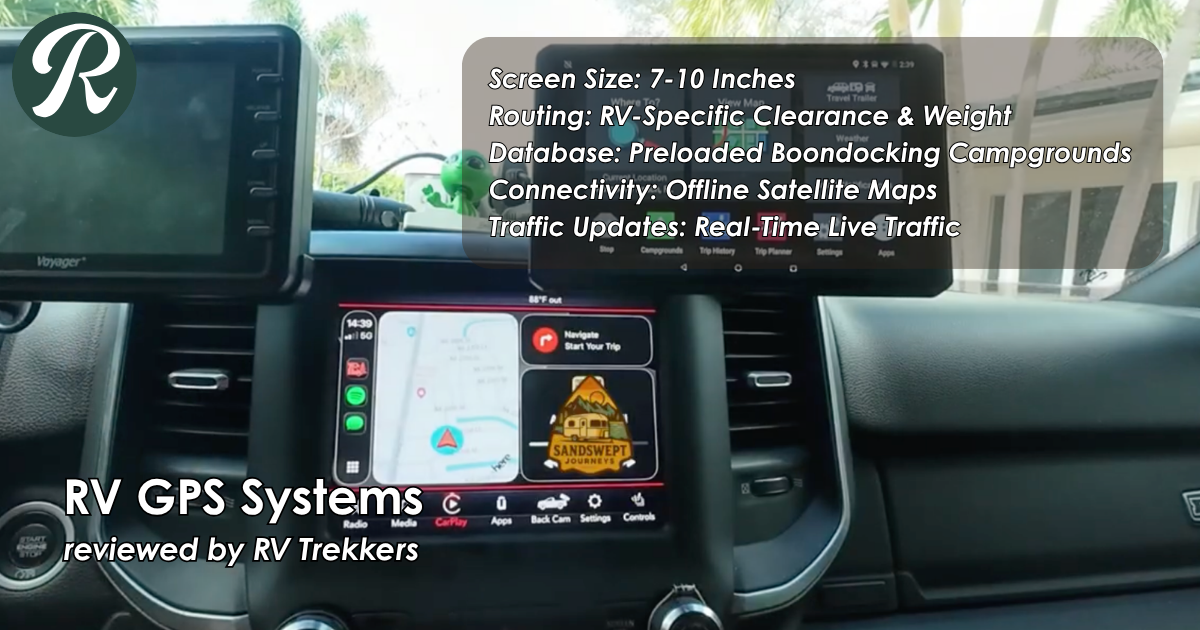
Best RV GPS options are dedicated navigation units that route larger rigs without leaning on cell coverage or a phone battery. This guide answers that buyer question first, then moves from the broader RV navigation-device category to truck-and-RV routing units and down to the 5 dashboard navigators that cleared the ranking filters.
Our top pick is the Garmin dezl 580 LMT-S, and the best budget runner-up is the Rand McNally TND 750. Both units pair custom routing with Wi-Fi connectivity, but the Garmin stays compact at 5 inches while the Rand stretches to 7 inches and 32 GB of storage. Every RV Trekkers score below is an editorial rating from our team, not a retailer star average.
Contents
- What Is an RV GPS?
- Which Quick Picks Define the Best RV GPS of 2026?
- What Makes the Best RV GPS for Real RV Travel?
- Which RV GPS Models Are Worth Buying in 2026?
- 1. Garmin dezl 580 LMT-S (5 in display, custom truck routing, Wi-Fi and Bluetooth)
- 2. Rand McNally TND 750 (7 in touchscreen, 32 GB storage, Bluetooth and Wi-Fi)
- 3. TomTom Trucker 620 (6 in touchscreen, truck maps, Wi-Fi and Bluetooth)
- 4. 9 in GPS Navigator for Car Truck RV (9 in touchscreen, 2026 maps, custom routing for 5 vehicle types)
- 5. OHREX N900 GPS Navigator (9 in touchscreen, lifetime updates, bridge height and weight alerts)
- How Do These Best RV GPS Picks Compare Side by Side?
- What Do the Comparison Results Show?
- Why Should You Trust Our Gear Reviews?
- How Did We Evaluate These RV GPS Units?
- How Do You Choose the Best RV GPS?
- What Is the Final Verdict?
What Is an RV GPS?
An RV GPS is a dedicated navigation unit that uses a map database and vehicle-profile routing to guide larger rigs around low clearances, weight limits, and lane changes.
In practice, that dashboard navigator sits between a phone app and a paper atlas. The parts that matter most are the touchscreen, the route engine, the map database, the Bluetooth or Wi-Fi radio, and the battery or power cord that keeps the system alive between stops. That matters in RV travel because a bad route is not a minor annoyance when a fifth-wheel, trailer, or tall Class C reaches a bridge that does not fit.
TL;DR: The Garmin dezl 580 LMT-S is the best RV GPS for most travelers because it pairs compact hardware with the deepest route logic in this field. The Rand McNally TND 750 is the better big-screen value pick, while the 9-inch budget units only make sense if size matters more than polish.
Which Quick Picks Define the Best RV GPS of 2026?
These 5 picks cover the main RV navigation jobs: best overall routing, best large-screen value, easiest Wi-Fi updating, biggest offline display, and budget-friendly 9-inch truck-and-RV guidance.
Only 5 products cleared the ranking filters for this keyword, so each pick fills a different use case.
1. Best Overall: Garmin dezl 580 LMT-S (5 in display, custom truck routing, Wi-Fi and Bluetooth) ($ Budget)
↓ Jump to Review
2. Best Budget: Rand McNally TND 750 (7 in touchscreen, 32 GB storage, Bluetooth and Wi-Fi) ($ Budget)
↓ Jump to Review
3. Best for Truck Drivers Who Want Wi-Fi Map Updates Without a Computer: TomTom Trucker 620 (6 in touchscreen, truck maps, Wi-Fi and Bluetooth) ($ Budget)
↓ Jump to Review
4. Best for Drivers Who Want a Large-Screen Offline GPS for Car, Truck, or RV Use: 9 in GPS Navigator for Car Truck RV (9 in touchscreen, 2026 maps, custom routing for 5 vehicle types) ($ Budget)
↓ Jump to Review
5. Best for Budget Large-Screen Truck and RV Routing: OHREX N900 GPS Navigator (9 in touchscreen, lifetime updates, bridge height and weight alerts) ($ Budget)
↓ Jump to Review
What Makes the Best RV GPS for Real RV Travel?
The best RV GPS balances routing logic, screen readability, update friction, and reliability complaints better than raw display size alone.
The first separator is route intelligence. Garmin, Rand, and TomTom all lean into truck-specific routing and restriction alerts, while the two 9-inch budget units lean harder on offline maps and big dashboards. A larger screen looks appealing, but a smarter route engine matters more than 2 to 4 extra inches when bridge height and weight limits start deciding the day.
The second separator is update path. Garmin, Rand, and TomTom give you Wi-Fi in the box, while OHREX asks for a Windows PC and external SD card, and the generic 9-inch model gives a lifetime-update promise without much hardware detail behind it. That difference hits the long game because map freshness is one of the first things buyers complain about in this category.
The third separator is trust. This lineup has only 5 qualified products, and the report flags caution on the lower-ranked models because the field gets thin fast once duplicate brands and weaker listings drop out.
Which RV GPS Models Are Worth Buying in 2026?
These 5 models are the only qualified picks in this keyword set, and the Garmin-Rand pair separates from the field on better-rounded route tools and fewer unresolved trade-offs.
1. Garmin dezl 580 LMT-S (5 in display, custom truck routing, Wi-Fi and Bluetooth)
Best Overall | RV Trekkers Rating: 9.5/10
The Garmin dezl 580 LMT-S ranks first because it gives RV travelers the strongest mix of route depth, compact size, and update convenience. It is the most complete navigation unit in this shortlist.
Specs:
- Price Tier: $ Budget
- Weight: 0.5 lbs
- Materials: Manufacturer materials not specified
- Dimensions: 5.9 x 1 x 3.7 in
- Routing Setup: Customized truck routing by size and weight, built-in Wi-Fi and Bluetooth, 16 GB internal storage, 2 hr battery life

Pros:
- The route engine supports 5 vehicle-profile inputs: height, weight, length, width, and hazardous materials.
- The unit adds 4 truck-specific alerts for bridge heights, weight limits, sharp curves, and steep grades.
- The 0.5 lb body and 5.9 x 1 x 3.7 in footprint fit tighter dashboards more easily than the 7 in and 9 in screens here.
Cons:
- The 5 in display gives up 2 to 4 inches of viewing area compared with every other pick in this guide.
- The listed 2 hr battery life is the shortest published endurance in the lineup.
The Garmin wins because its route engine handles more RV-relevant restrictions than any other model here. Those 5 vehicle-profile inputs plus 4 truck alerts give the navigator real decision-making depth beyond plain turn-by-turn mapping. That routing depth is the main reason we scored it 9.5/10.
We almost skipped it because the source report keeps circling back to freezes, shutdowns, and occasional satellite loss. On a late arrival after a long driving day, the 5-inch touchscreen feels dense rather than roomy, and that smaller display makes route prompts look busier than they do on the larger units.
The upside is that the compact chassis, truck-and-trailer service directory, and Wi-Fi updating still create the cleanest total package. Buy this if route quality matters more than screen size. Skip it if you want a 7 in to 9 in display or you do not trust older hardware.
2. Rand McNally TND 750 (7 in touchscreen, 32 GB storage, Bluetooth and Wi-Fi)
Best Budget | RV Trekkers Rating: 8.6/10
The Rand McNally TND 750 lands second because it gives RV drivers a larger dashboard screen without giving up custom routing. It is the better value pick for drivers who want more map real estate.
Specs:
- Price Tier: $ Budget
- Weight: Not listed by Amazon
- Materials: Plastic housing with LCD capacitive touchscreen
- Dimensions: 7.3 x 0.8 x 4.5 in
- Routing Setup: 7 in LCD touchscreen with 800 x 1280 resolution, 2 GB memory and 32 GB storage, Bluetooth and Wi-Fi connectivity, up to 5 hr battery life

Pros:
- The 7 in 800 x 1280 display gives you 2 more inches of screen than the Garmin and 1 more inch than the TomTom.
- The software layers in 4 live trip tools: traffic, construction, weather overlays, and fuel prices.
- The package includes 32 GB of storage plus truck-specific POIs, lane guidance, junction views, and mileage logs.
Cons:
- The listing gives 0 published weight data, which leaves storage planning less clear than expected.
- Power complaints matter more here because a navigator with up to 5 hr battery life still draws criticism for charging trouble.
The Rand solves a real RV pain point: a small screen is annoying when you are scanning lane guidance in an unfamiliar city. The 7-inch panel, custom trucking routes, and truck-specific POIs put more information in view without pushing the price beyond the Garmin. That better display-to-price balance is why it still holds an 8.6/10.
We almost pushed it lower because the report is blunt about charging problems, route misses, and signal loss. The magnetic mount sounds tidy on paper, but a navigation device feels a lot less reassuring once the battery and power accessories start becoming the weak link.
This is the right buy if you want a larger screen and a fuller live-data package at a budget-tier price. Buy this if map visibility matters more than compact storage. Skip it if power reliability and published carry weight are high on your list.
3. TomTom Trucker 620 (6 in touchscreen, truck maps, Wi-Fi and Bluetooth)
Best for Truck Drivers Who Want Wi-Fi Map Updates Without a Computer | RV Trekkers Rating: 7.8/10
The TomTom Trucker 620 holds third because it pairs a mid-size screen with a clean Wi-Fi update path. It is a convenience-first truck-and-RV route planner.
Specs:
- Price Tier: $ Budget
- Weight: 1.4 lbs
- Materials: Plastic housing, LCD display, magnetic mount
- Dimensions: 3.56 x 5.58 x 0.74 in
- Routing Setup: 6 in capacitive touchscreen, 480 x 272 resolution, Bluetooth and Wi-Fi connectivity, truck maps for USA and Canada

Pros:
- The route system covers 4 key routing variables: vehicle size, weight, cargo, and speed.
- The box includes 3 setup pieces beyond the navigator itself: an active magnetic mount, a car charger, and a USB cable.
- The 6 in display gives you 1 more inch than the Garmin while staying smaller than the 9 in budget units.
Cons:
- The asking price is far higher than the two 9 in budget models in this guide.
- The report flags 2 recurring frustrations at once: inaccurate truck routing and freezing glitches.
The TomTom earns third place because it keeps the update path simple while still giving RV users a dedicated route engine for large-vehicle travel. Those 4 routing variables matter once a camper, toy hauler, or boxy Class C turns a normal shortcut into a bad idea. That convenience-first setup is the main reason it scored 7.8/10.
We almost cut it because the report is also blunt about poor route accuracy in some areas. The 6-inch panel sits in the middle of this field, and that same middle-ground feel carries through the whole unit — not cramped like the Garmin, not roomy like the 9-inch screens.
The included mount and cable kit make it easier to deploy than the lower-ranked units, and Wi-Fi updates are a real quality-of-life gain. Buy this if update convenience is your main pain point. Skip it if you want the strongest value story or the cleanest routing confidence.
Best for Drivers Who Want a Large-Screen Offline GPS for Car, Truck, or RV Use | RV Trekkers Rating: 6.9/10
This generic 9-inch model ranks fourth because it gives the lineup its biggest low-cost display and offline mapping. It is the large-screen answer for buyers who care most about size.
Specs:
- Price Tier: $ Budget
- Weight: Not listed
- Materials: Not listed
- Dimensions: Not listed
- Routing Setup: 9 in capacitive touchscreen, preloaded North America maps with 2026 data and lifetime free updates, custom routing for car, RV, bus, van, and truck with speed camera and road alerts

Pros:
- The 9 in screen gives you 4 more inches than the Garmin and 2 more than the Rand.
- The software covers 5 vehicle types: car, RV, bus, van, and truck.
- The map package is preloaded with 2026 North America data and lifetime free updates, so offline routing starts out of the box.
Cons:
- The listing gives 0 published values for weight, dimensions, and materials.
- The report flags interface friction, and awkward menu flow feels worse on a display this large.
The main appeal is easy to see: a 9-inch screen in a budget-tier navigator is rare in this category. That screen size plus offline maps and 5 vehicle-type profiles keep it relevant for RV travelers who want basic routing without depending on a phone. Those size and value advantages keep it at 6.9/10.
We almost left it out because the report also flags thin brand detail and a clunky interface. A 9-inch display dominates more of the dash, which is great for quick glances, but that same size makes every laggy tap and awkward menu path stand out more.
This model makes sense if the biggest possible screen is the whole assignment and you accept sparse product detail. Buy this if you want a budget-friendly large display. Skip it if software polish and established support matter more than size.
Best for Budget Large-Screen Truck and RV Routing | RV Trekkers Rating: 6.0/10
The OHREX N900 takes fifth because it offers a 9-inch panel, lifetime maps, and large-vehicle alerts at a low price. Its trade-offs are harder to ignore than its screen size.
Specs:
- Price Tier: $ Budget
- Weight: 0.97 lbs
- Materials: Plastic housing, TFT LCD touchscreen, lithium battery
- Dimensions: 8.86 x 0.79 x 5.31 in
- Routing Setup: 9 in capacitive touchscreen with 800 x 480 resolution, preloaded North America maps with lifetime updates, custom truck routing with bridge height and weight limit alerts

Pros:
- The profile menu covers 6 driving modes: truck, RV, bus, taxi, ambulance, and car.
- The navigator adds lane guidance plus 5 alert groups: bridge heights, weight limits, curves, cameras, and crossings.
- The 0.97 lb body is lighter than the 1.4 lb TomTom even though both use dedicated dash hardware.
Cons:
- The update path asks for 1 Windows PC and 1 external SD card, which is clumsier than built-in Wi-Fi.
- The report flags 3 pain points at once: black-screen failures, hard map updates, and mixed routing accuracy.
The OHREX survives this list because the spec sheet is broad for the money. Those 6 driving modes, the 9-inch panel, and lifetime North America maps make the unit look attractive at first glance. That breadth is the main reason it still appears in the roundup at 6.0/10.
We almost skipped it because the reliability picture is rough. The large screen grabs attention on the dash, but the report also keeps pointing to dim brightness, inconsistent mount quality, and units that fail earlier than buyers expect.
The hard part is the maintenance path. Updating through a Windows PC and SD card is more work than the Wi-Fi route on Garmin, Rand, or TomTom. Buy this if low-cost 9-inch offline routing is the goal. Skip it if you want premium reliability or painless updates.
How Do These Best RV GPS Picks Compare Side by Side?
The Garmin wins the comparison for most RVers, while the Rand is the better large-screen value pick and the two 9-inch budget models only win on screen size.
| Rank | Product | Award | RV Trekkers Rating | Price Tier | Screen | Routing Focus | Connectivity | Update Path | Weight |
|---|---|---|---|---|---|---|---|---|---|
| 1 | Garmin dezl 580 LMT-S View at Amazon | Best Overall | 9.5/10 | $ | 5 in | Custom truck routing by size and weight | Wi-Fi, Bluetooth | Built-in Wi-Fi; 2 hr battery life | 0.5 lbs |
| 2 | Rand McNally TND 750 View at Amazon | Best Budget | 8.6/10 | $ | 7 in | Custom trucking routes | Bluetooth, Wi-Fi | Download 2025 maps; up to 5 hr battery life | — |
| 3 | TomTom Trucker 620 View at Amazon | Best for truck drivers who want Wi-Fi map updates without a computer | 7.8/10 | $ | 6 in | Truck routing for size, weight, cargo, and speed | Bluetooth, Wi-Fi | Wi-Fi updates for maps and services | 1.4 lbs |
| 4 | 9 in GPS Navigator View at Amazon | Best for drivers who want a large-screen offline GPS for car, truck, or RV use | 6.9/10 | $ | 9 in | Routing for car, RV, bus, van, and truck | — | 2026 North America maps; lifetime free updates | — |
| 5 | OHREX N900 View at Amazon | Best for budget large-screen truck and RV routing | 6.0/10 | $ | 9 in | Custom truck routing with bridge height and weight alerts | — | Lifetime updates via Windows PC and SD card | 0.97 lbs |
Note: We kept price tiers in the source report’s $ format, left missing values as —, and used only the listed routing, connectivity, update, and weight details from the selected-products report.
What Do the Comparison Results Show?
The table shows a clear split: Garmin and Rand own the dependable middle ground, while the two 9-inch budget units buy visibility by giving up polish and data completeness.
Screen size versus dash fit
Rand McNally TND 750 is the most balanced screen-size pick because 7 inches is large enough for easier map scanning without turning the unit into a giant slab on the windshield or dash. Garmin dezl 580 LMT-S goes the other direction and wins on compact packaging, which matters in tighter cockpits where every mount arm and charging cable starts fighting for space.
9 in GPS Navigator and OHREX N900 win raw visibility. They lose ground because the source report leaves more unanswered questions around hardware detail, interface quality, and long-term confidence. A bigger panel is useful, but it does not erase weak product detail.
Routing depth and alerts
Garmin dezl 580 LMT-S leads on route logic because its custom routing covers 5 profile inputs plus 4 truck alerts. TomTom Trucker 620 is also strong here, since the route engine looks at size, weight, cargo, and speed rather than generic car-navigation assumptions.
OHREX N900 and the generic 9 in GPS Navigator still cover bridge, weight, speed-camera, and road alerts, but the reporting around route accuracy is shakier. That is the core trade-off in this field: the cheaper large-screen units promise broad routing, yet the higher-ranked units give fewer reasons to doubt the route engine.
Update path and long-term friction
Garmin dezl 580 LMT-S, Rand McNally TND 750, and TomTom Trucker 620 all have Wi-Fi in the box, and that lowers maintenance friction over time. TomTom Trucker 620 deserves credit here because its entire award is tied to map updates that do not require a computer.
OHREX N900 is the hardest long-term ownership case because updates go through a Windows PC and SD card. The generic 9 in GPS Navigator promises lifetime updates too, but the listing gives far less surrounding detail, which makes the promise harder to evaluate.
Why Should You Trust Our Gear Reviews?
These rankings are trustworthy because RV Trekkers combines engineering training, RV inspection credentials, and more than 100,000 documented travel miles.
Ethan Walker brings a background that fits this category unusually well: a B.S. in Mechanical Engineering, NRVIA Certified RV Inspector credentials, NRVTA maintenance training, and full-time RV experience that spans more than 40 U.S. states. He also lives with the daily realities behind this product class in a 38-ft fifth-wheel towed by a 2022 Ford F-350 Super Duty. That mix matters when a route planner, touchscreen, battery, and map database all have to work together after a long drive.
How Did We Evaluate These RV GPS Units?
We evaluated each RV GPS against 4 buyer-critical points: routing logic, screen usability, update path, and the severity of reliability complaints recorded in the source report.
Routing logic and restriction handling
We scored route depth first because RV navigation is not ordinary car navigation. A unit moved up when the report listed vehicle-size routing, bridge-height alerts, weight-limit warnings, lane guidance, or truck-specific POIs. Garmin, Rand, and TomTom rose on this test because their route engines go beyond generic offline mapping.
Screen usability in a real RV cockpit
We compared the published 5-inch, 6-inch, 7-inch, and 9-inch screens against the realities of RV dashboards. A larger panel earned points for glanceability, but it also had to justify its space with better visibility or better route context. Missing weight and dimension data counted against the generic 9-inch model because cockpit fit is part of ownership, not a side note.
Update friction and maintenance path
We treated map maintenance as an ownership cost. Built-in Wi-Fi scored better than a Windows-PC-plus-SD-card workflow because easier updates reduce the odds that a route planner runs on stale data. The TomTom and Garmin gained ground here, while OHREX lost ground because the update path is plainly more awkward.
Reliability flags and support confidence
We also weighted the downside notes in the report. Freezing, shutdowns, route misses, charging failures, dim screens, and black-screen complaints all matter because a navigation device is only useful when the hardware stays alive and the map database stays trustworthy. That is why the lower-ranked units stayed lower even when they looked attractive on price or screen size.
How Do You Choose the Best RV GPS?
Choose an RV GPS by matching the route engine, screen size, update path, and brand support to your rig and travel style.
Is a dedicated RV GPS better than a phone app?
A dedicated navigation unit is better when your route depends on vehicle dimensions, not just traffic. The stronger picks in this guide use truck-style logic, which means the route engine looks at height, weight, cargo, bridge limits, and lane guidance in ways a generic phone app often does not.
That does not make every dedicated unit equal. The better question is whether the hardware solves a real pain point such as offline maps, truck alerts, or bigger dashboard visibility.
How much screen size fits your dashboard?
Screen size is useful when it matches the cockpit. A 9-inch display looks great on paper, but it takes more room and makes menu clunkiness harder to ignore. A 5-inch or 6-inch navigator saves space, while a 7-inch screen tends to be the middle ground for readability and fit.
| Screen size | Best fit | Main upside | Main trade-off |
|---|---|---|---|
| 5 in | Tight dashboards and simple mounts | Compact footprint | Denser map view |
| 6 in | Drivers who want a middle-ground unit | Better visibility than 5 in | Less roomy than 7 in or 9 in |
| 7 in | Most RV dashboards | Easier glance reading | Bigger mount footprint |
| 9 in | Large cockpits and max visibility | Largest map area | More space, more interface exposure |
Which update path wastes the least time?
Wi-Fi is the cleanest answer because the navigator stays self-contained. Garmin, Rand, and TomTom all use that approach. OHREX uses a Windows PC plus SD card, which adds friction every time the map database needs attention.
Support detail matters too. Listings with clear maintenance notes, storage data, and hardware context are easier to trust than vague lifetime-update promises with missing weight, dimension, or material fields.
What Is the Final Verdict?
The Garmin dezl 580 LMT-S is the best RV GPS here because it balances route intelligence, compact size, and feature depth better than the other 4 models.
If your version of best RV GPS means the most complete dedicated route planner for a trailer, fifth-wheel, or motorhome, buy the Garmin dezl 580 LMT-S. If you want a larger screen at a similar budget-tier price, the Rand McNally TND 750 is the better alternative, and the 9 in GPS Navigator for Car Truck RV is the low-cost big-display fallback. That closes the loop on the core topic: the best RV GPS is the one that routes your rig cleanly without turning every update, mount, and dashboard glance into extra work.