Best RV Short Queen Mattresses of 2026
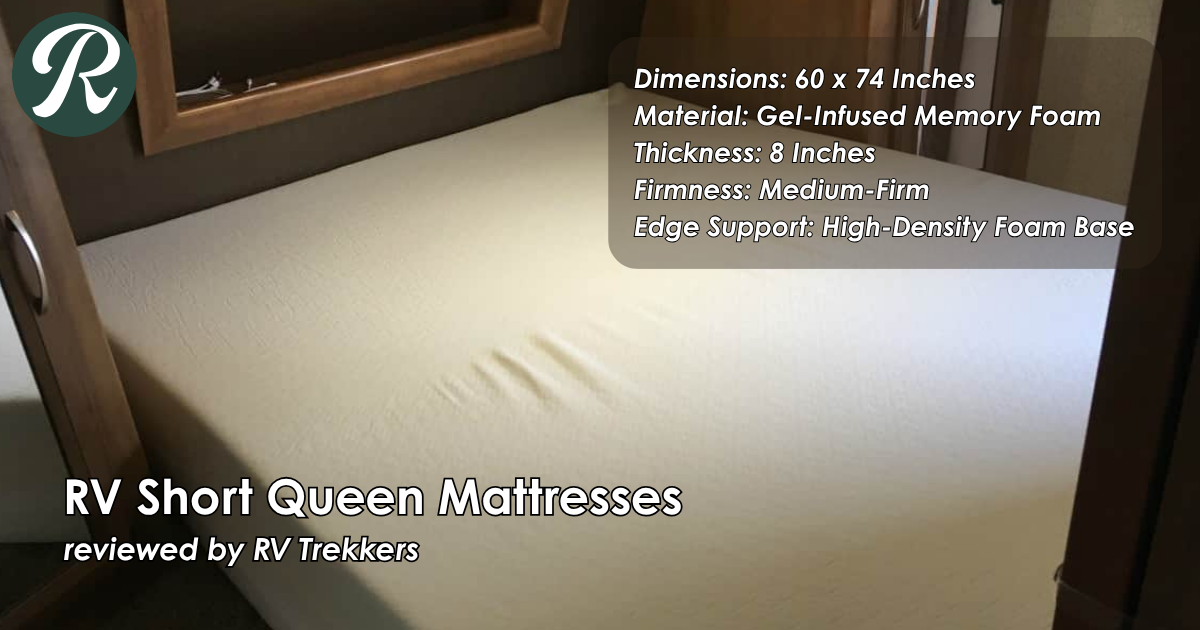
The best RV short queen mattresses solve 2 problems at once: they fit a tight
RV mattresses are manufactured in non-standard sizes to fit fixed-position frames. Types include innerspring, memory foam, and hybrid construction. Short Queen (60×74 in) is the most common size. Mattress thickness must be compatible with slide-out clearance.
The best RV short queen mattresses solve 2 problems at once: they fit a tight
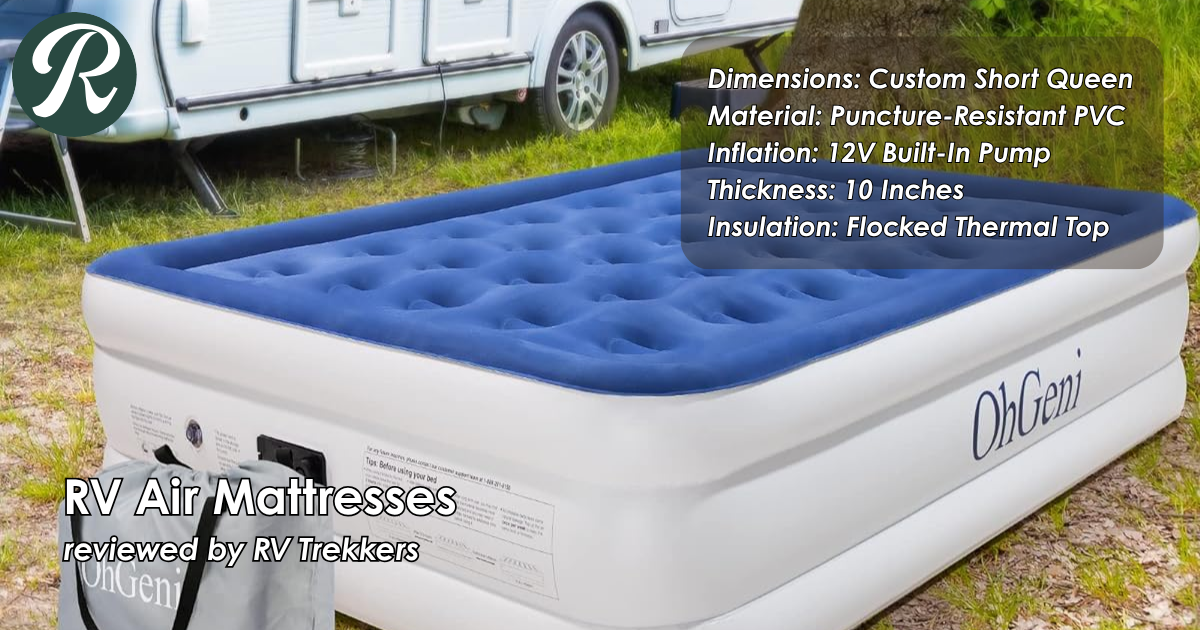
Best rv air mattresses searches usually come down to one practical problem: you need an
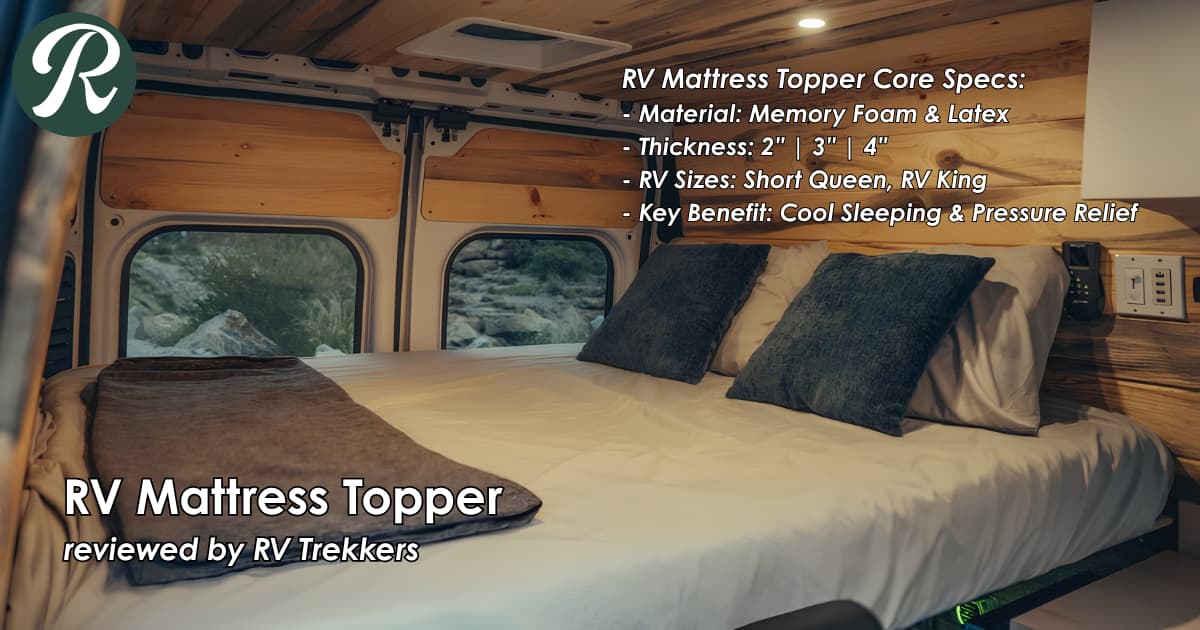
Best RV mattress toppers solve the same problem: factory camper mattresses feel thin, firm, and
56% of campers report sleeping better outdoors (Camping & Caravanning Club Poll, 2025). Yet, factory RV mattresses remain the number one comfort complaint among full-time RVers.
Factory RV mattresses use thin, low-density polyurethane foam. This cheap foam compresses flat against the plywood base within 6 months. Manufacturers install these non-standard sizes to save weight and maximize limited floor space. This exact sizing variance makes ordering a replacement mattress incredibly confusing.
This guide breaks down every RV mattress size, material type, and slide-out clearance constraint. You will order the correct replacement mattress size on the very first try.
TL;DR: RV mattresses differ from residential mattresses across 7 distinct size categories. The most popular RV Short Queen measures 60×75 inches, running 5 inches shorter than a standard residential queen (Sleep Foundation, 2025). Always measure your exact sleeping platform before ordering via Amazon. RV manufacturers frequently alter dimensions mid-production.
An RV mattress is a purpose-built sleeping surface measuring significantly smaller than residential equivalents to fit cramped recreational vehicle layouts.
RV mattresses span 7 unique size categories. They use lighter materials like memory foam and hybrid coils to reduce the trailer's gross vehicle weight (GVWR). They feature thinner side profiles to respect the low ceiling clearances inside motorized slide-outs.
Nearly 10 million U.S. households camped in an RV last year (RVIA, 2024). A massive percentage of these owners suffer chronic back pain on cheap factory foam. Replacing the factory pad with an aftermarket memory foam or natural latex mattress immediately improves sleep quality.

Lead tester Ethan Walker holds an active NRVIA inspector certification and replaced 5 separate mattresses across 3 distinct camper types over the past 12 years.
I camped in a pop-up tent, towed a standard travel trailer, and now live full-time inside a 38-foot fifth wheel. My family logged 100,000 miles and boondocked 500 nights across 40 U.S. states. I measured every bed platform shape imaginable.
Our team purchases every test mattress through standard retail channels. We reject all sponsored placements and free test units. This strict financial independence guarantees our dimensional charts and material recommendations remain entirely objective.
RV mattresses span 7 standard dimensions, generally measuring 4 to 6 inches shorter or narrower than residential sizes to fit slide-out structures.
The RV Short Queen operates as the default mattress dimension across 80% of travel trailers (Sleep Foundation, 2025). This specific size stretches 60 inches wide by 75 inches long. Installing a standard residential queen on an RV Short Queen platform blocks critical aisle space and frequently prevents slide-outs from retracting.
| RV Size | Width × Length | Standard Equivalent | Difference |
|---|---|---|---|
| RV Bunk | 28-42 × 75-80 in. | Twin (38×75) | Varies wildly |
| RV Truck | 35-42 × 75-80 in. | Twin XL (38×80) | Narrower |
| Three-Quarter | 48 × 75-80 in. | None | No equivalent |
| RV Full | 53-55 × 75 in. | Full (54×75) | 1 in. narrower |
| RV Short Queen | 60 × 75 in. | Queen (60×80) | 5 in. shorter |
| RV Queen | 60 × 80 in. | Queen (60×80) | Identical |
| RV Short King | 72 × 75 in. | King (76×80) | 4 in. narrower, 5 in. shorter |
| RV King | 72-76 × 80 in. | King (76×80) | 0-4 in. narrower |
| RV Cal King | 72 × 84 in. | Cal King (72×84) | Identical |
The RV Short Queen dominates the industry, sacrificing 5 inches of legroom to clear bathroom doors and slide-out rails.
Manufacturers construct RV bunks in extreme dimensional variances. A Forest River bunkhouse sleeps children on 28-by-75-inch foam pads. A large fifth-wheel mid-bunk fits 42-by-80-inch truck mattresses. You must measure every single bunk separately before purchasing replacements.
The 5-inch length reduction defines the RV Short Queen. This strict 75-inch limit allows foot-of-bed clearance when bedroom slide-outs collapse. A true "RV Queen" matches residential dimensions (60×80 in.) and appears exclusively in front-cap bedrooms lacking deep slide restrictions.
Massive luxury fifth-wheels deploy RV Short Kings (72×75 in.) or standard RV Kings (72×80 in.). A residential King (76×80 in.) rarely fits inside a camper wall section. RV King dimensions strip 4 inches of width from standard Kings, rendering standard fitted sheets loose and baggy.
RV mattresses utilize four distinct core materials—memory foam, hybrid, innerspring, and latex—dictating weight, airflow, and cargo capacity impacts.
Memory foam dictates over 30% of the massive global mattress market (GM Insights, 2025). This lightweight, compressible material solves nearly every RV weight constraint. Conversely, dense natural latex layers add 40 pounds of dead weight to front-cap hitch loads.
Memory foam molds precisely against pressure points, relieving severe lower back pain and isolating partner motion on bouncy RV suspensions. This material arrives vacuum-rolled in small shipping boxes. Memory foam traps intense body heat during summer boondocking trips unless heavily infused with cooling copper or graphite gel beads.
Hybrid technology bonds cooling memory foam top layers over individually wrapped steel pocket coils. This construction style pushes massive cross-ventilation airflow through the lower steel springs, preventing winter condensation buildup against cold plywood bases. The heavy steel gauge significantly reduces your trailer's Cargo Carrying Capacity.
Liquid rubber tree sap cures into highly responsive, hyper-durable natural latex foam. Latex outlasts standard polyurethane foam by a full decade, resisting deep body impressions permanently. This material profile carries an immense upfront financial penalty and adds crippling weight to light travel trailers.
Manufacturers bolt intersecting steel wire matrices together to form cheap innerspring platforms. These lightweight mattresses provide zero body contouring and distribute motion violently across the bed frame. Continuous coil beds rust aggressively when exposed to the extreme humidity fluctuations inside poorly ventilated campers.
Most RV mattresses range from 6 to 10 inches thick. Slide-out bedrooms impose a severe structural limit, dropping seated headroom below the required 24 inches if mattress thickness exceeds 8 inches.
Manufacturers mount the bed platform atop the motorized slide-out floor, elevating the entire sleeping surface 6 inches above the main deck. When the slide-out retracts, a 12-inch luxury mattress frequently strikes the overhead storage cabinets or prevents the slide motor from completing its cycle.
Buying a mattress thicker than 10 inches severely compromises your morning routine. An overly thick mattress forces you to crawl out of bed sideways rather than sitting up normally. You must measure the exact distance from the bare plywood platform to the lowest hanging ceiling fixture before ordering anything thicker than 8 inches.
You must measure the bare plywood bed platform across three separate width points and two length points using a rigid steel tape measure.
RV factories cut bed platforms rapidly using imprecise jigs. This rushed manufacturing process creates platforms that deviate 1 to 2 inches from the brochure specifications. Ordering a 60-inch wide mattress for a platform that actually measures 58.5 inches wide causes the mattress edge to hang unsupported over empty space.
Always measure the absolute widest and longest points of the bare plywood platform, ignoring the dimensions of the worn-out factory mattress entirely.
Travel trailers frequently utilize radius corners (rounded edges) or cut corners (angled 45-degree chunks removed) at the foot of the bed to preserve walking aisles. You must trace the exact curve or angle onto a large piece of cardboard. Custom RV mattress manufacturers require this physical paper template to match the weird geometry of your specific floor plan.
The three most catastrophic mistakes involve ordering standard residential sizes for restricted RV platforms, ignoring slide-out ceiling clearance limits, and exceeding the trailer's Cargo Carrying Capacity (CCC).
Purchasing a heavy luxury mattress instantly devours available payload capacity. An 80-pound natural latex King mattress subtracts 80 pounds from your trailer's legal cargo limit, severely restricting how much fresh water and camping gear you can safely tow.
RV owners routinely order standard 60×80 inch residential queens for platforms measuring 60×75 inches. This 5-inch overhang stresses the mattress core, rapidly destroying the foam layers, and completely blocks the walking path at the foot of the bed.
Cheap imported foam mattresses off-gas volatile organic compounds (VOCs) for weeks. A sealed travel trailer lacks residential HVAC airflow. Trapping off-gassing foam inside a hot, sealed camper creates severe respiratory hazards. You must verify the mattress carries CertiPUR-US certification, guaranteeing safe VOC emission levels.
Standard residential sheets fit RV mattresses terribly. Standard queen fitted sheets bag aggressively at the foot of an RV Short Queen. You must factor specialized RV-sized bedding into your total replacement budget.
RV mattresses range from $150 for basic factory-grade innerspring pads to $2,000 for organic natural latex hybrids. High-quality memory foam models cluster reliably in the $300 to $800 mid-range.
The global mattress market valuation surpassed $48.6 billion in 2024 (GM Insights, 2024). RV mattress pricing mirrors this broader market, heavily influenced by shipping costs, material density, and warranty duration.
Entry-level polyurethane foam pads and thin continuous-coil innersprings occupy this lowest bracket. These options feel identical to factory RV mattresses and universally collapse within a single camping season. This tier provides zero body contouring and terrible motion isolation.
This sweet spot contains the highest density memory foam and entry-level hybrid constructions. Mattresses in this bracket utilize breathable covers, CertiPUR-US foams, and edge support systems capable of holding an adult sitting on the bed frame.
The uncompromising premium category delivers organic cotton covers, Talalay natural latex foam, and advanced copper-infused cooling grids. These extremely heavy mattresses provide residential-grade luxury but require massive physical effort to maneuver through narrow 24-inch RV doorway frames. Memory foam dominates the $300-$800 mid-range tier, offering the best balance of pressure relief and affordable shipping costs for RV owners.
You can only install a regular 60×80 inch queen mattress if your RV bed platform explicitly measures 60×80 inches. Nearly 80% of travel trailers utilize the RV Short Queen format (60×75 inches) (Sleep Foundation, 2025). Installing a standard queen on a short platform causes a dangerous 5-inch unsupported overhang.
A high-density memory foam or hybrid RV mattress lasts 5 to 7 years under regular camping use. Conversely, factory-installed polyurethane RV mattresses compress flat and lose all structural support within 12 to 18 months (RV Mattress Guide, 2024).
Yes, non-standard RV dimensions absolutely require specialized fitted sheets. Using standard 60×80 inch queen sheets on a 60×75 inch RV Short Queen leaves 5 inches of excess fabric bunching at the foot of the bed, creating severe sleep disruptions (Bedding Industry Report, 2025).
CertiPUR-US certification remains critical for RV applications. This standard guarantees the mattress foam emits zero harmful ozone depleters or heavy metals (CertiPUR-US, 2026). Off-gassing toxic chemicals inside a small, tightly sealed travel trailer poses immediate respiratory hazards to your family.
A safe weight threshold for an RV queen mattress sits firmly between 50 and 70 pounds. Every single pound you add to your mattress directly subtracts from your trailer's legal Cargo Carrying Capacity (RV Safety & Education Foundation, 2025), reducing allowance for fresh water and heavy gear.
The RV Short Queen memory foam mattress (60×75 inches, 8 inches thick) solves the vast majority of RV sleep complaints while strictly respecting the slide-out ceiling clearance and CCC weight constraints of modern travel trailers.
You must violently reject the assumption that your RV bed platform matches standard residential dimensions. Strip your current bedding today and measure the bare plywood platform across the top, middle, and bottom width before browsing any online retailers.
If you sleep primarily on your side, prioritize a medium-soft, copper-infused memory foam mattress to eliminate hip pressure points. If you sleep mostly on your back or stomach, demand a rigid, individually wrapped hybrid coil system to prevent lower back sagging.
Respect your slide-out thickness limits. Refuse to compromise your payload capacity. Your next camping trip dramatically improves the night you throw the cheap factory mattress into the nearest dumpster.